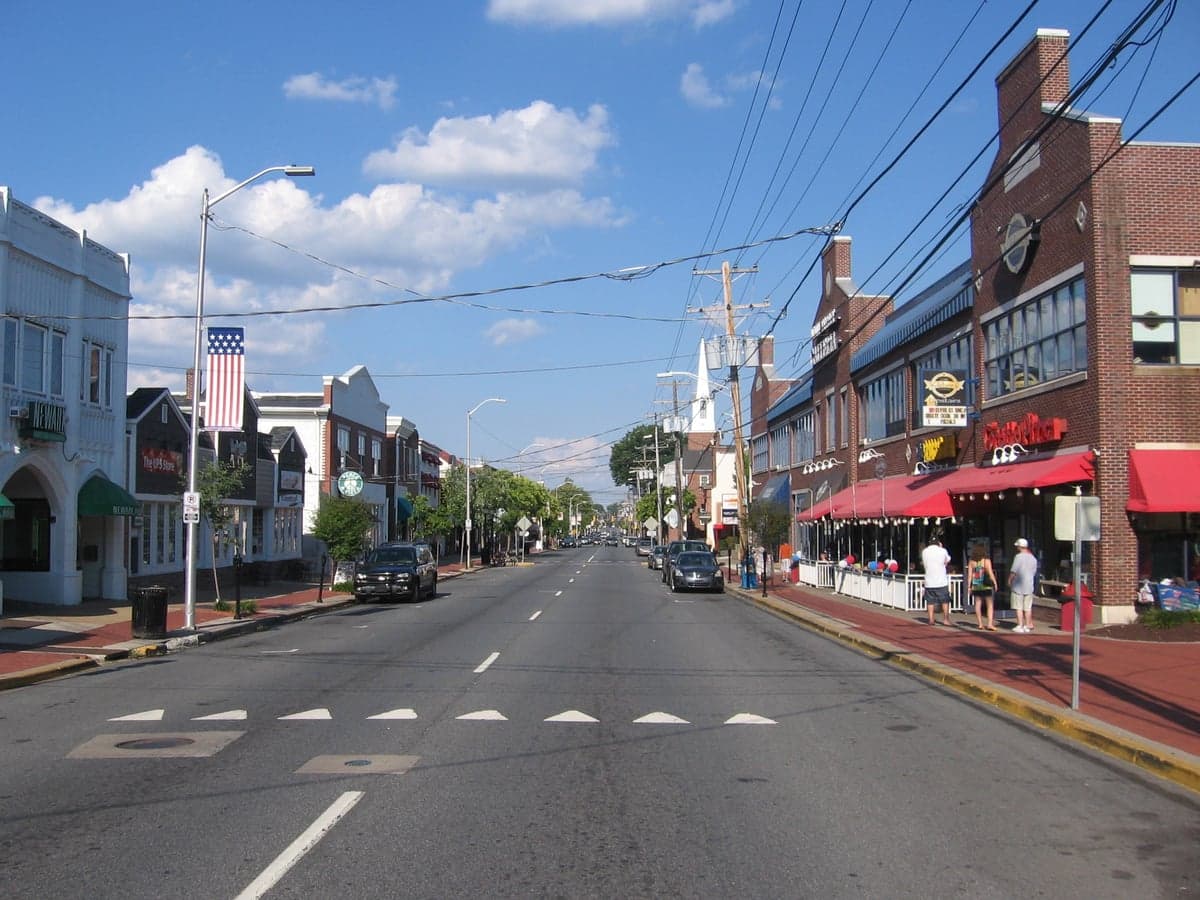
Photo: Wikipedia
Political ClimatePolitical Climate in Newark, DE
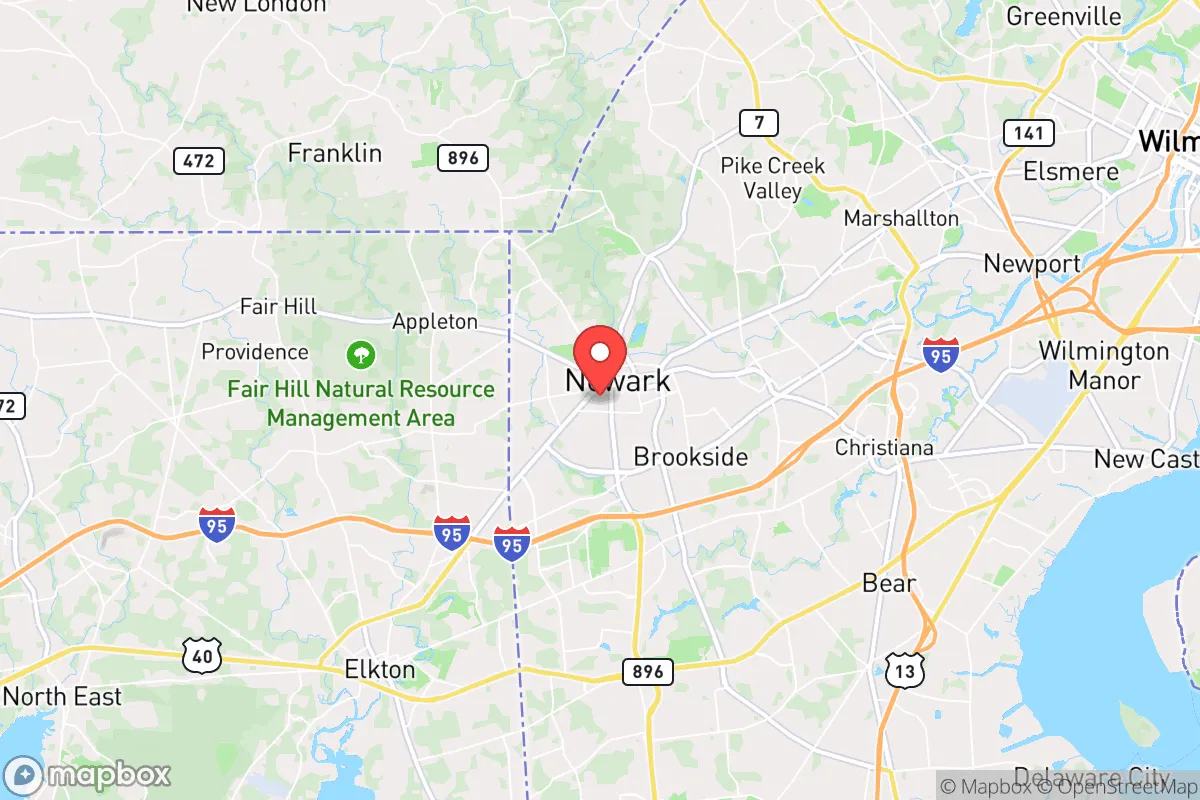
District shown is the primary district for this city’s centroid. Cities may span multiple districts.
Inherited from parent state — no local data available.
Local Political AnalysisPolitical Analysis of Newark, DE
Newark, Delaware, has shifted hard to the left over the past decade, and the numbers back it up. The Cook Partisan Voting Index (PVI) for the area sits at D+8, meaning it votes about eight points more Democratic than the national average. That’s a stark contrast to the rest of New Castle County outside the city limits, and it’s a far cry from the moderate, small-town feel this place had even twenty years ago. If you’re looking at the political climate here, you’re looking at a place that’s increasingly comfortable with progressive policies, and that trend shows no signs of slowing down.
How it compares
Drive ten minutes north up Route 896, and you’ll hit the more rural, reliably red areas of southern Chester County, Pennsylvania—places like Landenberg and Avondale that vote solidly Republican. Head south toward Middletown, and you’ll find a more balanced mix, but Newark itself is an island of deep-blue politics in a county that’s already trending left. The University of Delaware is the engine driving this, pulling in a young, transient population that votes overwhelmingly Democratic. Meanwhile, the surrounding suburbs like Pike Creek and Hockessin are more purple, but Newark’s city council and school board have been dominated by progressive voices for years. The contrast is sharp: you can live in a neighborhood where folks fly Trump flags, but the local government is passing resolutions on climate change and equity initiatives that feel like they’re from a different planet.
What this means for residents
For a long-time resident, the biggest concern is the steady creep of government overreach into everyday life. The city council has pushed through ordinances that feel less about safety and more about social engineering—think stricter rental regulations that make it harder for landlords to do business, and a police oversight board that adds layers of bureaucracy without clear results. Property taxes have crept up to fund these priorities, and there’s a growing sense that personal freedoms—like how you use your own land or what you can say in public meetings—are being squeezed. The school board has also leaned into controversial curriculum changes, and parents who push back are often labeled as out of touch. It’s not a full-blown crisis yet, but the trajectory is clear: more rules, more oversight, and less room for the kind of independent, live-and-let-live attitude that used to define this town.
Looking ahead, the near future likely means more of the same. The university’s influence will only grow as enrollment stays high, and the city’s affordable housing push will bring in even more renters who vote left. Long-term, if you value low taxes, minimal government interference, and a community that respects traditional values, Newark is becoming a tougher place to call home. The cultural shift is real—neighbors used to wave and chat; now, political yard signs can cause awkward silences. If you’re considering a move here, just know that the political climate is baked into the cost of living, and it’s not going to swing back anytime soon.

State Political ClimatePolitical Climate in Delaware
State Political AnalysisPolitical Environment in the State
Delaware has historically been a moderate swing state, but over the past two decades it has shifted noticeably to the left, driven by population growth in the northern suburbs of Wilmington and an influx of out-of-state transplants. While the state still elects a Republican governor occasionally—like John Carney, who was a moderate Democrat—the legislature has been firmly under Democratic control for years, and recent elections show the state trending bluer. For a conservative considering relocation, the key takeaway is that Delaware’s political center of gravity is now in New Castle County, and the rural southern counties are increasingly outvoted on state-level policy.
Urban vs. rural divide
The political map of Delaware is a classic story of a deep blue north and a red south, with a narrow purple strip in the middle. New Castle County, home to Wilmington and its affluent suburbs like Greenville and Hockessin, delivers roughly 60% of the state’s vote and leans heavily Democratic—often by 20 points or more. This is where the corporate headquarters, the University of Delaware in Newark, and the bulk of the state’s professional class reside. In contrast, Sussex County—the beach and farming region including Rehoboth Beach, Lewes, and Georgetown—has been reliably Republican for decades, though the coastal towns are now seeing an influx of retirees from blue states who are shifting some precincts purple. Kent County, with Dover as its anchor, is the true swing region; it voted for Trump in 2016 and 2020 but also elects moderate Democrats locally. The rural-urban split is stark: drive 20 minutes south of Wilmington and you’re in Trump country, but that doesn’t matter much when the legislature is drawn to favor the north.
Policy environment
Delaware’s policy environment has become increasingly progressive, and it’s a major concern for conservatives. The state has no sales tax, which sounds great, but it makes up for it with high property taxes in New Castle County and a progressive income tax that tops out at 6.6%—not the worst, but creeping upward. In 2021, the legislature passed a paid family and medical leave law funded by a payroll tax, which took effect in 2026, adding another 0.8% deduction from every paycheck. On education, Delaware has a statewide school choice program that includes charter schools and vouchers for low-income students, but the teachers’ union is powerful and has blocked expansion of private school options. The state also enacted universal background checks for gun purchases and a red flag law in 2018, and in 2022 it banned the sale of assault-style rifles and high-capacity magazines—a major red flag for Second Amendment supporters. Election laws have been loosened: no-excuse absentee voting was made permanent in 2022, and same-day voter registration was enacted in 2023. For a conservative, the regulatory trend is clearly toward more government involvement in daily life.
Trajectory & freedom
Delaware is becoming less free, not more, and the pace has accelerated since 2020. The most concerning area is gun rights: the 2022 assault weapons ban and magazine capacity limit were followed by a 2023 law requiring a permit to purchase a handgun, which includes a 120-day waiting period and a training requirement. These laws are being challenged in court, but for now, they’re in effect. On parental rights, the state passed a law in 2021 that prohibits schools from outing a student’s gender identity to parents without the student’s consent—a direct blow to family authority. In 2023, Delaware expanded Medicaid coverage for gender-affirming care, including for minors, which many conservatives see as government overreach into medical decisions. On property rights, the state has not enacted rent control, but it did pass a law in 2024 requiring landlords to accept Section 8 vouchers, which some property owners view as an infringement on their right to choose tenants. The only bright spot is that Delaware has no state-level income tax on Social Security benefits, which helps retirees, but the overall trajectory is toward more regulation and less personal autonomy.
Civil unrest & political movements
Delaware is not a hotbed of civil unrest, but it has seen its share of political flashpoints. In 2020, Wilmington experienced several nights of protests and looting following the George Floyd killing, with damage to businesses along Market Street. The state’s sanctuary policies are limited—Delaware does not have a formal sanctuary state law, but Wilmington and Newark have adopted “welcoming city” ordinances that limit cooperation with federal immigration enforcement. In 2023, a controversy erupted in Middletown when the school board attempted to implement a policy requiring parental notification for any changes to a student’s gender identity; the board was flooded with public comments, and the policy was ultimately defeated by progressive activists. The Delaware Republican Party is weak and fractured, with a small but vocal libertarian wing and a larger establishment faction that struggles to win statewide races. There’s no serious secession or nullification movement, but you will find active Second Amendment sanctuary resolutions passed in Sussex County and parts of Kent County, where local sheriffs have pledged not to enforce the new gun laws. Election integrity is a live issue: in 2020, Delaware had one of the highest rates of mail-in voting in the country, and while no major fraud was proven, the lack of voter ID requirements (the state has no strict photo ID law) remains a concern for conservatives.
Projection
Over the next 5-10 years, Delaware will likely continue its leftward drift, driven by demographic trends. The population is growing fastest in New Castle County, particularly in the Bear and Glasgow areas, which are filling with young families and professionals from the Northeast who bring blue-state voting habits. Sussex County is also growing, but the new arrivals are often retirees from New York and New Jersey who may be fiscally conservative but socially liberal, diluting the traditional Republican base. The state’s economy is heavily dependent on the financial and legal sectors (thanks to Delaware’s corporate-friendly court system), and those industries tend to attract a more progressive workforce. Realistically, expect the legislature to pass more gun control, possibly a state-level carbon tax, and further expansions of paid leave and healthcare mandates. The Republican Party’s only hope is to win back moderate voters in Kent County and the southern suburbs of Wilmington, but that’s a long shot given the current trends. If you’re moving to Delaware now, plan for a state that will be more like New Jersey or Maryland in a decade than the swing state it was in the 1990s.
For a conservative relocating to Delaware, the bottom line is this: you can find like-minded communities in Sussex County or the rural parts of Kent County, but you will be fighting a losing battle at the state level. The tax burden is moderate but rising, gun rights are being steadily eroded, and parental authority is under direct assault in the schools. If you value low regulation and personal freedom, Delaware is not the worst state in the Northeast—that’s New York or New Jersey—but it’s heading in that direction. Your best bet is to settle in a red pocket like Millsboro or Selbyville in Sussex County, where local government is still conservative, and accept that you’ll be outvoted on state policy. If that sounds like a dealbreaker, you might want to look further south.
* Values derived from national, state, county, city and local statistics and may differ in a specific area. Last updated: 2026-04-29T23:51:10.000Z
Narrative content on this page is AI-generated and may contain mistakes. Verify any details that matter before acting on them.
ReloMaps may earn a commission from affiliate links at no extra cost to you.

