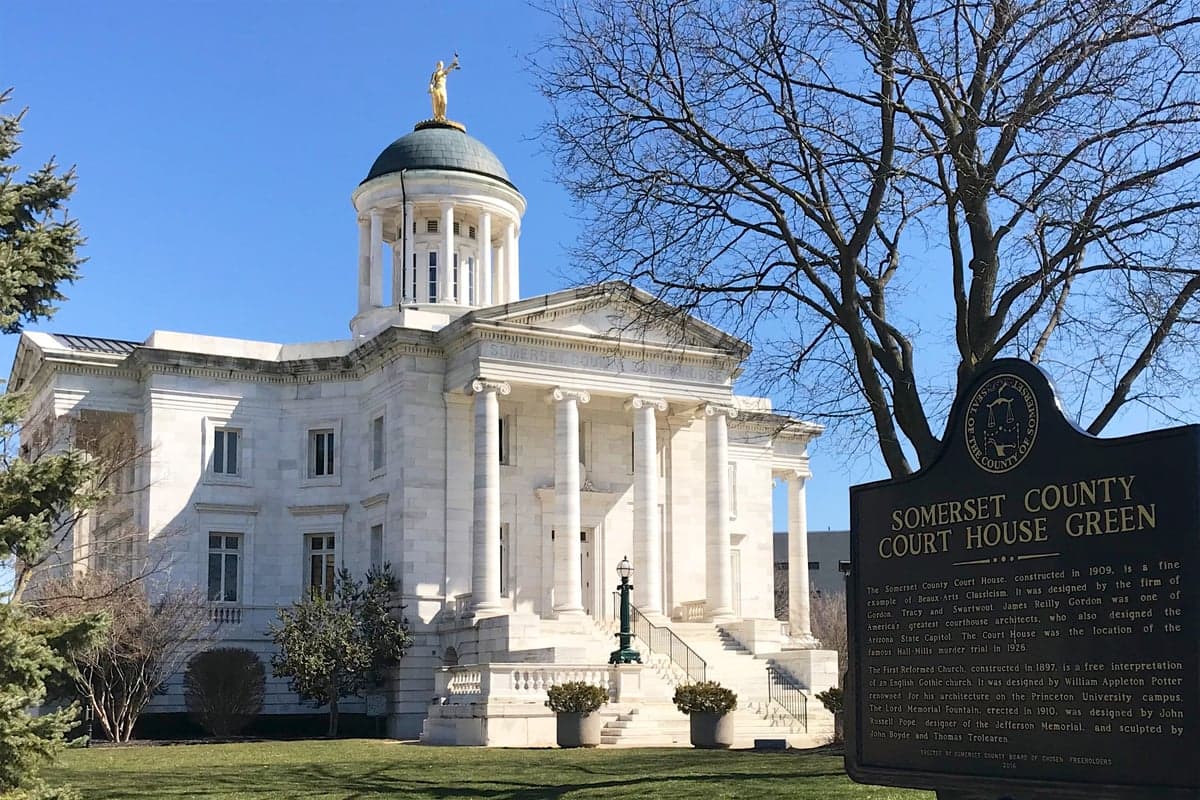
Photo: Wikipedia
Political ClimatePolitical Climate in Somerset County
Showing district-level results — no local-only data available.
Local Political AnalysisPolitical Analysis of Somerset County
Somerset County sits in a unique political space in New Jersey, holding a Cook PVI of EVEN — meaning it votes almost exactly in line with the national average — while the state as a whole leans D+5. That gap is the key to understanding the county: it’s a genuine battleground in a blue state, and its trajectory has been shifting slowly but steadily leftward over the past decade. In 2020, Joe Biden carried Somerset by about 8 points, a margin that would have been unthinkable in the Reagan or even George W. Bush years, when the county was reliably red. Today, it’s a place where both parties can win depending on the year and the candidate, and where local elections often hinge on turnout in a handful of swing precincts.
How it compares
Compared to New Jersey’s D+5 lean, Somerset County is noticeably more moderate. The state’s blue tilt is driven by dense urban counties like Essex (Newark) and Hudson (Jersey City), which routinely deliver 70-80% Democratic margins. Somerset, by contrast, is a mosaic. The northern and central towns — Somerville, Bound Brook, and North Plainfield — lean reliably Democratic, often by double digits, fueled by a mix of younger professionals, renters, and diverse populations. Meanwhile, the county’s wealthy exurban enclaves — Bernardsville, Far Hills, and Peapack-Gladstone — remain solidly Republican, with GOP margins of 10-15 points in most races. The real action is in the swing towns: Bridgewater, Hillsborough, and Montgomery. These are the precincts where national trends play out in miniature. Bridgewater, the county’s largest municipality, has trended blue in presidential years but still elects Republican mayors and council members, making it a bellwether for the county’s overall mood.
What this means for residents
For conservative residents, Somerset County offers a much friendlier environment than most of New Jersey. You’ll find Republican elected officials at the county level — the Board of County Commissioners has a 3-2 GOP majority as of 2025 — and local school boards in towns like Bernards and Bedminster often lean conservative. Property taxes, while high by national standards, are lower than in deep-blue counties like Essex or Bergen, and the county’s GOP representatives in Trenton have real influence. For liberal residents, the county is increasingly comfortable. Democratic candidates now compete seriously in every town, and progressive policies — like affordable housing mandates and environmental initiatives — have traction in the county seat of Somerville and in Montgomery. The key difference from deep-blue parts of the state is that nothing is taken for granted here; both sides have to organize, knock on doors, and show up at town council meetings to get their way.
Culturally, Somerset County reflects its political split. You’ll see Trump flags on pickup trucks in the rural western hills around Branchburg and Readington, and “In This House We Believe” signs in the walkable downtowns of Somerville and Manville. The county’s policy distinctions from the rest of New Jersey are subtle but real: it was one of the last counties in the state to adopt a full paid-sick-leave ordinance, and its zoning laws tend to favor larger lot sizes in the west, preserving a rural character that contrasts with the denser development in the east. For a resident, the practical upshot is that your neighbors likely disagree with you politically, but the county’s moderate institutions — its schools, its parks, its commuter rail — tend to keep things civil. Somerset is a place where you can have a spirited argument over dinner and still carpool to the train station the next morning.

State Political ClimatePolitical Climate in New Jersey
State Political AnalysisPolitical Environment in the State
New Jersey is a solidly Democratic state with a Cook PVI of D+5, meaning it votes about five points more Democratic than the national average in presidential elections. The state hasn't gone Republican in a presidential race since 1988, when George H.W. Bush carried it, and the Democratic lean has only deepened since then—Barack Obama won it by 17 points in 2008, Joe Biden by 16 in 2020, and Kamala Harris by about 6 in 2024. That said, the state is far from a monolith: it's a patchwork of dense urban strongholds, sprawling suburbs that have shifted left, and rural and exurban areas that remain reliably red. For a conservative-leaning relocator, the picture is nuanced—you'll find plenty of like-minded communities, but the state government's policy direction is unmistakably progressive.
Urban vs. rural divide
The political map of New Jersey is a tale of three regions. The northeast corridor—anchored by Newark, Jersey City, and Paterson—is the engine of Democratic dominance. These cities are dense, diverse, and heavily unionized, with turnout machines that reliably deliver 70-80% Democratic margins. Hudson County, home to Jersey City, has become a Democratic stronghold thanks to an influx of young professionals and immigrant communities. Bergen County, once a swing area, has trended sharply blue since the 1990s; it now routinely votes 55-60% Democratic. The Philadelphia suburbs in South Jersey—Camden, Burlington, and Gloucester counties—have also shifted left, driven by suburban women and college-educated voters. Meanwhile, the rural northwest and southern shore areas remain Republican. Sussex County and Hunterdon County are the most reliably red, often voting 55-60% Republican. Ocean County, a massive retirement and exurban hub, is the GOP's biggest prize—it went for Trump by 20 points in 2020 and 2024. The divide isn't just urban vs. rural; it's also about density and education. Towns like Montclair and Princeton are deep blue, while Toms River and Newton are deep red. A relocator looking for a conservative community should focus on Ocean, Sussex, or Hunterdon counties, or the more rural parts of Burlington and Gloucester.
Policy environment
New Jersey's policy environment is defined by high taxes, strong regulation, and a robust social safety net. The state has the highest property taxes in the nation, averaging over $9,500 annually, and a progressive income tax that tops out at 10.75% for income over $1 million. Sales tax is 6.625%, but many municipalities add local levies. The regulatory posture is business-friendly in some sectors (pharma, tech, finance) but burdensome for small businesses, with strict environmental and labor laws. Education policy is centralized and well-funded: New Jersey consistently ranks among the top states for K-12 outcomes, but school choice is limited—charter schools exist but are capped, and there's no broad voucher program. Healthcare is heavily regulated, with a state-based insurance exchange and strong Medicaid expansion. Election laws are among the most accessible in the country: no-excuse mail-in voting, automatic voter registration, and same-day registration are all in place. For a conservative, the policy environment is a mixed bag: you get excellent schools and infrastructure, but you pay for it in taxes and bureaucracy.
Recent policy direction
Over the past decade, New Jersey has moved decisively left on most fronts. On gun policy, the state passed some of the nation's strictest laws: a 2022 law requires a "justifiable need" for a concealed carry permit (currently being challenged in court), and a 2023 law bans carrying guns in "sensitive places" like parks, libraries, and public transit. On parental and education rights, the state has gone the opposite direction of many red states: a 2022 law requires schools to adopt LGBTQ-inclusive curriculum, and a 2024 law prohibits school districts from banning books based on "partisan or doctrinal" objections. On medical and bodily autonomy, New Jersey has codified abortion rights into law (2018's Freedom of Reproductive Choice Act) and expanded access to gender-affirming care for minors. On property rights, the state's rent control laws and strict zoning regulations make development difficult, driving up housing costs. On taxation, the trend has been upward: a 2023 "millionaires' tax" hike made the top rate permanent, and a 2024 law increased the corporate business tax. On voting and ballot access, the state has expanded mail-in voting and automatic registration, but a 2024 law requiring drop boxes to be monitored has drawn criticism from both sides. For a conservative relocator, the key takeaway is that the state's policy direction is unlikely to reverse—if you value low taxes, gun rights, or school choice, you'll find yourself swimming against the current.
Civil unrest & political movements
New Jersey has a history of organized activism on both sides, but the left is far more visible. The Black Lives Matter protests in 2020 were large and sustained, particularly in Newark and Jersey City, and led to police reform laws like the 2021 "Use of Force" statute. The pro-choice movement is well-organized, with groups like the New Jersey Abortion Access Fund holding regular rallies. On the right, the New Jersey 2nd Amendment Society and local gun clubs are active, but they're fighting an uphill battle in the legislature. Immigration politics are a flashpoint: New Jersey is a "sanctuary state" under a 2018 executive order that limits cooperation with ICE, and towns like Newark and Jersey City have their own sanctuary policies. This has led to tensions in more conservative areas like Ocean County, where local officials have passed resolutions opposing the state's policies. Election integrity has been a minor issue: after the 2020 election, a few Republican county commissioners in Ocean and Sussex called for audits, but no major fraud was found. The most visible political movement in recent years has been the anti-tax "NJ Can't Afford It" campaign, which has pushed for a state spending cap and property tax relief. A new resident would notice that political activism is less about street protests and more about local school board meetings and county party politics—especially in the suburbs.
Projection
Over the next 5-10 years, New Jersey's Democratic lean is likely to deepen, but not uniformly. The suburban shift left will continue as college-educated professionals move in from New York and Philadelphia, particularly in Bergen, Essex, and Morris counties. The urban cores will remain Democratic strongholds, but their growth is limited by high housing costs. The rural and exurban areas will stay red, but they're losing population relative to the rest of the state. The wild card is in-migration: New Jersey has been losing residents to lower-tax states like Florida and Texas, but it's also gaining immigrants and young professionals who are more liberal. The state's demographic trajectory—aging, diversifying, and becoming more educated—points toward continued Democratic dominance. For a conservative relocator, the realistic outlook is that you'll find your community in places like Ocean County or Sussex County, but you'll be living under a state government that is increasingly progressive on taxes, guns, and social policy. The state's fiscal challenges—a massive pension liability and high debt—could force a reckoning, but don't expect a political realignment anytime soon.
For a new resident, the bottom line is this: New Jersey offers a high quality of life with excellent schools, infrastructure, and proximity to major cities, but it comes with a high price tag and a policy environment that leans heavily left. If you're a conservative, you'll find like-minded neighbors in the right counties, but you'll need to accept that state-level politics will be against you on most issues. If you're a liberal, you'll find a state that largely aligns with your values, but you'll still pay some of the highest taxes in the country. The state is what it is—a dense, diverse, expensive, and deeply blue place where your local community matters more than the state government. Choose your town wisely, and you can make it work regardless of your politics.
* Values derived from national, state, county, city and local statistics and may differ in a specific area. Last updated: 2026-09-30T11:10:15.000Z
Narrative content on this page is AI-generated and may contain mistakes. Verify any details that matter before acting on them.
ReloMaps may earn a commission from affiliate links at no extra cost to you.

