 Popular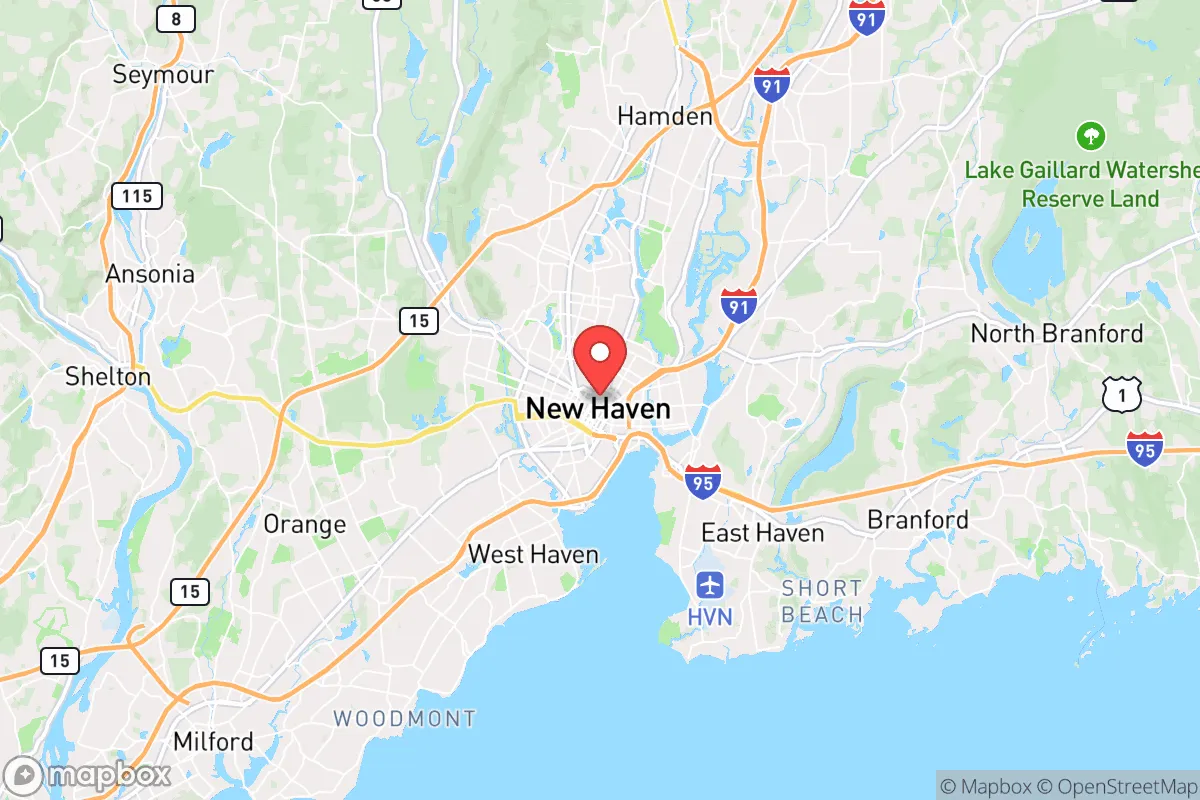
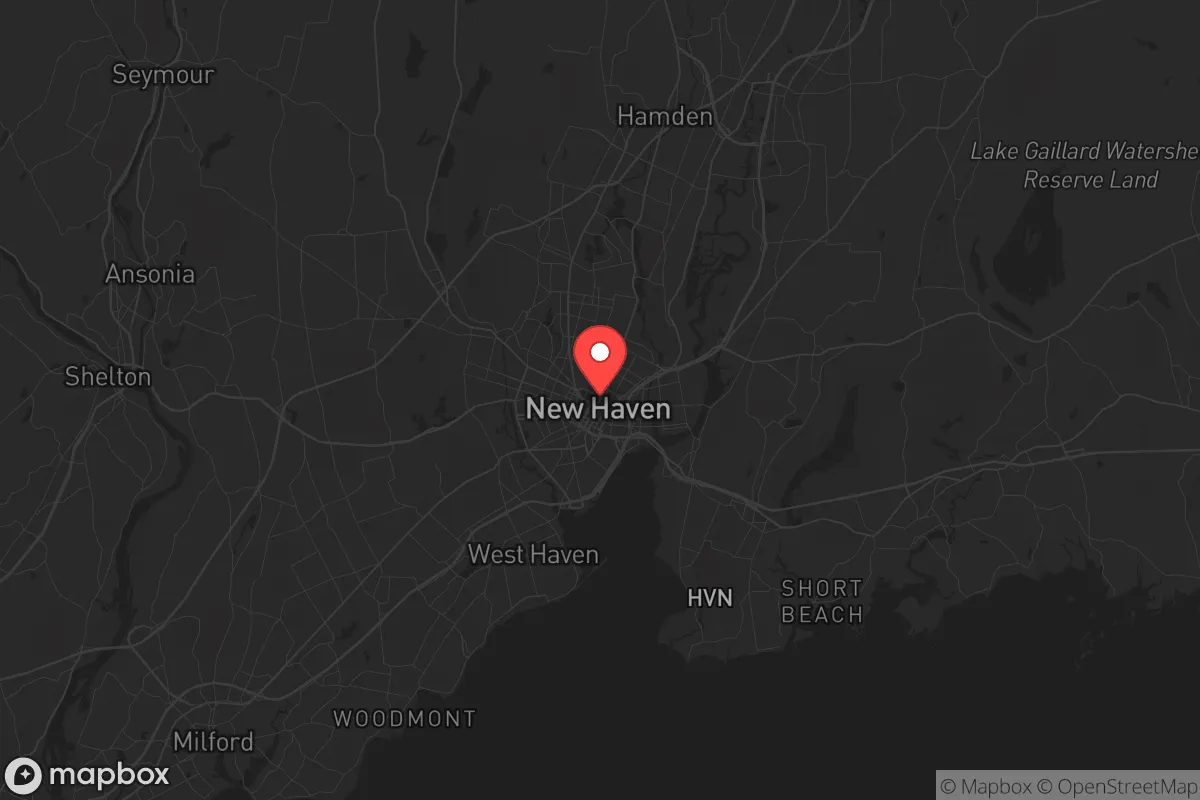
Photo: Wikipedia
Strategic Assessment of New Haven, CT
High tactical risk. This location is likely close to major population centers, strategic targets, or sits in a high-disaster corridor. A retreat property and careful exit planning is required.
What does the Strategic Assessment tell us?
Our Strategic Assessment grades tactical survivability of an area. Major population centers, military targets, fallout zones, natural disasters, and border exposure all drive risk — lower exposure means a more defensible position in a crisis.
This is heavily inspired by Joel Skousen's Strategic Relocation book. Highly recommended you checkout the book ($)What does this tell us?
Our Strategic Assessment grades tactical survivability of an area. Major population centers, military targets, fallout zones, natural disasters, and border exposure all drive risk — lower exposure means a more defensible position in a crisis.
This is heavily inspired by Joel Skousen's Strategic Relocation book. Highly recommended you checkout the book ($)Strategic Pillars

Key Distances
Regional Safe Places
Below is our recommended "safe zones" in Connecticut and the surrounding area based on our strategic heuristics. For most people, it's unrealistic to live in a “safe zone” full-time due to work, family or other personal reasons. They tend to be more rural. However, many of these areas are perfect for second homes and retreat properties that double as a vacation home or even a short-term rental.
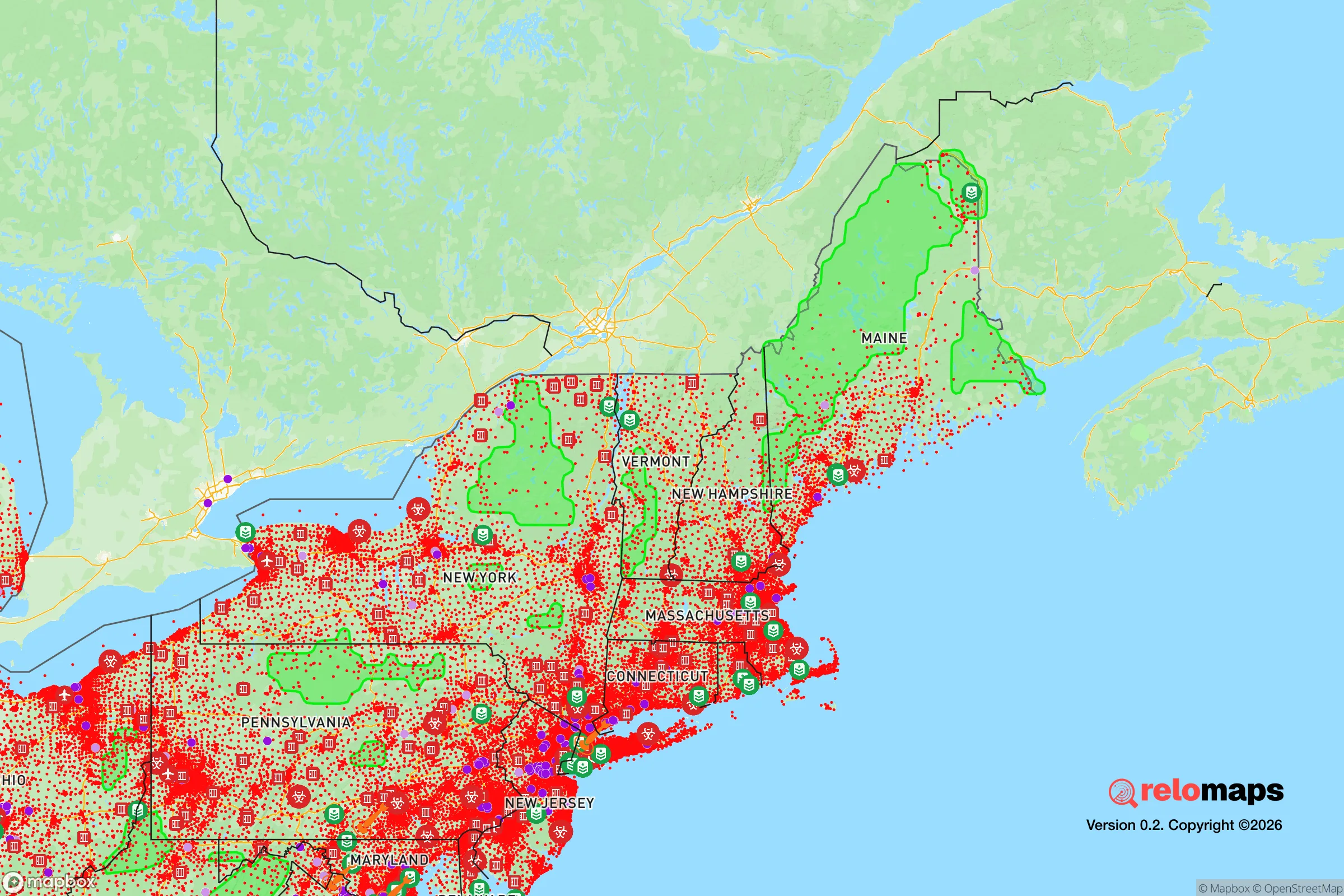
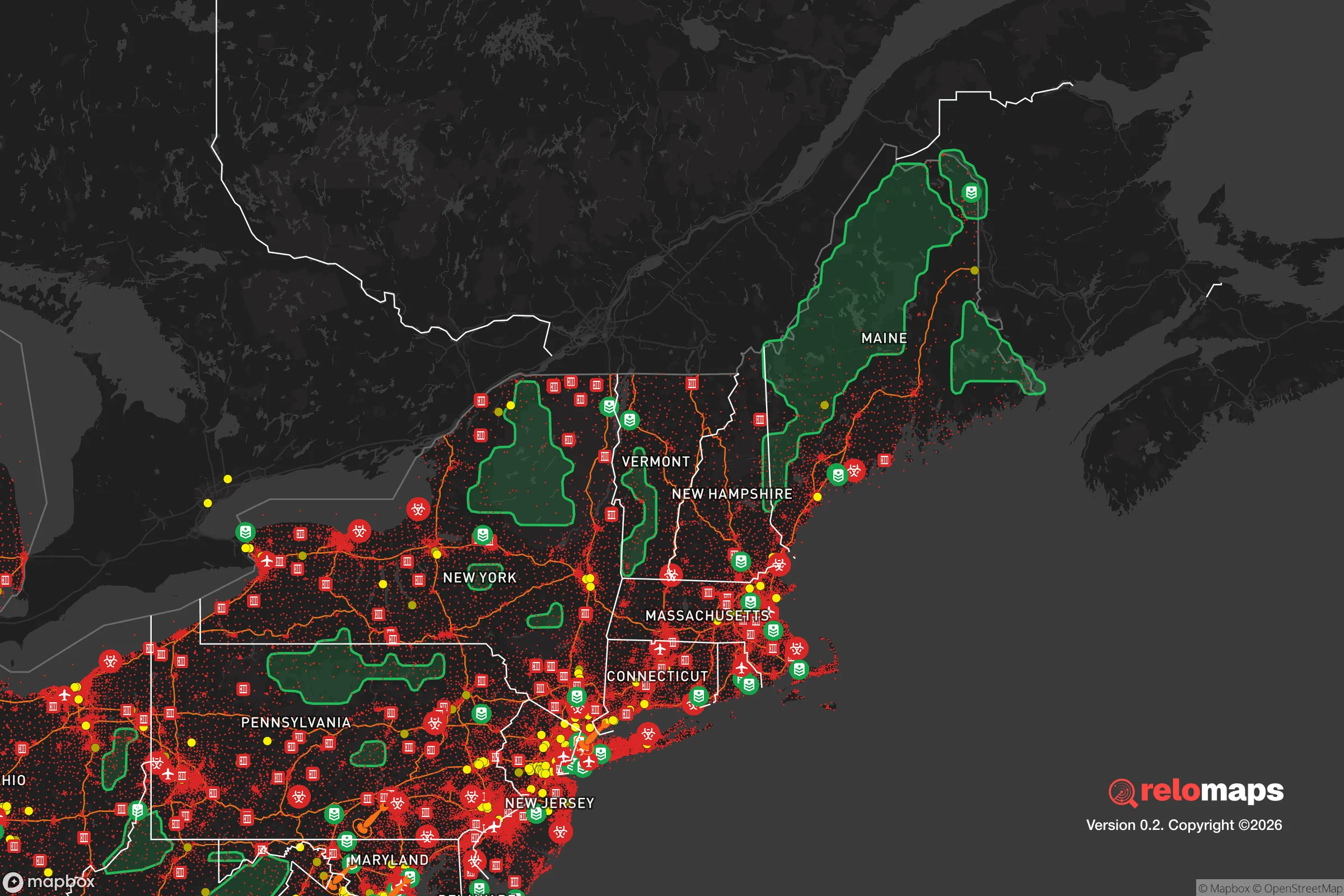


Important Note: For informational purposes only. This does not mean nothing bad ever happens in the green zones. Please use common sense. This is based on public data and modeled with AI. We tried to take a conservative approach but mistakes happen. We update this regularly as new information becomes available.
Solar Generator Recommendations
Backup power matters more here than in safer locations. We've picked three solar generators across budgets and capacity tiers — start with the budget unit if you only need a few essentials, or step up if you want to run a fridge and HVAC for days at a time.

Jackery Portable Power Station Explorer 300
Budget OptionPower on the Go: Weighing only 11 lbs, it's convenient to set up and store with book-sized foldable solar panels

BLUETTI Portable Power Station AC180
Designed for both indoor and outdoor scenarios, AC180 is highly capable as it has a robost capacity and continuous output power.

EF ECOFLOW DELTA Pro Ultra Power Station
Upgraded PickEcoFlow DELTA Pro Ultra is a whole-home energy system designed to grow with your family. Integrated with the Smart Home Panel 2, it scales to meet your evolving energy needs — keeping your home powered, intelligent, and secure through every stage of life.
We earn a commission, at no additional cost to you.
Strategic Assessment Analysis
New Haven, Connecticut, presents a deeply contradictory picture for the conservative prepper or strategic relocator. On one hand, its location on the Long Island Sound and its historic role as a regional hub offer certain logistical advantages; on the other, its proximity to the New York City metroplex, its dense urban core, and its deep-blue political environment create significant vulnerabilities that make it a poor choice for anyone seeking long-term resilience and self-sufficiency. For the individual or family prioritizing escape from civil unrest, fallout zones, and cascading infrastructure failures, New Haven is best understood as a high-risk, moderate-reward location that requires constant vigilance and a well-rehearsed exit plan.
Geographic position and natural advantages for long-term survival
New Haven sits on the north shore of the Long Island Sound, roughly 75 miles northeast of New York City and 40 miles southwest of Hartford. Its coastal position provides access to maritime resources—fishing, shipping, and potential water-based escape routes—but this is a double-edged sword. The city is sheltered by the Quinnipiac and Mill Rivers, which empty into the harbor, offering some inland water access. The surrounding terrain is a mix of coastal lowlands and rolling hills, with the trap rock ridges of the Metacomet Ridge to the north providing modest defensible high ground. The climate is humid continental, with cold winters and warm summers, meaning a prepper must plan for seasonal extremes—snowstorms, nor’easters, and occasional hurricane remnants. The natural advantages here are real but limited: the harbor could support small-scale fishing and trade in a collapse scenario, and the rivers offer fresh water, but the area lacks the deep, remote forests or arid isolation that many survivalists seek. The soil is rocky and acidic, making large-scale agriculture difficult without significant amendment. In short, New Haven’s geography is a compromise—better than a landlocked urban center, but far from ideal for a self-reliant homestead.
Risks, exposures, and proximity to fallout-relevant landmarks
The single greatest liability for New Haven in a strategic relocation context is its proximity to New York City and the dense Northeast Corridor. In the event of a major terrorist attack, nuclear exchange, or widespread civil unrest, New Haven sits within the blast and fallout shadow of one of the world’s primary target zones. The city is also within 20 miles of the Millstone Nuclear Power Station in Waterford, a boiling water reactor that, while generally well-regulated, represents a fixed-point risk for any prepper mapping fallout patterns. Additionally, the Port of New Haven handles significant quantities of petroleum, chemicals, and bulk cargo—a potential target for sabotage or accident. The city itself is a dense urban environment with a population of roughly 135,000, but the greater metro area pushes past 800,000. This density means that in a crisis, New Haven would experience rapid resource depletion, traffic gridlock on I-95 and I-91, and likely civil unrest as supply chains fail. The city’s crime rate is notably high—violent crime rates are consistently above national averages, with property crime a persistent issue. For the conservative relocator, this means that even in peacetime, New Haven requires a robust personal security posture. In a collapse scenario, the city’s demographics and political culture—overwhelmingly liberal, with a strong reliance on state and federal social services—could lead to rapid social fragmentation. The presence of Yale University, while an economic anchor, also makes the city a potential target for ideological violence or anti-elite sentiment during unrest. Simply put, New Haven is too close to too many high-value targets and too dense to be a safe haven.
Practical resilience for a relocator: food, water, energy, and defensibility
For the prepper evaluating daily life in New Haven, the practical challenges are significant. The city’s water supply comes from the Lake Whitney and Maltby Lakes reservoirs, managed by the South Central Connecticut Regional Water Authority. While the water quality is generally good, the system is centralized and vulnerable to contamination or disruption. A well-prepared relocator would need to invest in a high-quality filtration system and store at least two weeks of water per person—more if they plan to shelter in place. Food resilience is poor: the city has a handful of farmers’ markets and community gardens, but the vast majority of food is trucked in via the I-95 corridor. In a prolonged disruption, grocery shelves would empty within days. The energy grid is equally fragile, with overhead lines vulnerable to storms and tree falls. Backup solar or generator power is essential, but city ordinances and dense housing make installation difficult for renters or condo dwellers. Defensibility is the weakest point. New Haven is a walkable, grid-based city with limited natural chokepoints. The neighborhoods of East Rock, Westville, and the Hill offer slightly better defensibility due to elevation or layout, but none are truly secure. The city’s police force is understaffed and politically constrained, meaning that in a crisis, residents would largely be on their own. For the single individual or family, the best practical approach is to treat New Haven as a temporary base with a pre-positioned bug-out location in the Litchfield Hills or the Berkshires—areas with better water, lower population density, and more defensible terrain. The city itself is not a place to make a stand.
In the final strategic assessment, New Haven fails the core test for a conservative prepper relocation: it is not a place where you can build a sustainable, independent life away from the chaos of the collapsing coastal megacities. Its location offers some maritime and logistical access, but the risks from proximity to New York, the nuclear plant, and the city’s own density and crime far outweigh the benefits. The political environment is hostile to the values of self-reliance and limited government that underpin a prepper mindset. For the relocator who must be in Connecticut for work or family, the better play is to live in a small town north or west of New Haven—places like Bethany, Oxford, or Woodbury—and commute in only as necessary. New Haven itself is a place to pass through, not to dig in. If you are serious about long-term survival and strategic relocation, look elsewhere. This city is a trap dressed in ivy and brick.

* Values derived from national, state, county, city and local statistics and may differ in a specific area. Last updated: 2026-04-30T05:54:41.000Z
Narrative content on this page is AI-generated and may contain mistakes. Verify any details that matter before acting on them.
ReloMaps may earn a commission from affiliate links at no extra cost to you.

