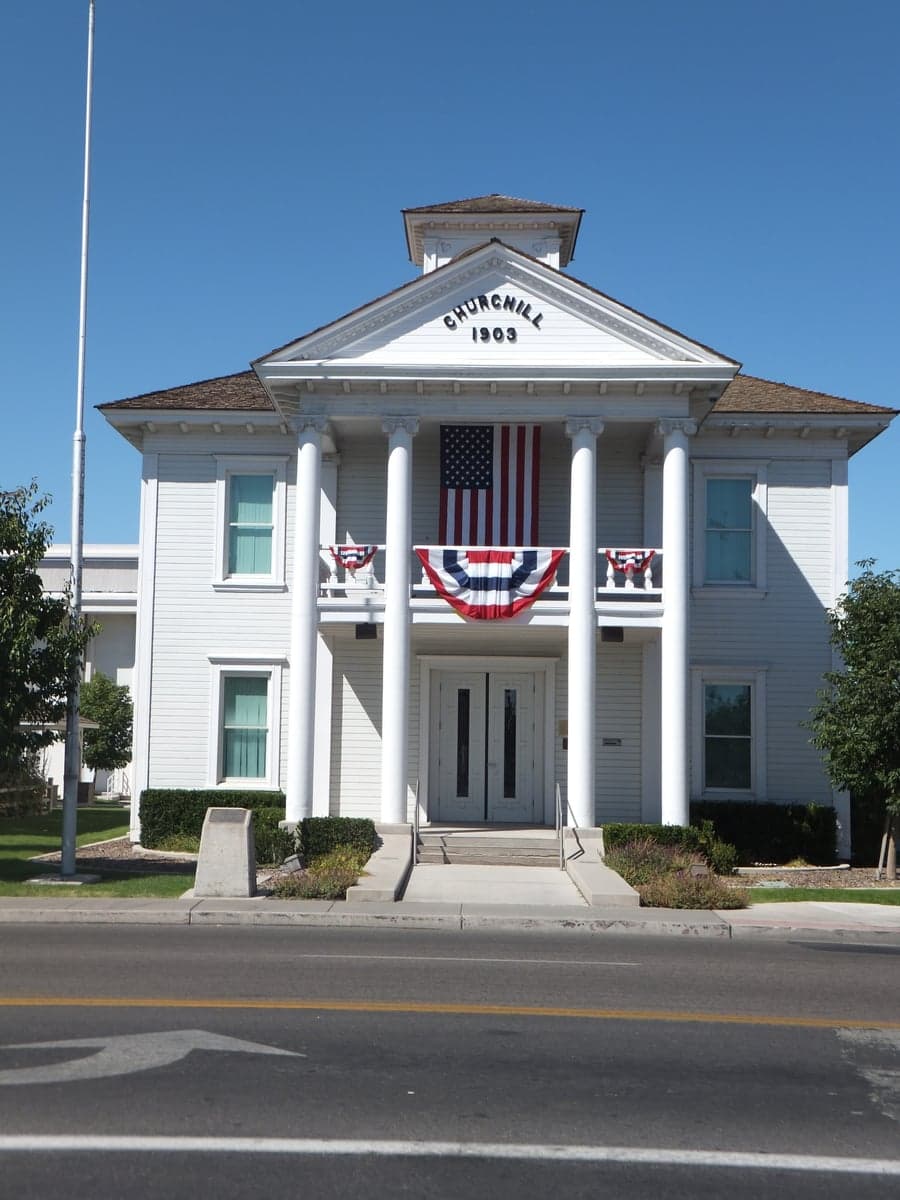
Photo: Wikipedia
Demographics of Churchill County
Affluence Level in Churchill County
A middle-class area roughly in line with national averages across income, home values, education, and employment.
People of Churchill County
Churchill County, Nevada, is home to roughly 25,600 residents, making it one of the state's more sparsely populated counties, yet its identity is distinctly rural, Western, and politically conservative. The population is overwhelmingly white (71.5%) with a significant Hispanic minority (14.8%), a very small foreign-born share (1.6%), and a low college attainment rate (18.6%), reflecting a working-class economy rooted in agriculture, mining, and state government. The county's people are concentrated in the seat of Fallon, with smaller clusters in the communities of Stillwater, Dixie Valley, and the former railroad stop of Hazen, and they carry a legacy of homesteaders, railroad workers, and military families that continues to shape the area's character today.
Settlement & growth (pre-1960)
Long before Anglo-American settlement, the region was the territory of the Northern Paiute people, who lived a semi-nomadic lifestyle centered on the Carson Sink and the Humboldt River drainage. The Paiute had no permanent towns in the modern sense, but their seasonal camps dotted the wetlands around Stillwater and the Carson Lake area, where they fished for cui-ui and hunted waterfowl. The first non-Native presence came with fur trappers in the 1820s, but permanent settlement did not begin until after the 1859 Comstock Lode discovery in Virginia City, which created demand for food and supplies from the surrounding valleys.
The U.S. Army established Fort Churchill in 1860 along the Carson River to protect the mail route and settlers, and the fort's presence drew the first wave of Euro-American homesteaders. These early arrivals were primarily of English, Irish, and German stock, lured by the promise of irrigated farmland along the Carson River and the Lahontan Valley. The town of Fallon was formally founded in 1896 as a railroad stop on the Carson and Colorado Railway, and it quickly became the commercial hub for the surrounding agricultural district. The Newlands Reclamation Act of 1902 transformed the region: the Truckee-Carson Irrigation District was created, and the Lahontan Dam was completed in 1915, bringing thousands of acres of desert into cultivation. This drew a second wave of settlers—Midwestern farm families from Nebraska, Kansas, and Iowa, many of German and Scandinavian descent—who established dairy farms, alfalfa fields, and livestock operations around Stillwater and Dixie Valley.
The railroad also brought a small but notable Chinese population to the area in the 1870s and 1880s, who worked on track construction and later in laundries and restaurants in Fallon. However, the Chinese Exclusion Act of 1882 and subsequent hostility drove most out by the early 1900s. The Great Depression and Dust Bowl era of the 1930s pushed a wave of Okies and Arkies—white families from Oklahoma, Arkansas, and the Texas Panhandle—into Churchill County, where they found work on farms and ranches. Many settled in the unincorporated areas around Hazen and along the Stillwater Slough. World War II brought the establishment of Naval Air Station Fallon (now NAS Fallon) in 1942, which introduced a steady stream of military personnel and their families, a demographic that remains significant today. By 1960, the county's population had reached roughly 8,500, overwhelmingly white, native-born, and employed in agriculture, the railroad, or the base.
Modern era (post-1965)
The 1965 Hart-Cellar Act had a minimal direct impact on Churchill County, as the area attracted very few post-1965 immigrants compared to coastal cities. The foreign-born share today is just 1.6%, far below the national average. The most significant demographic shift since the 1960s has been the growth of the Hispanic population, which rose from negligible levels in 1970 to 14.8% today. This growth came primarily through domestic migration—Mexican-American families moving from California and the Southwest for agricultural work in the Lahontan Valley's onion, alfalfa, and mint fields, and later for construction and service jobs tied to the military base. These families concentrated in Fallon, particularly in the older neighborhoods near the downtown core and along the U.S. 50 corridor, though no formal ethnic enclave formed.
The East/Southeast Asian population (2.1%) is a more recent arrival, driven almost entirely by the military presence at NAS Fallon. Filipino and Korean spouses of U.S. service members, along with a small number of Japanese and Vietnamese families, have settled in Fallon and the base housing areas. The Black population (1.8%) is also military-linked, with African-American service members and their families stationed at the base, though retention after separation is low. The Indian subcontinent population is effectively zero (0.0%), reflecting the county's lack of tech or medical sectors that attract South Asian professionals. The white population, while still the overwhelming majority at 71.5%, has declined from over 90% in 1980, as the Hispanic share has grown and as some white families have left for larger cities in Nevada or the West Coast.
Domestic migration since 1990 has been modest but notable: a small influx of retirees and remote workers from California, drawn by lower housing costs and the rural lifestyle, has settled in Fallon and the newer subdivisions around the base. However, the county has not experienced the explosive growth seen in Washoe or Clark counties. The population has grown slowly but steadily, from about 23,000 in 2000 to 25,600 today, with most growth occurring in Fallon's outskirts and along the U.S. 50 corridor toward Fernley (in neighboring Lyon County).
The future
Churchill County's population is likely to continue its slow, steady growth, reaching perhaps 28,000–30,000 by 2040, driven primarily by natural increase among the Hispanic population and by continued military-related migration. The Hispanic share is projected to rise to 20–22% by 2040, as the existing population is younger and has higher fertility than the white population. The white share will continue to decline gradually, but the county will remain overwhelmingly white and native-born for the foreseeable future. The East/Southeast Asian and Black populations will remain small and tied to the base, with no sign of independent growth.
The county is not tribalizing into distinct ethnic enclaves; rather, it is slowly homogenizing as Hispanic families integrate into the broader community, with intermarriage rates rising and Spanish-language use declining among the second generation. The cultural identity of the county—conservative, rural, military-friendly, and self-reliant—is absorbing new arrivals rather than being transformed by them. In-migration from California is likely to continue at a modest pace, but these newcomers tend to be politically conservative themselves, reinforcing rather than challenging the county's character. The biggest wildcard is the future of NAS Fallon: any major expansion or contraction of the base would directly affect population growth and demographic composition.
For someone moving into Churchill County now, the bottom line is that this is a stable, slow-growing, culturally homogeneous rural community where the population is becoming slightly more diverse but remains firmly rooted in its Western, agricultural, and military heritage. The county offers a predictable, low-crime, family-oriented environment, but those seeking ethnic diversity, a large immigrant community, or a rapidly changing social landscape will not find it here. The people of Churchill County are, and will likely remain, a population shaped by the land, the base, and a deep continuity with the homesteaders and ranchers who first settled the Lahontan Valley.

* Values derived from national, state, county, city and local statistics and may differ in a specific area. Last updated: 2026-05-12T08:38:46.000Z
Narrative content on this page is AI-generated and may contain mistakes. Verify any details that matter before acting on them.
ReloMaps may earn a commission from affiliate links at no extra cost to you.

