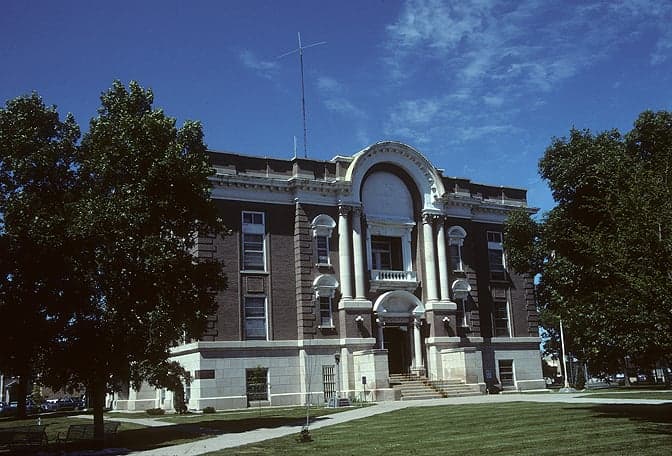
Photo: Wikipedia
Demographics of Phelps County
Affluence Level in Phelps County
A middle-class area roughly in line with national averages across income, home values, education, and employment.
People of Phelps County
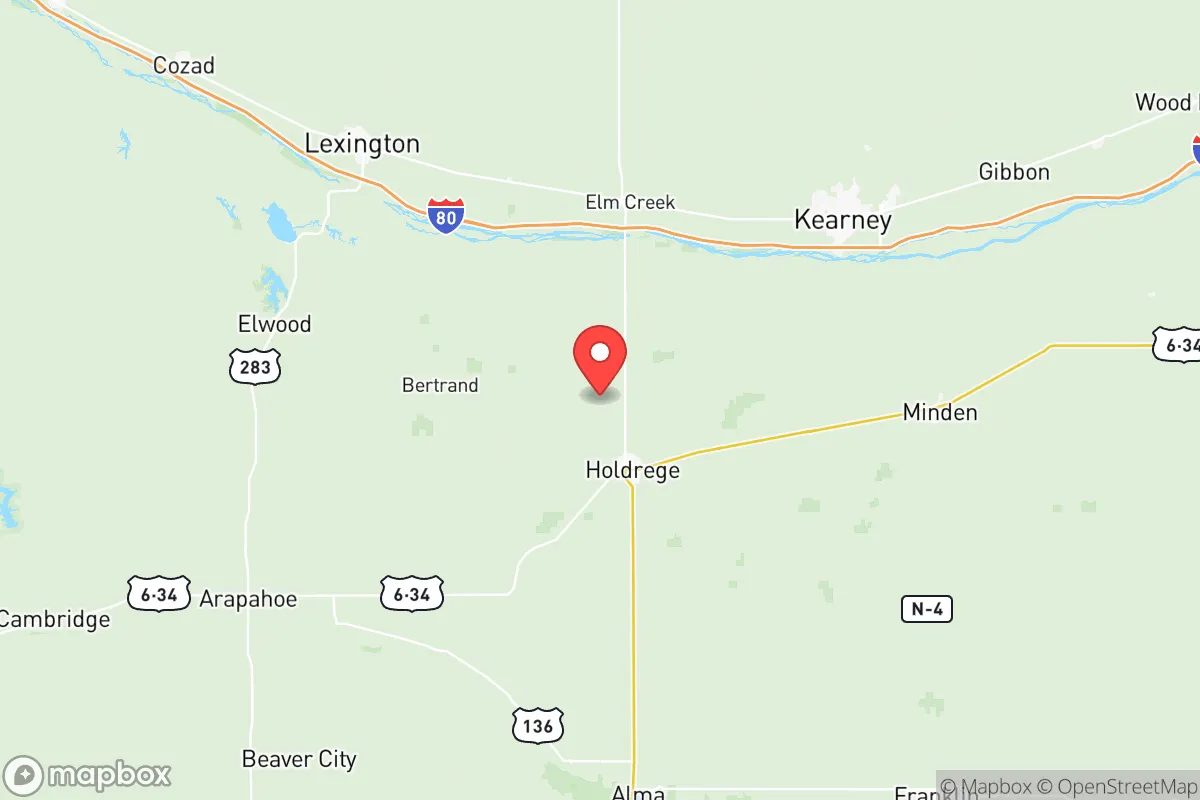
The people of Phelps County, Nebraska, today number 8,983, forming a predominantly white (90.1%) and native-born (98.1% U.S.-born) population spread across a rural agricultural landscape. The county seat of Holdrege serves as the commercial and social hub, while smaller communities like Bertrand, Funk, Loomis, and Atlanta anchor a network of farm towns. Distinctive markers include a strong German and Czech heritage visible in local churches, surnames, and community festivals, a relatively low college attainment rate of 26.7%, and a small but growing Hispanic population (6.5%) that is reshaping the labor force in agriculture and meat processing.
Settlement & growth (pre-1960)
Before American settlement, the land that became Phelps County was part of the traditional territory of the Pawnee Nation, particularly the Kitkehahki (Republican) band, who hunted bison and cultivated crops along the Republican River and its tributaries. The Pawnee were forcibly removed to reservations in Oklahoma through a series of treaties in the 1830s and 1850s, opening the region to Euro-American homesteaders. No Spanish, French, or British colonial settlements existed here; the area remained largely uncolonized until the U.S. acquired it through the Louisiana Purchase (1803) and subsequent treaties with Native nations.
Phelps County was formally organized in 1873, named after William Phelps, a Mississippi River steamboat captain. The first wave of settlers arrived in the 1870s and 1880s, drawn by the Homestead Act of 1862, which offered 160 acres of land to anyone willing to farm it for five years. These early pioneers were predominantly native-born Americans from Midwestern states like Iowa, Illinois, and Ohio, along with a significant number of German immigrants fleeing economic hardship and political instability in the German Empire. The Burlington and Missouri River Railroad reached the area in 1879, establishing the town of Holdrege as a division point and fueling rapid growth. German families settled heavily in and around Holdrege, Bertrand, and Loomis, establishing Lutheran and Catholic churches that remain community anchors today.
A second wave came in the 1880s and 1890s: Czech immigrants (then often called Bohemians) arrived, drawn by cheap land and chain migration from established Czech communities in Saunders and Colfax counties to the east. They concentrated in the southern part of the county, particularly around Funk and Atlanta, where Czech-language newspapers and fraternal societies flourished into the early 20th century. A smaller number of Swedish and Danish families also homesteaded in the area, though their numbers were never as large as the German and Czech blocs.
The Dust Bowl and Great Depression of the 1930s hit Phelps County hard, causing a population decline from a peak of roughly 12,000 in 1920 to under 10,000 by 1940. Many farm families left for California or urban centers. Those who remained shifted from wheat to more diversified farming—corn, soybeans, and livestock—a transition that stabilized the agricultural economy. No significant new immigrant groups arrived between 1930 and 1960; the population became increasingly homogeneous, with the German and Czech ethnic identities blending into a broader "Nebraska farm culture."
Modern era (post-1965)
The 1965 Hart-Cellar Act, which abolished national-origin quotas, had minimal direct impact on Phelps County. The foreign-born population today stands at just 1.9%, far below the national average. The county did not experience the large-scale immigration from Asia, Latin America, or Africa that transformed many urban and coastal areas. Instead, the most significant demographic shift since 1965 has been the gradual arrival of Hispanic workers, primarily of Mexican origin, beginning in the 1990s and accelerating after 2000.
Hispanic residents now make up 6.5% of the population, up from less than 1% in 1990. This growth is tied directly to the expansion of meatpacking and food-processing industries in the broader region. While Phelps County itself does not host a major packing plant, nearby communities like Lexington (Dawson County) and Grand Island (Hall County) have large meatpacking facilities that draw Hispanic workers, some of whom settle in Holdrege and Bertrand for cheaper housing and smaller-town life. These families are predominantly young, with higher birth rates than the aging white population, and they are increasingly integrated into local schools and churches. The East/Southeast Asian population is negligible at 0.1%, and the Indian-subcontinent population is effectively zero (0.0%). The Black population remains very small at 0.8%.
Domestic migration patterns since 1965 have been dominated by rural outmigration. Young adults leave for college and careers in Lincoln, Omaha, or Denver, and few return. The population has declined from 9,747 in 2000 to 8,983 in 2020, a drop of roughly 8%. Those who remain are older: the median age is 43.7, compared to the national median of 38.8. Suburbanization has not occurred in any meaningful sense; there are no suburbs, only the existing towns and open countryside. The county's character remains deeply agricultural, with corn, soybeans, cattle, and hogs as economic pillars.
The future
The population of Phelps County is likely to continue its slow decline over the next 10–20 years, driven by an aging white population and outmigration of young adults. The Hispanic share will continue to grow, probably reaching 10–12% by 2040, as Hispanic families have higher birth rates and younger age structures. This growth is not creating distinct ethnic enclaves; rather, Hispanic residents are dispersing across Holdrege and the smaller towns, attending the same schools and churches, and assimilating into the broader community. The county is homogenizing in terms of cultural identity—the German-Czech heritage is fading as older generations pass away, replaced by a more generic Midwestern rural identity that incorporates Hispanic elements.
No new immigrant groups are expected to arrive in significant numbers. The foreign-born share will likely remain below 3%, as the county lacks the industrial or urban draw that attracts international migration. The East/Southeast Asian and Indian populations will remain negligible. The Black population may grow slightly if meatpacking plants in nearby counties recruit more African American workers, but this is uncertain.
In-migration from outside the region is minimal and unlikely to change the cultural identity. The county is not a destination for coastal refugees or remote workers; its appeal is limited to those with existing family ties or agricultural connections. The next 20 years will see a smaller, slightly more Hispanic, and older population, with the same rural, conservative, and community-oriented character that has defined it for a century.
For someone moving in now, Phelps County offers a stable, safe, and predictable environment where neighbors know each other and the pace of life is slow. The demographic trends mean that schools will continue to shrink, churches will consolidate, and the local economy will depend increasingly on Hispanic labor. The cultural identity is absorbing its new Hispanic residents rather than being transformed by them, and the county will remain one of the most homogeneous and native-born places in Nebraska for the foreseeable future.

* Values derived from national, state, county, city and local statistics and may differ in a specific area. Last updated: 2026-05-08T16:10:36.000Z
Narrative content on this page is AI-generated and may contain mistakes. Verify any details that matter before acting on them.
ReloMaps may earn a commission from affiliate links at no extra cost to you.

