Photo: Wikipedia
Demographics of Naperville, IL
Affluence Level in Naperville, IL
An upper-middle-class area. Household wealth, education levels, and homeownership run ahead of national benchmarks.
People of Naperville, IL
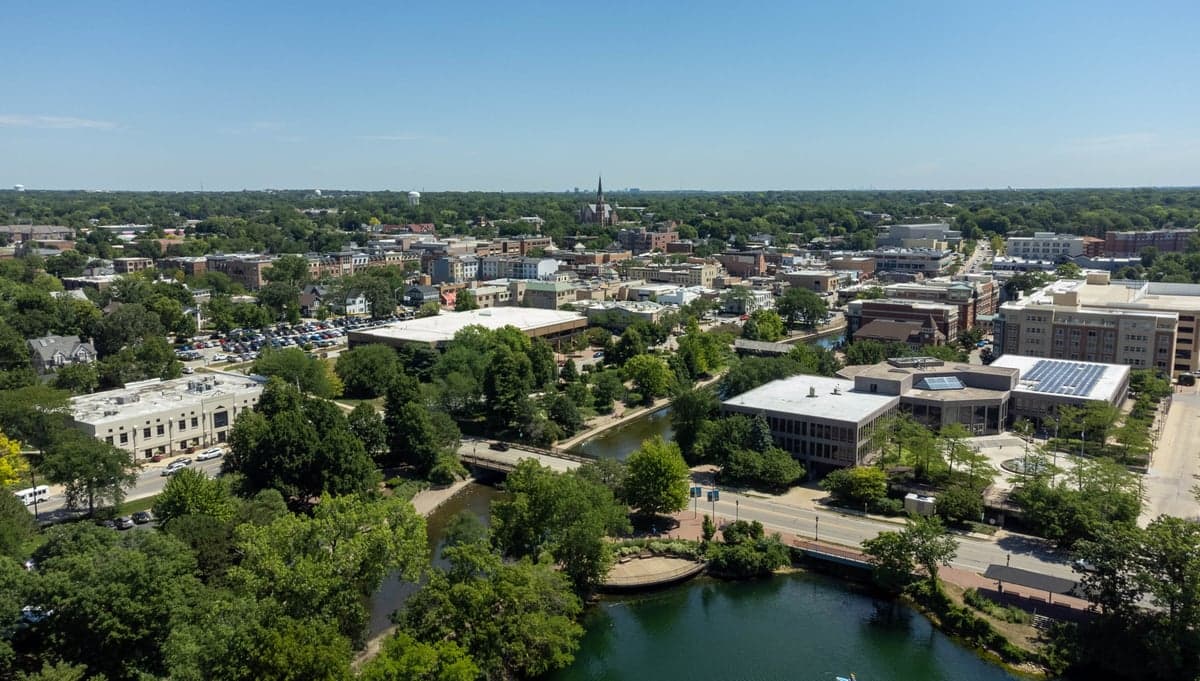
Today, Naperville, Illinois is a city of 149,424 residents defined by its high educational attainment—71.7% hold a college degree—and a notably diverse Asian and Indian population that together make up over 21% of the city. The city’s character is shaped by a blend of established white-collar professionals, large East and Southeast Asian communities concentrated in the southeast, and a substantial Indian-subcontinent population centered near the northern neighborhoods. With a foreign-born share of 10.2%, Naperville is less immigrant-heavy than many Chicago suburbs but more ethnically stratified, with distinct residential clusters reflecting the city’s layered migration history.
How the city was settled and grew
Naperville’s original population was drawn by the promise of fertile prairie land and the construction of the Galena & Chicago Union Railroad in the 1860s. The city was platted in 1831 by Joseph Naper, a New Englander who led a small group of Yankee settlers from Vermont and New York. These early families built homesteads in what is now the Naperville Historic District, centered around Jefferson Avenue and Main Street, where many original Greek Revival and Italianate homes still stand. Through the late 19th and early 20th centuries, the population remained overwhelmingly white and native-born, supplemented by a modest wave of German and Irish laborers who worked on the railroad and in local mills. These groups settled in the Old Town area west of Washington Street, where small worker cottages and corner taverns once dotted the landscape. By 1950, Naperville was still a small town of fewer than 7,000 people, with a population that was nearly 100% white and largely of Northern European descent.
Modern era (post-1965)
The passage of the Hart-Cellar Act in 1965, combined with the expansion of the Illinois Tollway and the rise of corporate campuses along the I-88 corridor, transformed Naperville’s population. The city became a magnet for domestic white-collar migrants from the Midwest and East Coast, who filled new subdivisions like Ashbury and White Eagle in the south and west. Simultaneously, a wave of East and Southeast Asian professionals—many from China, Korea, and Vietnam—began arriving in the 1980s and 1990s, drawn by high-tech jobs at companies like Bell Labs, Alcatel-Lucent, and BP. These families concentrated in the South Naperville neighborhoods around 95th Street and Route 59, where Asian-owned grocery stores, restaurants, and tutoring centers now anchor a distinct commercial corridor. A separate, later wave of Indian-subcontinent immigrants—primarily from India’s IT and medical sectors—accelerated after 2000, settling heavily in the North Naperville area near the 75th Street and Naper Boulevard intersection. Today, Indian residents make up 13.9% of the city, a share that exceeds the East/Southeast Asian population (7.8%) and is concentrated in newer, larger homes in subdivisions like Tall Grass and Willowbrook. The Hispanic population, at 7.4%, is smaller and more dispersed, with clusters in older multifamily housing near the downtown fringe. Black residents, at 4.4%, are the least concentrated, spread across the city without a dominant neighborhood.
The future
Naperville’s population is trending toward greater ethnic stratification rather than homogenization. The Indian-subcontinent community, driven by continued professional migration and chain migration, is projected to grow further, likely pushing past 18% by 2035. This group shows strong retention, with many families staying long-term and investing in the North Naperville and Tall Grass areas, where Indian cultural institutions and temples have taken root. The East/Southeast Asian population appears to be plateauing, with younger generations assimilating and dispersing to other suburbs or urban centers. The white population, while still the majority at 62%, is aging and declining in share as older residents downsize or move to retirement communities. Hispanic and Black populations are growing slowly but remain small, with no signs of forming large ethnic enclaves. The city’s high housing costs and competitive school system act as a filter, favoring affluent professional migrants over lower-income groups. Over the next decade, Naperville will likely become even more bifurcated: a well-educated, high-income core of white, Indian, and East/Southeast Asian professionals, with a smaller, more diverse service-sector population living in older, denser pockets near the train stations.
For a conservative-leaning individual or parent considering a move, Naperville offers a stable, high-achieving environment where property values and school rankings are reinforced by a steady inflow of educated professionals. The city is not homogenizing into a generic suburb but is instead developing distinct ethnic neighborhoods that coexist with minimal friction. The practical takeaway: newcomers should expect a community where academic competition is intense, cultural diversity is real but segmented, and the overall trajectory is toward greater affluence and educational stratification—not decline.

* Values derived from national, state, county, city and local statistics and may differ in a specific area. Last updated: 2026-04-24T14:16:35.000Z
Narrative content on this page is AI-generated and may contain mistakes. Verify any details that matter before acting on them.
ReloMaps may earn a commission from affiliate links at no extra cost to you.

