Photo: Wikipedia
Demographics of Nanticoke, PA
Affluence Level in Nanticoke, PA
A below-average socioeconomic profile. Incomes, home values, and educational attainment trail the U.S., with higher poverty and unemployment.
People of Nanticoke, PA
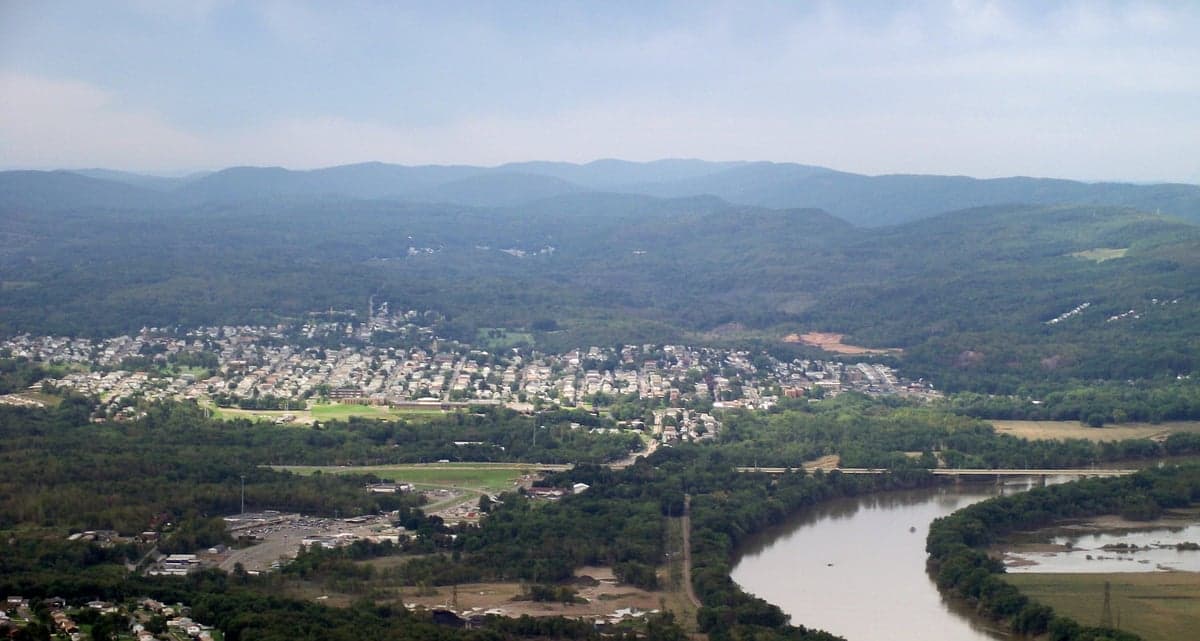
The people of Nanticoke, Pennsylvania today make up a small, predominantly white working-class city of 10,610 residents, shaped by deep Eastern European roots and a modest recent diversification. The population is 78.9% white, with a Hispanic minority of 10.8% and a Black minority of 8.1%, while the foreign-born share is a negligible 0.6% and only 19.1% of adults hold a college degree. This is a place where family ties, church communities, and a sense of local history matter more than high-end amenities, and the city retains a distinctive blue-collar character rooted in its anthracite coal past.
How the city was settled and grew
Nanticoke's population history begins with English and Welsh settlers who farmed the Susquehanna River flats in the late 1700s, but the city's explosive growth came with the anthracite coal industry after 1860. The first major immigrant wave brought Irish miners into the East Side neighborhoods around East Union Street, where they built St. Mary's Church as a community anchor. A second, larger wave of Eastern Europeans — Poles, Lithuanians, Slovaks, and Ukrainians — arrived between 1880 and 1920, concentrating in the West Side around St. Stanislaus Church and Kosciuszko Street, and in the South Nanticoke district near the coal breakers. The Pioneer section, a separate coal patch town annexed in the early 1900s, housed Hungarian and Slovak families in company-owned rowhouses. By the 1930s, the city peaked at roughly 25,000 residents, making it one of Luzerne County's most densely populated industrial towns, with a proud, insular ethnic character defined by parish life, fraternal societies, and union solidarity.
Modern era (post-1965)
The collapse of deep anthracite mining after the 1950s triggered a long population decline, with many white families moving to neighboring Hanover Township and Newport Township. Following the 1965 Hart-Cellar Act, Nanticoke saw only minimal new foreign immigration due to the lack of entry-level industrial jobs; the foreign-born share remains under 1% today. Instead, domestic in-migration reshaped the city. Hispanic families — largely Puerto Rican and Dominican — began settling in the Downtown corridor along Main Street and in parts of the West Side during the 1980s and 1990s, drawn by inexpensive housing and proximity to manufacturing and distribution jobs at the PPL Susquehanna power plant and area warehouses. The Black population, which grew to 8.1% by 2020, concentrated in the East Side and parts of South Nanticoke, particularly in the more affordable housing stock near the river. Meanwhile, the white population aged and thinned as younger adults left for larger metro areas, shifting the city's ethnic balance from nearly all-white European in the 1970s to a more diverse but still majority-white working-class community today.
The future
Nanticoke's population is projected to continue a slow decline, consistent with broader trends in northeastern Pennsylvania's post-industrial towns. The Hispanic share — already 10.8% — is likely to grow modestly as younger families move into affordable housing in the Downtown and West Side neighborhoods, while the white population will continue to age and shrink. The Black population may stabilize or grow slightly, but the city's very low foreign-born rate (0.6%) means little new international immigration will occur. The Eastern European cultural identity will persist

* Values derived from national, state, county, city and local statistics and may differ in a specific area. Last updated: 2026-06-20T15:38:55.000Z
Narrative content on this page is AI-generated and may contain mistakes. Verify any details that matter before acting on them.
ReloMaps may earn a commission from affiliate links at no extra cost to you.

