Photo: Wikipedia
Demographics of Montgomery, AL
Affluence Level in Montgomery, AL
A below-average socioeconomic profile. Incomes, home values, and educational attainment trail the U.S., with higher poverty and unemployment.
People of Montgomery, AL
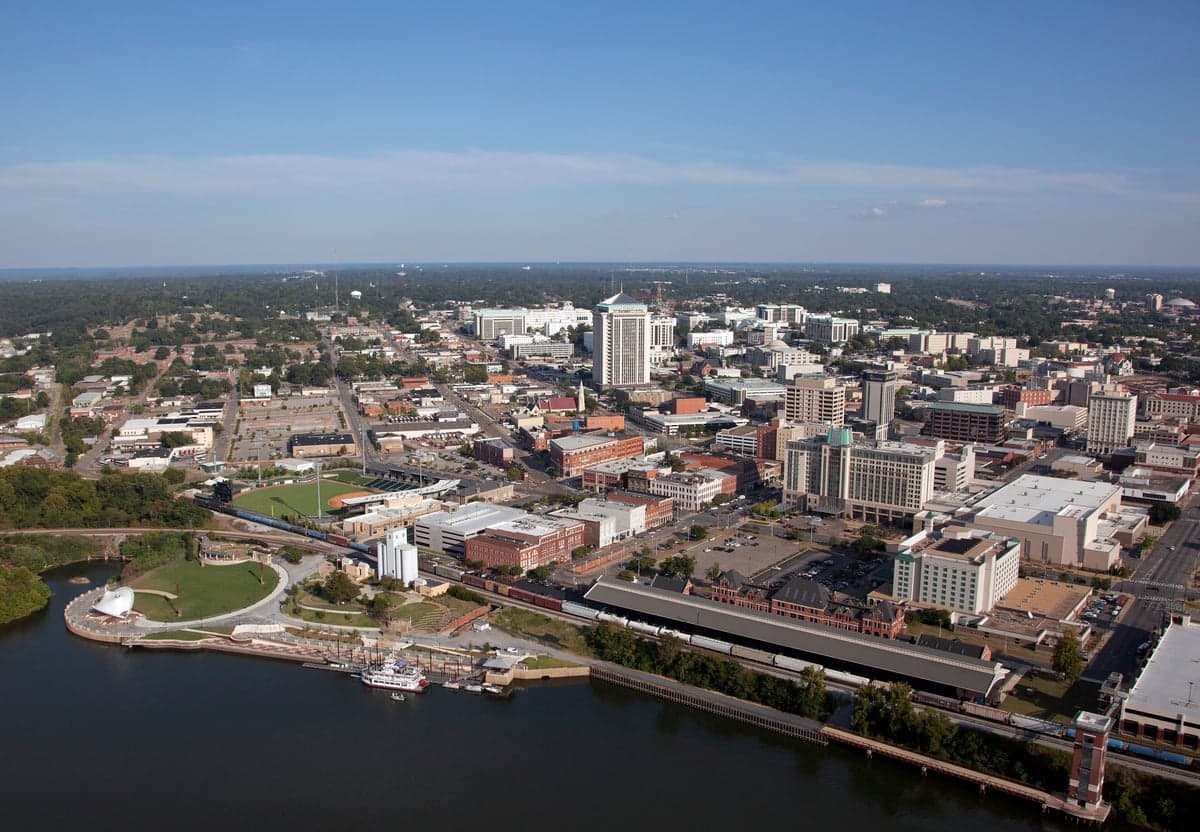
The people of Montgomery, Alabama, today form a majority-Black city of roughly 198,440 residents, defined by a deep civil rights legacy and a slowly diversifying population that remains one of the most racially concentrated in the South. With a foreign-born share of just 3.6%—well below the national average—the city’s identity is overwhelmingly native-born, anchored by a Black population at 62.8% and a White population at 26.6%. Montgomery’s character is shaped by its role as the state capital, a hub for government employment, and a place where historic neighborhoods still reflect the settlement patterns of the 19th and 20th centuries.
How the city was settled and grew
Montgomery was founded in 1819 on the Alabama River, drawing early settlers as a cotton and river-trade center. The original White population arrived from Virginia, Georgia, and the Carolinas, establishing the city as a planter aristocracy centered around the Garden District, where antebellum homes still stand. Enslaved Black people, forcibly brought from the Upper South, made up the majority of the labor force and lived in areas like Old Cloverdale and the South Perry Street corridor, often in alley dwellings behind White-owned homes. After the Civil War, freedmen concentrated in Centennial Hill, which became the heart of Montgomery’s Black professional class—home to early civil rights leaders and the site of the 1955-56 bus boycott. The early 20th century saw a small wave of Jewish immigrants from Eastern Europe, who settled near Dexter Avenue and established retail businesses, while the city’s industrial growth—railroads, then Maxwell Air Force Base (opened 1910)—drew additional White and Black migrants from rural Alabama through the 1940s and 1950s.
Modern era (post-1965)
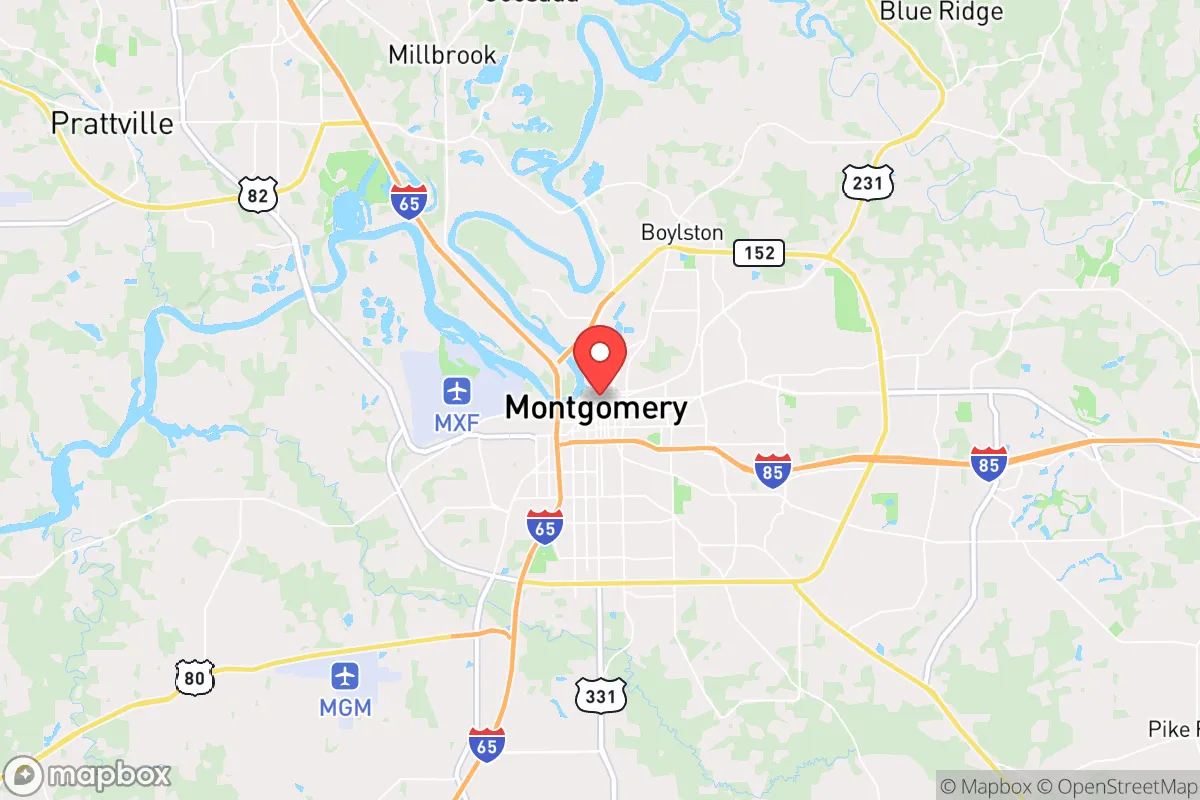
After the 1965 Voting Rights Act and the end of legal segregation, Montgomery experienced rapid White flight to suburbs like East Montgomery and Pike Road, reshaping the city’s racial geography. By 1980, the city had shifted from roughly 40% Black to over 55% Black, a trend that continued through the 2000s. The post-1965 immigration reforms had a muted effect here: Montgomery’s foreign-born population remains low, but the city did see a modest influx of East/Southeast Asian communities—primarily Vietnamese and Filipino families—who settled in East Montgomery near the Hyundai plant (opened 2005) and the Maxwell-Gunter annex. Indian-subcontinent residents, numbering about 0.9% of the population, arrived later, many as medical professionals at Baptist Health and Jackson Hospital, and concentrated in the Halcyon area. Hispanic growth (now 4.8%) began in the 1990s, driven by construction and poultry processing, with clusters forming in South Montgomery near the Interstate 65 corridor. The city’s Black population, while still dominant, has seen a slight decline from a peak of roughly 65% in 2010, as some middle-class Black families have also moved to eastern suburbs.
The future
Montgomery’s population is slowly diversifying, but the pace is modest. The White share has stabilized around 26-27% after decades of decline, while Hispanic and Asian shares are growing from a low base—Hispanic growth is the fastest, at roughly 0.3% per year. The foreign-born population, though still low, is becoming more varied, with small but growing Arab and African immigrant communities (notably Ethiopian and Nigerian) settling in East Montgomery. The city is not homogenizing; instead, it is tribalizing into distinct enclaves: Centennial Hill remains predominantly Black and historic, East Montgomery is increasingly multiethnic and middle-class, and South Montgomery is becoming a Hispanic gateway. The next 10-20 years will likely see the Black share edge down toward 58-60%, the Hispanic share rise to 7-8%, and the Asian and Indian shares each approach 2-3%, as the city’s economy—anchored by state government, Hyundai, and Maxwell Air Force Base—continues to attract skilled immigrants and domestic migrants from the Northeast and Midwest seeking lower costs.
For someone moving in now, Montgomery is a majority-Black city with a stable, native-born core and a slow but real diversification underway. The city’s historic neighborhoods offer distinct cultural identities, while newer eastern areas provide a more suburban, mixed-income environment. The low foreign-born share means less ethnic friction than in gateway cities, but also less of the economic dynamism that immigration often brings. Montgomery is becoming a slightly more diverse, still deeply Southern capital—a place where the past is never far from the present, and where the population story is one of gradual change rather than rapid transformation.

* Values derived from national, state, county, city and local statistics and may differ in a specific area. Last updated: 2026-04-19T18:59:06.000Z
Narrative content on this page is AI-generated and may contain mistakes. Verify any details that matter before acting on them.
ReloMaps may earn a commission from affiliate links at no extra cost to you.

