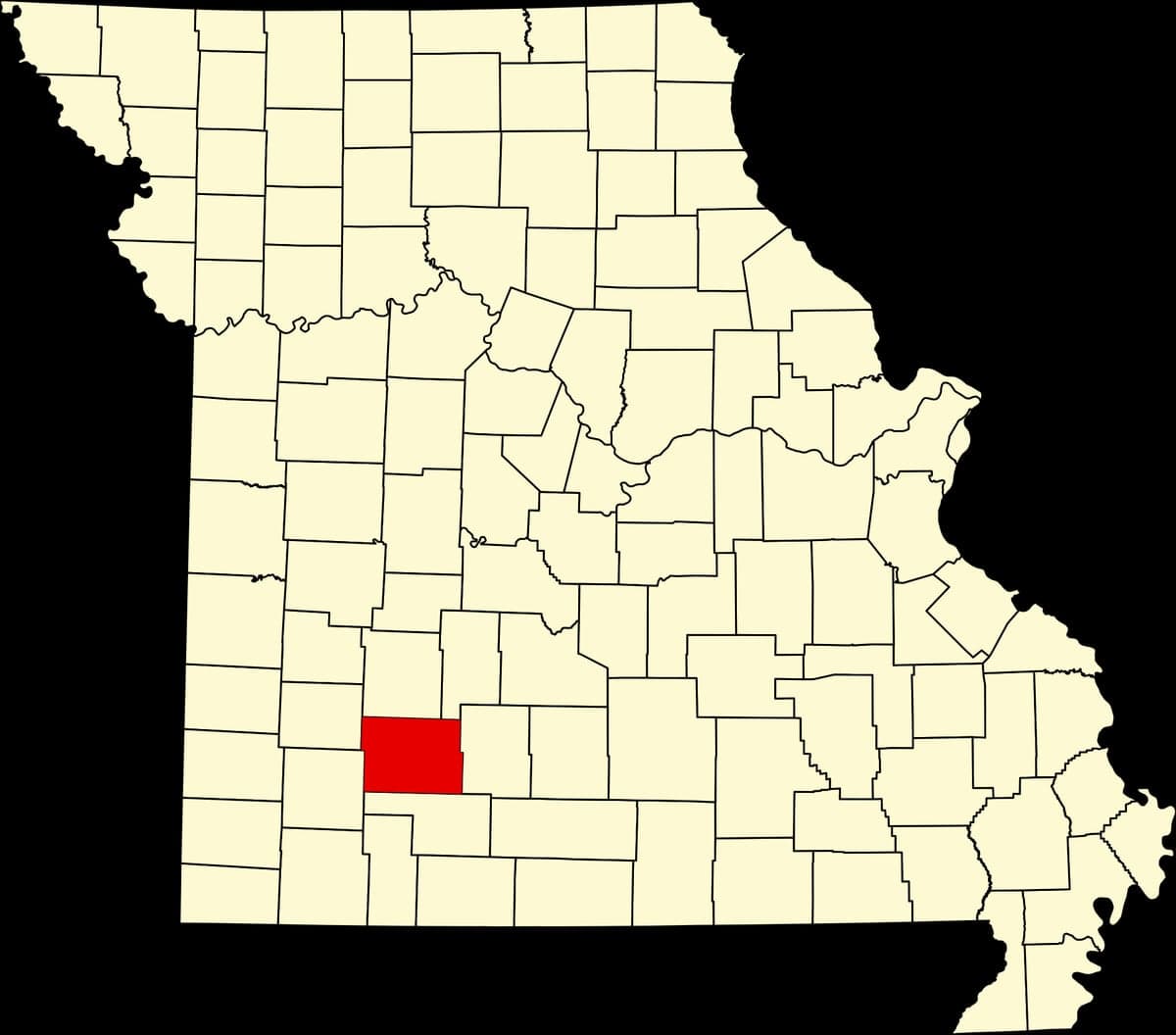
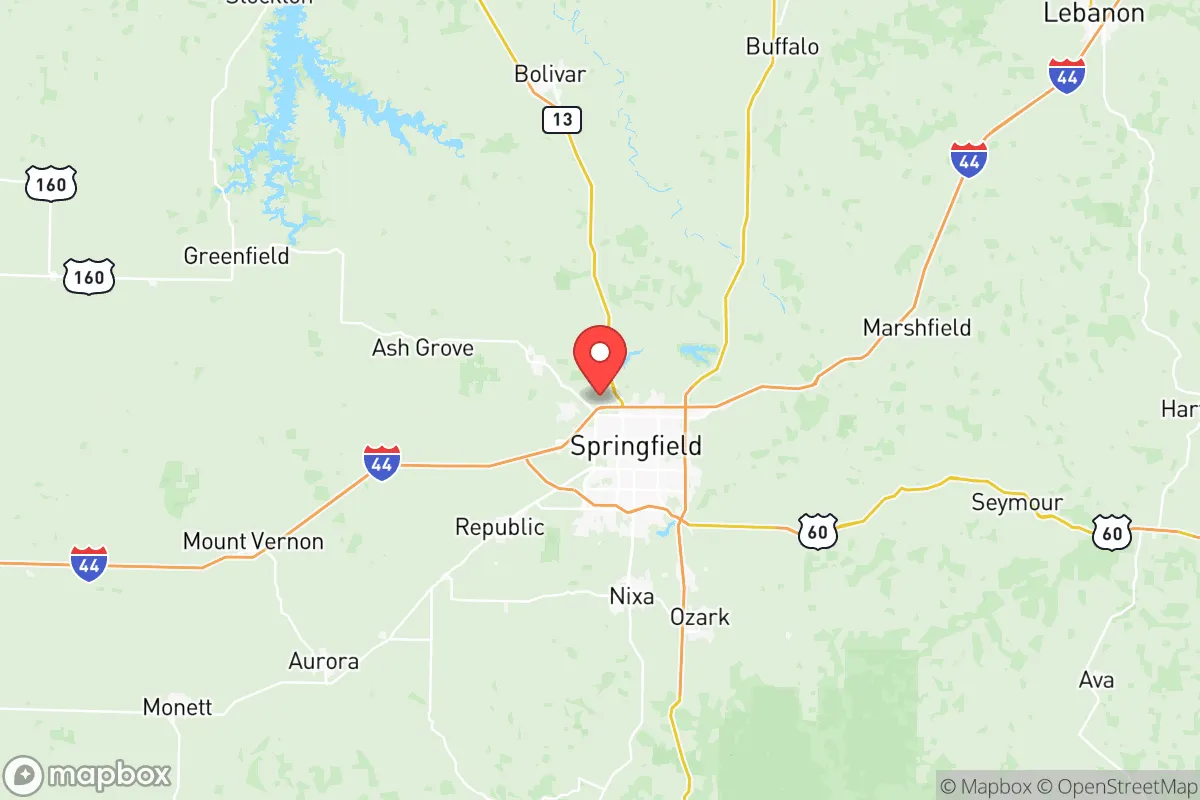
Photo: Wikipedia
Demographics of Greene County
Affluence Level in Greene County
A middle-class area roughly in line with national averages across income, home values, education, and employment.
People of Greene County
Greene County, Missouri, is home to roughly 301,000 residents, a population that is predominantly white (84.7%) and notably less diverse than the national average, with a foreign-born share of just 1.8%. The county’s character is shaped by its role as the anchor of the Springfield metropolitan area—a regional hub for healthcare, education, and logistics—where a strong sense of local identity, religious conservatism, and a slower pace of life define daily existence. Distinctive markers include a deep-rooted Ozarks heritage, a reliance on major employers like Mercy Hospital and Bass Pro Shops, and a population that is slightly more college-educated (32.4%) than the Missouri average but still below the national figure.
Settlement & growth (pre-1960)
Before American settlement, the area now known as Greene County was part of the ancestral homeland of the Osage Nation, who controlled much of the Ozarks region. French fur traders and trappers passed through in the 1700s, but no permanent European settlements took hold until after the Louisiana Purchase. The county was officially organized in 1833, named after Revolutionary War General Nathanael Greene, and the first wave of settlers were primarily Scots-Irish and English migrants from Kentucky, Tennessee, and the Upper South, drawn by the promise of cheap, fertile land in the Ozark Plateau. These early arrivals established the county seat of Springfield in the 1830s, which quickly became a commercial and political center.
The second major wave came in the decades following the Civil War, when German immigrants began arriving in the 1870s and 1880s. Unlike the Scots-Irish, who were largely subsistence farmers, the Germans brought specialized agricultural skills and a strong work ethic that helped establish the county’s dairy and fruit industries. Many settled in the northern part of the county, particularly around Willard and Ash Grove, where German Lutheran churches and community halls still stand. A smaller number of Italian immigrants arrived around the same time, finding work on the railroad and in the limestone quarries near Republic and Strafford.
The early 20th century saw a steady influx of rural Missourians from surrounding Ozark counties, drawn to Springfield’s growing economy as a railroad and trade hub. The Great Depression and Dust Bowl of the 1930s pushed a modest number of Okies and Arkies into the county, though not in the numbers seen in California or the Southwest. World War II brought a temporary population boom as Camp Crowder, a major Army Signal Corps training base near Neosho (just south of Greene County), spilled over into the region. After the war, the county’s population grew steadily, reaching about 100,000 by 1960, as returning veterans and their families settled in new suburbs like Battlefield and Fremont Hills.
Modern era (post-1965)
The 1965 Hart-Cellar Act had a minimal direct impact on Greene County, as the region did not attract the large-scale immigration seen in coastal cities. Instead, the county’s modern demographic story is one of domestic migration—primarily from the Rust Belt and rural Midwest. From the 1970s through the 1990s, Springfield and its surrounding towns became a destination for retirees and families from Illinois, Indiana, and Ohio, seeking a lower cost of living, a slower pace, and a more conservative social environment. This wave concentrated in the southern and eastern parts of the county, especially in Ozark (just over the county line in Christian County) and the newer subdivisions of Nixa and Rogersville.
Suburbanization accelerated after 1990, with Springfield’s population spilling into unincorporated areas and small towns like Fair Grove and Walnut Grove. The county’s Hispanic population, while still small at 5.0%, grew noticeably after 2000, driven by employment in construction, meatpacking, and agriculture. Most Hispanic residents are of Mexican descent and have settled in Springfield’s north side and in the town of Strafford, where a small but growing community supports a handful of Spanish-language churches and markets. The Black population, at 2.9%, remains concentrated in Springfield’s historic Black neighborhoods near the city center, with little suburban dispersion. East and Southeast Asian communities (1.6%) are largely composed of Vietnamese and Korean families, many of whom arrived as refugees or through family reunification in the 1980s and 1990s, and are clustered in Springfield’s southeast quadrant near the university. The Indian subcontinent population (0.3%) is tiny and consists primarily of professionals working in healthcare and technology, scattered across the county rather than forming a distinct enclave.
Overall, Greene County remains overwhelmingly white and native-born, with a foreign-born share (1.8%) that is a fraction of the national average. The county’s diversity has increased only modestly since 2000, and the population growth—about 15% since 2010—has been driven almost entirely by domestic migration from other parts of Missouri and the Midwest.
The future
Demographic projections suggest Greene County will become slightly more diverse over the next 10-20 years, but at a slower pace than the nation as a whole. The Hispanic population is expected to grow to around 7-8% by 2040, driven by natural increase and continued labor migration, with new concentrations likely in Springfield’s north side and in Republic. The East and Southeast Asian population may see modest growth as the healthcare and logistics sectors expand, but the Indian subcontinent population is unlikely to exceed 0.5% without a major shift in local industry. The white population will remain the overwhelming majority, though its share will decline gradually as the county’s older, non-Hispanic white residents age out and younger, more diverse cohorts enter adulthood.
Culturally, Greene County is likely to remain a conservative, religiously oriented region, with the Ozarks identity—self-reliance, suspicion of government, and a strong church presence—continuing to define social life. New residents, whether from the coasts or the Rust Belt, tend to self-select for these values, reinforcing rather than challenging the existing character. The county’s population will continue to grow, but at a slower rate than the fast-growing suburbs of Kansas City or St. Louis, as Springfield’s economy remains stable but not explosive.
For someone moving in now, Greene County offers a community that is stable, predictable, and culturally cohesive—a place where demographic change is gradual and where the dominant identity remains rooted in Ozarks tradition and Midwestern conservatism. The trade-off is limited diversity and a slower pace of cultural evolution, which suits many families and individuals seeking a low-cost, low-stress environment but may feel insular to those accustomed to more dynamic, multicultural settings.

* Values derived from national, state, county, city and local statistics and may differ in a specific area. Last updated: 2026-06-12T17:40:25.000Z
Narrative content on this page is AI-generated and may contain mistakes. Verify any details that matter before acting on them.
ReloMaps may earn a commission from affiliate links at no extra cost to you.

