
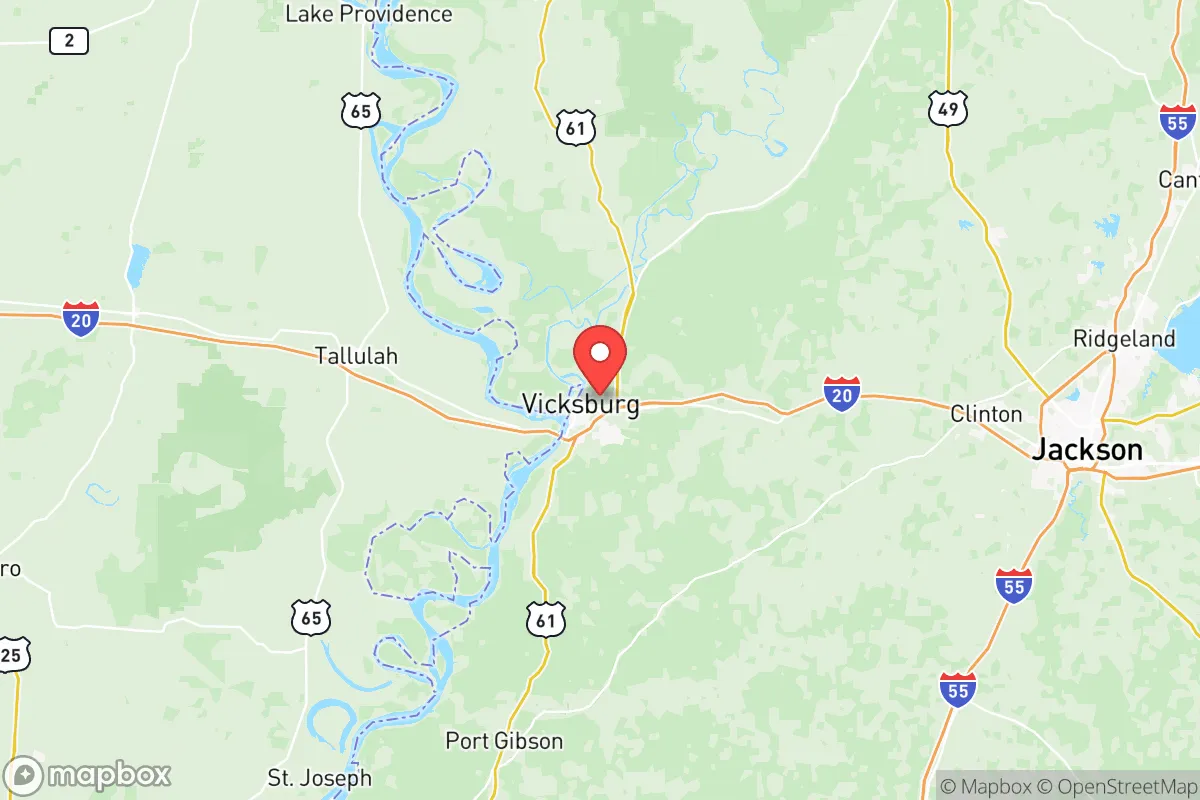
Photo: Wikipedia
Political ClimatePolitical Climate in Warren County
Showing district-level results — no local-only data available.
Local Political AnalysisPolitical Analysis of Warren County
Look, if you're thinking about moving to Warren County, you need to understand the politics here, because it's a real outlier in Mississippi. The county as a whole carries a Cook PVI of D+11, meaning it's reliably Democratic by double digits, while the rest of the state leans R+11 — a massive 22-point gap. That wasn't always the case, and the shift has accelerated over the last decade, especially as national trends have dragged Vicksburg further left. If you value limited government and personal freedoms, you'll want to know exactly where those lines are drawn.
How it compares
To put it bluntly, Warren County is a blue island in a deep red sea. The city of Vicksburg itself is the engine of that Democratic lean, with heavy African-American turnout and a growing number of progressive transplants driving precincts like those around Washington Street and the downtown core solidly blue. Drive just five miles out to Bovina or Redwood, and you'll find precincts that vote more like the rest of Mississippi – heavily Republican and skeptical of government overreach. The swing precincts are the rural-urban fringe, places like Oak Ridge and the area around Warren County Central High School, where you see a real contest between Vicksburg's progressive pull and the county's traditional conservative base. While the state as a whole has trended rightward since the 1980s, Warren County has actually trended leftward, which means the cultural and policy gap between Vicksburg and the surrounding countryside is widening every election cycle.
What this means for residents
For someone who's concerned about personal freedoms – your right to work, your gun rights, your freedom from overreaching regulations – living in Warren County means being aware that local governance in Vicksburg has taken a turn toward heavier hand. The city council has pushed more ordinances on rental properties, noise, and even business signage that would feel out of place in, say, Edwards or Cary just a few miles east. Property taxes have crept up faster than most of the state, partly to fund new city initiatives that a lot of us in the rural parts see as unnecessary. The county school district, which covers the areas outside Vicksburg city limits, still reflects more traditional values – but you have to be careful where you buy. If you settle in parts of Waltersville or along the river south of town, you'll still get a strong conservative voting bloc on the county board of supervisors, which helps hold the line on spending and regulations. But the demographic shift inside the city limits means those fights are getting harder every year.
Socially, you'll notice a real divide. The local Warren County Republican Party is active, but it's fighting against a well-funded city machine. A lot of longtime residents, myself included, remember when Vicksburg was a lot more moderate. Now you see a push for things like "inclusive" zoning talk and other progressive buzzwords that most folks outside the city limits want no part of. If you move here, you'll need to pick your neighborhood carefully – northern Yazoo County adjacent areas still feel like old Mississippi, but don't expect that to last forever. My advice: get involved in the county board meetings and the local school board races if you want to keep your rights intact. Otherwise, the same overreach you see in bigger cities will creep into this corner of the state. It hasn't gone full liberal yet, but the trend lines are concerning, and you'll have to work to keep it from getting there.

State Political ClimatePolitical Climate in Mississippi
State Political AnalysisPolitical Environment in the State
Mississippi remains one of the most reliably conservative states in the country, with a Cook PVI of R+11 that has held steady for over a decade. The dominant coalition is culturally conservative, pro-business, and skeptical of federal overreach, though the internal dynamics have shifted notably since the early 2000s as suburban growth around Memphis and the Gulf Coast has deepened the state's red tilt, while Jackson's influence has receded. Over the last 15 years, the state has moved from a more traditional, religious-right-aligned conservatism toward a harder-edged libertarian-leaning Republicanism, driven by in-migration from other conservative states and a generational turnover in the legislature.
Urban vs. rural divide
The political map breaks down along predictable but intensifying lines. Jackson, the state capital and largest city in Hinds County, is the only reliably blue metro area, delivering 80%+ margins for Democrats in statewide races, but its population has declined by over 10% since 2010, shrinking its electoral weight. The Gulf Coast cities of Biloxi and Gulfport lean Republican but are more moderate and economically focused, with a strong military and tourism presence that keeps them in the GOP column by smaller margins than the rest of the state. Oxford and Starkville, home to the University of Mississippi and Mississippi State respectively, show increasing blue tendencies among younger voters and faculty, though the surrounding Lafayette and Oktibbeha counties remain solidly red. The real engine of Mississippi's conservatism is the suburban crescent stretching from DeSoto County down through Rankin and Madison counties—the Memphis exurbs and Jackson suburbs—where growth has been explosive and voting margins regularly exceed +30% Republican. Rural counties along the Mississippi Delta and the Pine Belt are deeply red, with many precincts hitting 85-90% GOP support. The only notable exception is the largely African American majority counties in the Delta region, like Bolivar and Washington, which vote heavily Democratic but have little influence beyond local races due to low turnout.
Policy environment
Mississippi's policy posture is among the most conservative in the nation, with a deliberate low-tax, low-service approach. The state income tax is being phased out through a series of bills starting with HB 1439 in 2022, aiming for full elimination by the early 2030s, though the effective date keeps getting pushed back as revenue projections shift. Sales tax rates are high at a combined 7%+ in many areas, and property taxes remain among the lowest in the country, which is a major draw for retirees and families. Education policy is a flashpoint: the state has expanded charter schools and recently passed the CHOOSE Act (2024), which created Education Savings Accounts for students in failing districts, a move that energized school choice advocates but sparked litigation from teachers unions and the NAACP. Healthcare is the weak spot—Mississippi has not expanded Medicaid under the ACA, leaving roughly 200,000 working poor in a coverage gap, and rural hospital closures have accelerated, with 14 hospitals shuttering since 2010, the highest rate per capita in the country. The state's election laws are among the most restrictive by national standards: voter ID is required, early voting is limited to in-person absentee with an excuse required, and no-excuse mail voting is not allowed. Election integrity measures passed in 2023 included stricter chain-of-custody rules for absentee ballots and a ban on ballot harvesting.
Trajectory & freedom
On personal freedoms, Mississippi has trended decisively toward expansion on most conservative priorities. Constitutional carry was signed into law in 2023 (SB 2149), allowing permitless concealed carry for adults who can legally possess a firearm. The state also passed a parental rights bill in 2024 requiring school districts to notify parents of any curriculum involving sexual orientation or gender identity and to obtain parental consent before any counseling services. Medical freedom saw major wins with a 2022 law banning vaccine mandates for state employees and private employers receiving state contracts, though it faced court challenges on federal contractor applicability. Religious freedom remains protected under the Mississippi Religious Freedom Restoration Act of 2014, which has been upheld in state courts. On the concerning side, property rights advocates have raised alarms about the state's use of eminent domain for private economic development projects, particularly along the Gulf Coast for casino and resort expansions near Gulfport and Pass Christian. A 2021 bill expanded the definition of blight, which critics say gives local governments too much latitude to seize land for redevelopment. The trajectory is clear: the legislature is moving toward a more libertarian posture on guns, education, and medical choice, but government creep on eminent domain and local zoning eases a cautionary note for anyone valuing property sovereignty.
Civil unrest & political movements
Organized protest activity has been relatively muted compared to other Southern states, but there are visible flashpoints. The Jackson water crisis of 2022-2023 drew national attention and sparked repeated demonstrations at the state capitol, with activists demanding state funding for infrastructure repairs—a rare left-progressive movement that actually gained traction, leading to a $600 million infrastructure bill in 2023. On the right, grassroots groups like the Mississippi Republican Assembly have focused on school board elections and county-level GOP precinct organizing, with notable success in DeSoto County and Madison County where moderate school board members were replaced with culturally conservative challengers in 2023-2024. Immigration politics are less intense than in border states, but a 2024 law (HB 1640) required local law enforcement to cooperate with ICE detainer requests, which triggered protests in Jackson and Gulfport from immigrant advocacy groups. Election integrity controversies have been minimal—Mississippi saw no widespread fraud claims after 2020, and the state's voter ID system is widely accepted across both parties. Secessionist and nullification rhetoric occasionally surfaces in rural legislative districts, but it remains fringe, with no serious movement gaining traction in the last decade. A new resident would notice the absence of visible political street presence compared to states like Georgia or Texas; most political energy is channeled through churches, civic clubs, and the statehouse.
Projection
Over the next 5-10 years, Mississippi's political trajectory is likely to remain deep red, but with a narrowing of the coalition as suburban voters moderate on some economic issues while rural and exurban voters harden on cultural ones. In-migration is accelerating along the Gulf Coast—particularly in Harrison County and Hancock County—driven by remote workers from California and the Northeast seeking low taxes and coastal living. This wave leans right-of-center but is less religious and more libertarian, which may push the legislature toward further tax cuts and deregulation while softening the social conservative edge on issues like alcohol sales and Sunday blue laws (some of which have already been relaxed in coastal counties). The Delta region will continue to lose population and political influence, while DeSoto County's growth (now the third-largest county by population) will cement the northern suburbs as the GOP's strongest base. The wild card is healthcare: if rural hospital closures continue and the coverage gap remains, expect growing pressure from chambers of commerce and even some Republican counties for limited Medicaid expansion. That issue alone could determine whether Mississippi remains a solid R+11 or drifts slightly toward R+9 by 2030. For a new resident moving in now, expect to find a state that is aggressively conservative on taxes and regulation but increasingly pragmatic on local economic development, with a political culture that rewards personal relationships over party loyalty.
For anyone moving to Mississippi, the bottom line is straightforward: you get low taxes, strong gun and religious freedoms, and a school choice landscape that is expanding rapidly, balanced against weak healthcare infrastructure and a state government that takes a hands-off approach to most local issues. If you value community and personal liberty over government services, the trade-off is clear. Just be ready to drive an hour for a specialist doctor and to navigate local politics through church networks rather than party meetups.
* Values derived from national, state, county, city and local statistics and may differ in a specific area. Last updated: 2026-05-21T01:03:08.000Z
Narrative content on this page is AI-generated and may contain mistakes. Verify any details that matter before acting on them.
ReloMaps may earn a commission from affiliate links at no extra cost to you.

