
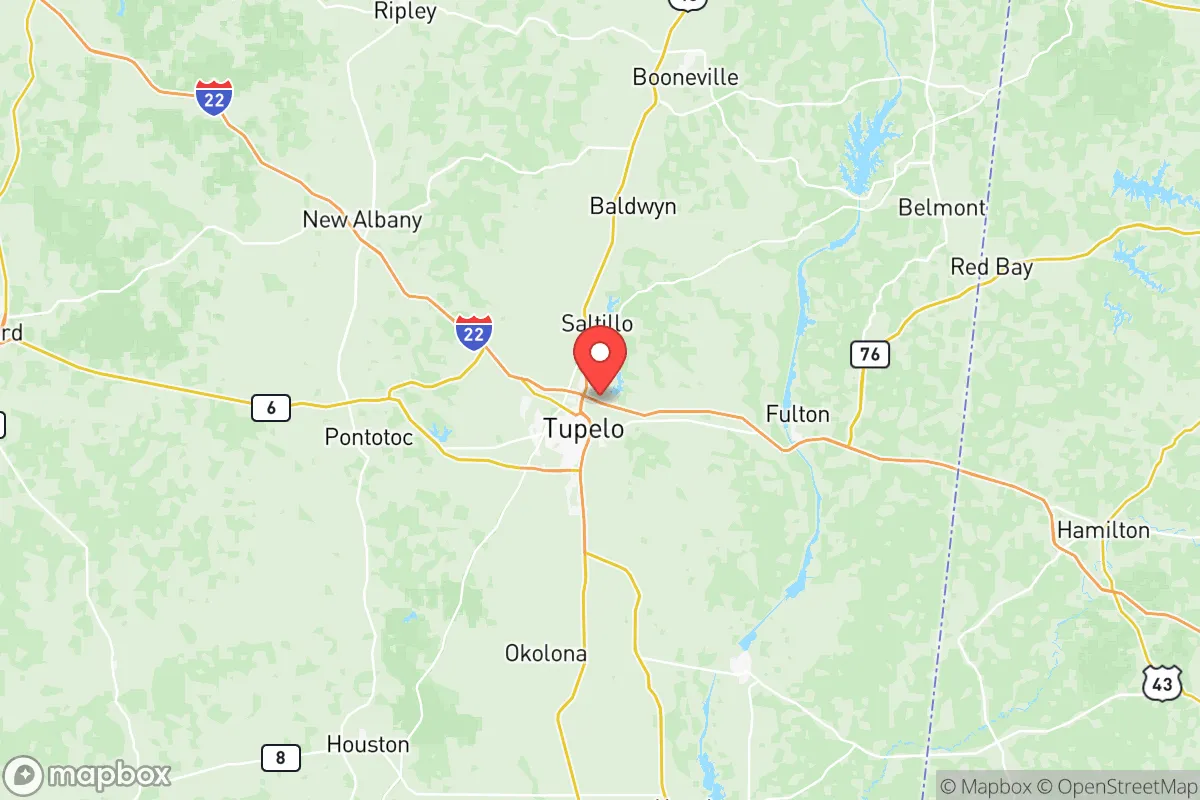
Photo: Wikipedia
Political ClimatePolitical Climate in Lee County
Showing district-level results — no local-only data available.
Local Political AnalysisPolitical Analysis of Lee County
Lee County, Mississippi, is a reliably conservative area with a Cook Partisan Voting Index (PVI) of R+18, making it significantly more Republican than the state as a whole, which sits at R+11. This isn't a recent shift; the county has been a GOP stronghold for decades, driven by a mix of rural values, a strong manufacturing base, and a predominantly white, church-going population. While the county as a whole votes red, there's a noticeable split between the more moderate, slightly more diverse city of Tupelo and the deeply conservative rural precincts in places like Saltillo and Shannon. The overall trajectory is steady—don't expect Lee County to become a swing area anytime soon, though the margins in Tupelo's core precincts have tightened slightly in recent presidential cycles as younger professionals move in.
How it compares
The R+18 rating puts Lee County about seven points to the right of Mississippi's statewide average. That gap is meaningful. In the 2024 presidential election, while Mississippi went for the Republican candidate by roughly 11 points, Lee County delivered a margin closer to 18-20 points. The difference is most visible in the county's rural and suburban precincts. For example, precincts in Guntown and Baldwyn routinely vote 75-80% Republican, while Tupelo's Ward 1 and Ward 2—which include the downtown area and the historically Black neighborhoods near the Fairpark district—can swing closer to 55-60% Democratic. The county's Republican lean is also more pronounced than in neighboring counties like Pontotoc (R+16) or Itawamba (R+15), but less intense than the deep-red rural counties to the north like Prentiss (R+22). What this means is that Lee County is the conservative anchor of northeast Mississippi, but it's not a monolith—Tupelo's status as a regional medical and retail hub brings in a more diverse workforce that keeps the local Democratic Party alive, even if it rarely wins countywide races.
What this means for residents
For conservative residents, the political climate is comfortable and affirming. Local elections are dominated by Republicans, and the county's representation in the state legislature—Senator Chris McDaniel and Representative Jerry Turner, for example—are staunch conservatives. Policy debates in the county tend to focus on economic development, infrastructure, and education funding, with social issues like abortion and gun rights rarely challenged. For liberal residents, the reality is more about finding community within a minority. Tupelo's downtown area and the university-adjacent neighborhoods near the Itawamba Community College campus offer pockets of progressive thought, but running for office as a Democrat in a countywide race is an uphill battle. The practical effect is that most political energy in the county is channeled through the local Chamber of Commerce and economic development councils rather than partisan activism. Both sides tend to agree on keeping taxes low and supporting the Tupelo Public School District, which is a point of pride.
Culturally, Lee County is distinct from the Mississippi Delta or the Gulf Coast. It's part of the hill country, with a strong tradition of self-reliance and a work ethic tied to its manufacturing roots—Toyota's Blue Springs plant and the North Mississippi Medical Center are the two biggest employers. There's a noticeable absence of the plantation-era politics that still haunt the Delta; instead, the local Republican Party is more focused on business-friendly policies and school choice. The county's large evangelical population means that church culture heavily influences social norms, but Tupelo's growing arts scene and the presence of the Elvis Presley birthplace museum give the area a slightly more cosmopolitan edge than its rural neighbors. For anyone moving here, the political climate is stable, predictable, and overwhelmingly conservative, with Tupelo offering the only real counterbalance.

State Political ClimatePolitical Climate in Mississippi
State Political AnalysisPolitical Environment in the State
Mississippi is one of the most reliably Republican states in the country, with a Cook Partisan Voting Index of R+11, meaning it votes about 11 points more Republican than the national average in presidential elections. The state hasn’t voted for a Democratic presidential candidate since Jimmy Carter in 1976, and in 2024, Donald Trump carried it by roughly 17 points over Joe Biden. Over the past 20 years, the GOP’s grip has tightened as white voters in rural and suburban areas have consolidated behind the party, while the state’s large Black population (about 38%) remains overwhelmingly Democratic. The result is a deeply polarized but stable political landscape where Republicans control every statewide office, both chambers of the legislature, and all four U.S. House seats.
Urban vs. rural divide
The political map of Mississippi is a textbook study in urban-rural polarization. The state’s only reliably Democratic strongholds are the majority-Black Delta counties and the capital city of Jackson. In 2024, Hinds County (Jackson) voted about 70% for Joe Biden, while neighboring Madison County—a wealthy, rapidly growing suburb north of Jackson—went about 65% for Trump. The Gulf Coast cities of Biloxi and Gulfport lean Republican but are more competitive, often splitting tickets in local races. The northeastern corner, anchored by Tupelo and Columbus, is solidly red, with Tupelo’s Lee County voting about 70% for Trump in 2024. The Mississippi Delta, including towns like Greenville and Clarksdale, remains the state’s most Democratic region, but its population has been declining for decades, reducing its electoral weight. The fastest-growing areas—the DeSoto County suburbs of Memphis (like Southaven and Olive Branch) and the Madison-Ridgeland corridor—are heavily Republican, pulling the state’s overall lean further right.
Policy environment
Mississippi’s policy environment is among the most conservative in the nation. The state has no individual income tax on wages (phased out by 2026), a flat 4% corporate income tax, and a 7% sales tax on most goods. Property taxes are low, with no state-level property tax and local rates averaging about 0.8% of assessed value. The regulatory posture is business-friendly: Mississippi is a right-to-work state with weak unions and minimal environmental permitting hurdles. Education policy is dominated by school choice: the state has a robust charter school law, a voucher-like Education Scholarship Account program for students with disabilities, and a new universal school choice program passed in 2025 that allows any student to use state funds for private school tuition. Healthcare is a flashpoint: Mississippi has not expanded Medicaid under the Affordable Care Act, leaving about 100,000 low-income adults in a coverage gap. The state has some of the strictest abortion laws in the country, with a near-total ban in effect since the Dobbs decision, including no exceptions for rape or incest. Election laws require a government-issued photo ID to vote, and early voting was expanded in 2024 to allow in-person absentee voting for up to 10 days before an election, though no-excuse mail voting remains unavailable.
Recent policy direction
Over the past five years, Mississippi has moved decisively to the right on nearly every front. In 2024, the legislature passed a permitless carry law, allowing any adult who can legally possess a firearm to carry it concealed or openly without a license. The same year, a parental rights bill was signed requiring schools to notify parents of any curriculum involving sexual orientation or gender identity and to obtain parental consent before a student can change their name or pronouns. On education, the 2025 universal school choice law is the most significant expansion of private school funding in state history. On speech and privacy, Mississippi passed a law in 2023 prohibiting government entities from requiring COVID-19 vaccines or masks, and a 2024 law restricts the use of facial recognition technology by law enforcement without a warrant. Property rights were strengthened by a 2023 law limiting the use of eminent domain for economic development. On voting, the 2024 early voting expansion was a bipartisan compromise, but the state still has some of the shortest early voting windows in the South. The overall direction is toward fewer restrictions on gun ownership, more parental control in schools, lower taxes, and limited government surveillance.
Civil unrest & political movements
Mississippi has a history of civil rights activism, but large-scale protests are rare today. The most visible flashpoint in recent years was the 2020 Black Lives Matter protests in Jackson, which drew hundreds of demonstrators and led to a brief curfew. Since then, organized activism has been more localized: the Mississippi Poor People’s Campaign holds annual rallies at the state capitol, and the NAACP Mississippi State Conference continues to push for Medicaid expansion and voting rights. On the right, the Mississippi Republican Party is dominated by the conservative grassroots, with groups like the Mississippi Tea Party and the Mississippi Center for Public Policy advocating for lower taxes and school choice. Immigration politics are less heated than in border states, but in 2024, the legislature passed a law requiring local law enforcement to cooperate with federal immigration authorities and banning sanctuary city policies. Election integrity remains a live issue: after the 2020 election, the state conducted a forensic audit of its voting machines (finding no irregularities), and in 2023, the legislature passed a law requiring all ballots to be hand-counted in precincts with fewer than 5,000 voters, a move that drew criticism from voting rights groups. Secession or nullification rhetoric is rare but surfaces occasionally in rural county resolutions; no serious movement exists.
Projection
Over the next 5-10 years, Mississippi is likely to become even more Republican, driven by two demographic trends. First, the state’s Black population is slowly declining as younger residents move to Atlanta, Dallas, and other Sun Belt metros, reducing the Democratic base. Second, the fastest-growing counties—DeSoto, Madison, and Rankin—are overwhelmingly white and Republican, attracting retirees and remote workers from higher-tax states. The 2030 redistricting cycle will likely further entrench GOP control of the legislature and congressional map. However, the state’s poverty rate (about 19%, highest in the nation) and low educational attainment could create pressure for more spending on public services, potentially moderating the tax-cut agenda. A new resident moving in now should expect a state that remains deeply conservative on social issues, with low taxes and limited government, but also with significant challenges in healthcare access, infrastructure, and public education. The political climate is stable and predictable—no one expects a Democratic breakthrough in statewide elections anytime soon.
For a new resident, the bottom line is this: Mississippi offers a low-cost, low-regulation environment with a strong conservative tilt that affects everything from gun laws to school choice. If you’re a conservative, you’ll find your values reflected in state policy and a welcoming community in the suburbs of Jackson, the Gulf Coast, or the Memphis exurbs. If you’re a liberal, you’ll find a small but active Democratic base in Jackson and the Delta, but you should expect to be in the minority on most issues. The state’s politics are stable and predictable—what you see now is likely what you’ll get for the next decade, with the conservative majority only growing stronger.
* Values derived from national, state, county, city and local statistics and may differ in a specific area. Last updated: 2026-08-16T15:10:34.000Z
Narrative content on this page is AI-generated and may contain mistakes. Verify any details that matter before acting on them.
ReloMaps may earn a commission from affiliate links at no extra cost to you.

