

Photo: Wikipedia
Political ClimatePolitical Climate in Lauderdale County
Showing district-level results — no local-only data available.
Local Political AnalysisPolitical Analysis of Lauderdale County
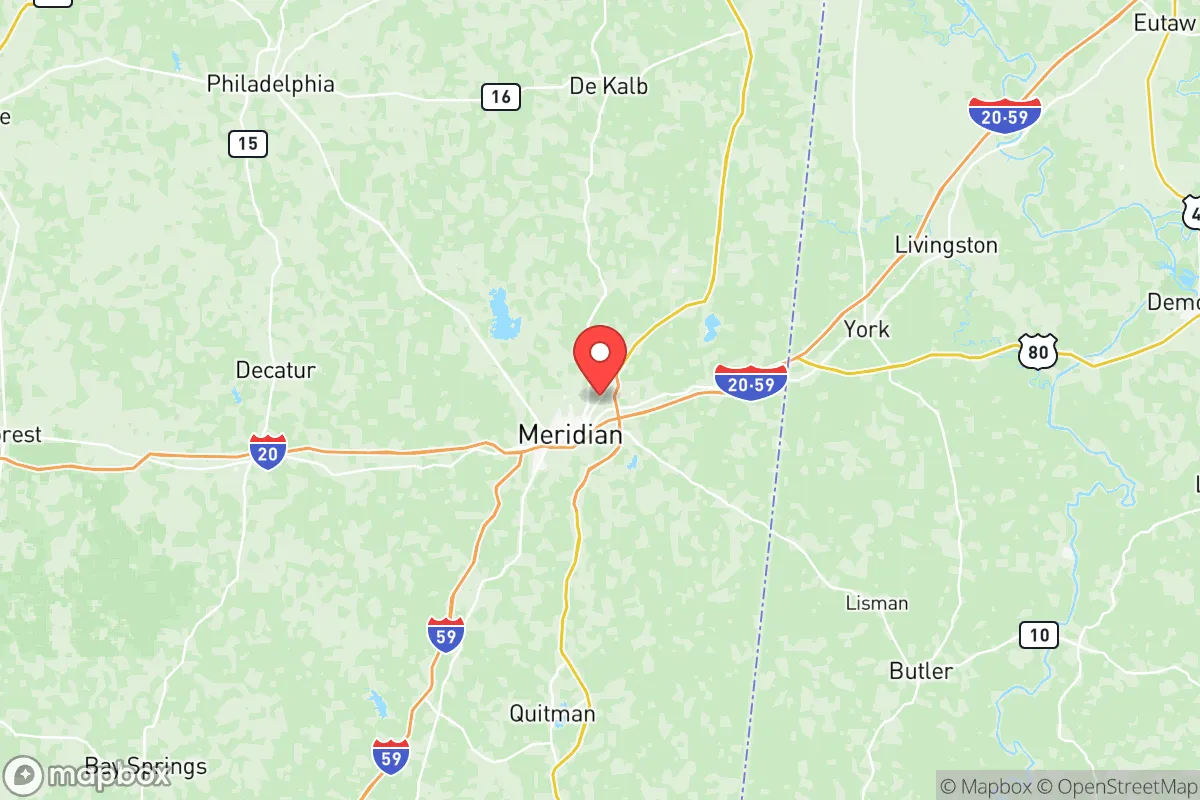
Lauderdale County, Mississippi, is a reliably Republican stronghold with a Cook Partisan Voting Index (PVI) of R+14, meaning it votes about 14 points more Republican than the national average. This is a shade redder than the state of Mississippi as a whole, which sits at R+11, reflecting the county's deeply conservative, rural, and faith-driven electorate. While the county has been trending red for decades, the shift has accelerated since 2016, with the suburbs of Meridian and the smaller towns like Marion and Collinsville solidifying their GOP loyalty, while a handful of precincts in downtown Meridian and around the university campus still lean Democratic.
How it compares to Mississippi
Lauderdale County's R+14 PVI is three points more Republican than the state's R+11, a meaningful gap in a state that is already one of the most conservative in the nation. To put it in perspective, while Mississippi as a whole has a strong Republican lean, Lauderdale County is even more resistant to Democratic inroads. The difference is largely driven by the county's demographics: it has a smaller Black population (roughly 35-40%) than the state average (about 38%), and its white voters, particularly in the rural areas and suburbs, vote overwhelmingly Republican. In contrast, the state's overall R+11 is pulled slightly left by the Mississippi Delta and urban centers like Jackson and Hattiesburg, which have larger Black populations and more Democratic leanings. Within Lauderdale County, the political map is clear: the city of Meridian itself is a battleground, with its northern and western precincts (like those around the historic downtown and the Mississippi State University-Meridian campus) occasionally voting Democratic, while the southern and eastern parts of the county—including the towns of Toomsuba, Bailey, and the sprawling subdivisions near the Naval Air Station Meridian—are deeply red. The county's trajectory is also notable: it has moved rightward faster than the state average since 2000, driven by white flight from the city center and the growing influence of conservative churches and gun rights groups.
What this means for residents
For conservative residents, the R+14 lean means their values are broadly reflected in local governance. The county commission, school board, and most municipal offices are held by Republicans, and issues like lower taxes, Second Amendment rights, and religious freedom are front and center. The local Republican Party is well-organized, with active precinct captains and a strong presence at the county courthouse. For liberal residents, the reality is more challenging. While they have a voice in the city of Meridian's more diverse precincts, they are largely outmatched in countywide elections. Democratic candidates rarely win county-level races, and progressive policy proposals—like expanding public transit or raising the minimum wage—face an uphill battle. However, the county's political climate is not hostile; it's more of a quiet, entrenched conservatism. There's a live-and-let-live attitude in many social settings, but the political discourse is dominated by Fox News, local talk radio, and church bulletins. The Naval Air Station Meridian brings in a transient military population that tends to lean conservative but also values stability and community service, which tempers some of the more extreme partisan rhetoric.
Culturally, Lauderdale County stands apart from Mississippi's more liberal enclaves like Oxford or the Gulf Coast. The county is a hub for the "Bible Belt" ethos, with a high density of Southern Baptist and Methodist churches that shape both social and political life. Policy-wise, the county has been a testing ground for state-level conservative initiatives, such as the 2018 "Mississippi Invitation" law (which allowed religious organizations to deny services based on sexual orientation) and the 2021 "Mississippi Religious Freedom Restoration Act." These laws enjoy broad support in the county, but they also create a cultural divide, particularly for LGBTQ+ residents and their allies. The county's political trajectory suggests it will remain a GOP stronghold for the foreseeable future, with the only real shifts coming from demographic changes—like the slow growth of the Hispanic population in the poultry processing plants around Marion—or from a potential national realignment. For now, Lauderdale County is a place where the political temperature is warm but not boiling, and where most residents, regardless of party, agree on the importance of family, faith, and community.

State Political ClimatePolitical Climate in Mississippi
State Political AnalysisPolitical Environment in the State
Mississippi is one of the most reliably Republican states in the country, with a Cook Partisan Voting Index of R+11, meaning it votes about 11 points more Republican than the national average in presidential elections. The state hasn't voted for a Democratic presidential candidate since Jimmy Carter in 1976, and that trend has only hardened over the past two decades as the white rural electorate has consolidated behind the GOP. However, the state's politics are far from monolithic — a large and politically active Black population, concentrated in the Delta and urban centers, keeps the Democratic Party competitive at the local and legislative level, and the state's overall conservative tilt masks significant internal variation.
Urban vs. rural divide
The political geography of Mississippi breaks down along stark urban-rural and racial lines. The Jackson metro area, anchored by Hinds County, is a Democratic stronghold — Hinds County gave Joe Biden over 80% of the vote in 2020, driven by a majority-Black population and a concentration of government workers, educators, and healthcare professionals. The Gulf Coast, including cities like Biloxi and Gulfport, leans Republican but is more moderate than the rest of the state, with a mix of military retirees, casino workers, and tourism industry employees. The DeSoto County suburbs of Memphis — places like Southaven and Olive Branch — are among the fastest-growing and most reliably Republican areas in the state, with white-collar commuters and families drawn by lower taxes and housing costs. The Mississippi Delta, including Greenville and Clarksdale, is heavily Democratic due to its large Black population, but turnout is lower and economic decline has sapped its political influence. The rest of the state — the Pine Belt, the northeastern hill country around Tupelo, and the southwestern corner near Natchez — is overwhelmingly rural and Republican, with white evangelical voters forming the core of the GOP base. The only county that flipped from Trump to Biden between 2016 and 2020 was Madison County, a wealthy Jackson suburb that has become more diverse and educated; it's a bellwether for where the state might be headed demographically.
Policy environment
Mississippi's policy environment is among the most conservative in the nation. The state has no state income tax on wages — the individual income tax was phased out entirely as of 2026, following legislation passed in 2022. The sales tax is 7%, among the highest in the country, and local options can push it higher. Property taxes are low by national standards, with no state-level property tax and local rates averaging around 0.8% of assessed value. The regulatory posture is business-friendly: Mississippi is a right-to-work state, has no minimum wage above the federal $7.25, and has weak environmental regulations compared to neighboring states. Education policy is dominated by school choice — Mississippi has a robust charter school law, a voucher program for special-needs students, and a new Education Scholarship Account program passed in 2024 that allows families to use public funds for private school tuition. Healthcare is a major weak point: the state did not expand Medicaid under the Affordable Care Act, leaving about 75,000 low-income adults in the coverage gap, and has some of the worst health outcomes in the country. Election laws are restrictive: Mississippi requires a government-issued photo ID to vote, has no early voting (except absentee by mail with an excuse), and has a strict felony disenfranchisement law that bars about 50,000 people from voting. The state legislature, controlled by a supermajority of Republicans, has consistently opposed ballot initiatives and citizen-led lawmaking after the 2020 state Supreme Court ruling that invalidated the state's initiative process.
Recent policy direction
Over the past five years, Mississippi has moved aggressively to expand gun rights, restrict abortion, and limit LGBTQ+ protections. In 2023, the legislature passed permitless carry, allowing any adult who can legally possess a firearm to carry a concealed weapon without a license. Abortion is effectively banned after six weeks under the 2019 Gestational Age Act, with no exceptions for rape or incest; the trigger law that took effect after Dobbs v. Jackson Women's Health in 2022 bans abortion with limited exceptions for life endangerment. Parental rights have been strengthened: the 2023 "Parents' Bill of Rights" requires schools to notify parents of any changes to a student's mental, emotional, or physical health, effectively limiting transgender accommodations. Medical freedom is constrained — Mississippi has some of the strictest vaccine mandates in the South for schoolchildren, but also allows broad religious exemptions. Property rights are strong: the state has no statewide zoning, and eminent domain is rarely used for private development. Privacy and surveillance are relatively unregulated — there is no state law limiting police use of facial recognition or license plate readers. Voting access has tightened: the 2023 law requiring a photo ID for absentee voting was upheld, and the state has resisted automatic voter registration. On the tax front, the 2022 income tax phase-out was the signature achievement of Governor Tate Reeves, and the state is now one of nine with no income tax.
Civil unrest & political movements
Mississippi has a long history of civil rights activism, and that legacy continues today. The Jackson-based organization Mississippi Poor People's Campaign has held regular protests at the state capitol over Medicaid expansion and poverty issues. In 2023, the state saw large demonstrations in Jackson over water infrastructure failures and the state takeover of the Jackson police department. On the right, the Mississippi Republican Party has been factionalized between establishment conservatives and more populist, Trump-aligned activists; the 2023 gubernatorial primary saw a challenge to Reeves from a more conservative candidate. Immigration politics are less heated than in border states — Mississippi has a small foreign-born population (about 2.5%), and there are no sanctuary cities. The state has a 2008 law requiring all employers to use E-Verify, but enforcement is lax. Secession rhetoric is rare but not absent — a 2021 bill to create a "Second Amendment Sanctuary State" passed the House but died in the Senate. Election integrity has been a flashpoint: the 2020 election saw no major controversies in Mississippi, but the state GOP has pushed for stricter voter ID laws and purges of voter rolls. The most visible political flashpoint for newcomers is likely the Confederate flag debate — the state removed the Confederate battle emblem from its flag in 2020 after nationwide protests, but the decision remains controversial in rural areas.
Projection
Over the next 5-10 years, Mississippi is likely to remain solidly Republican, but demographic shifts could slowly moderate its politics. The growth of DeSoto County and the Jackson suburbs is bringing in more college-educated, moderate voters who may push the GOP toward a more suburban-friendly agenda on education and infrastructure. The Black population, which makes up about 38% of the state, is slowly declining as a share due to out-migration, which could weaken the Democratic base. In-migration is modest — Mississippi attracts retirees and remote workers from higher-cost states, but not at the scale of Tennessee or Florida. The biggest wildcard is the state's economic trajectory: if the income tax phase-out and business-friendly policies succeed in attracting investment, the state could see a modest influx of new residents from the Northeast and Midwest, potentially shifting the political center of gravity. However, the state's poor health outcomes, low educational attainment, and high poverty rate are structural drags that will limit growth. For a new resident, the political environment will likely remain very conservative, with the GOP controlling all statewide offices and both chambers of the legislature for the foreseeable future. The Democratic Party will remain competitive only in majority-Black districts and a handful of college towns like Oxford and Starkville.
For someone moving to Mississippi, the bottom line is that you'll be living in a state where conservative values dominate policy and culture. If you're a conservative, you'll find low taxes, strong gun rights, school choice, and a government that generally stays out of your business. If you're a liberal, you'll face a political environment where your views are in the minority, but you'll find like-minded communities in Jackson, the college towns, and the Delta. The practical takeaway is that Mississippi offers a low-cost, low-regulation lifestyle with a strong sense of community, but the trade-offs include limited public services, poor health outcomes, and a political system that moves slowly on change. It's a place where your vote matters less in statewide races but can make a real difference in local elections, especially in the growing suburbs.
* Values derived from national, state, county, city and local statistics and may differ in a specific area. Last updated: 2026-07-29T22:32:40.000Z
Narrative content on this page is AI-generated and may contain mistakes. Verify any details that matter before acting on them.
ReloMaps may earn a commission from affiliate links at no extra cost to you.

