Photo: Wikipedia
Strategic Assessment of Miami Gardens, FL
Multiple tactical vulnerabilities. Population density, target proximity, or disaster risk are likely compounding. A retreat property and exit planning is required.
What does the Strategic Assessment tell us?
Our Strategic Assessment grades tactical survivability of an area. Major population centers, military targets, fallout zones, natural disasters, and border exposure all drive risk — lower exposure means a more defensible position in a crisis.
This is heavily inspired by Joel Skousen's Strategic Relocation book. Highly recommended you checkout the book ($)What does this tell us?
Our Strategic Assessment grades tactical survivability of an area. Major population centers, military targets, fallout zones, natural disasters, and border exposure all drive risk — lower exposure means a more defensible position in a crisis.
This is heavily inspired by Joel Skousen's Strategic Relocation book. Highly recommended you checkout the book ($)Strategic Pillars

Key Distances
Regional Safe Places
Below is our recommended "safe zones" in Florida and the surrounding area based on our strategic heuristics. For most people, it's unrealistic to live in a “safe zone” full-time due to work, family or other personal reasons. They tend to be more rural. However, many of these areas are perfect for second homes and retreat properties that double as a vacation home or even a short-term rental.

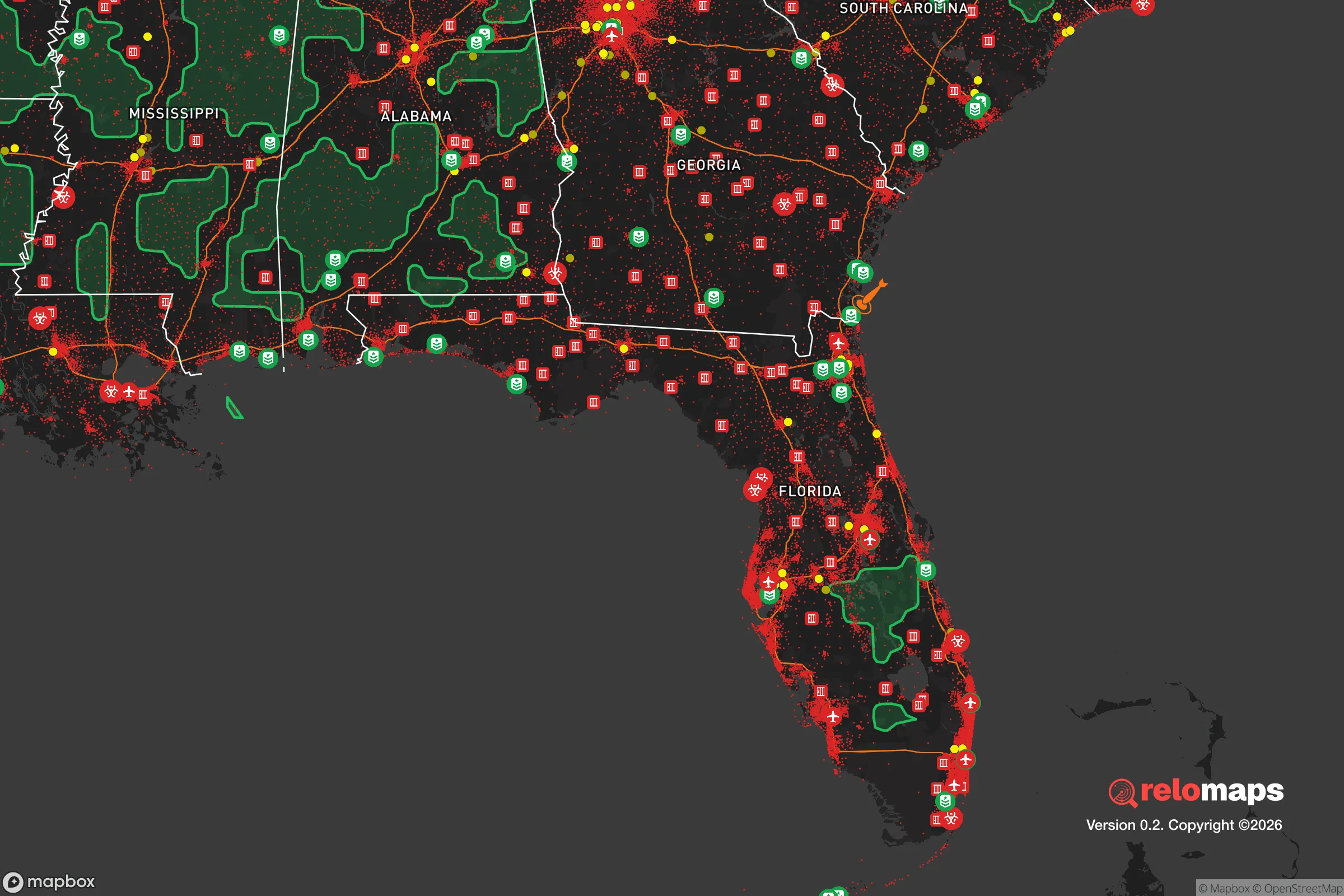


Important Note: For informational purposes only. This does not mean nothing bad ever happens in the green zones. Please use common sense. This is based on public data and modeled with AI. We tried to take a conservative approach but mistakes happen. We update this regularly as new information becomes available.
Solar Generator Recommendations
Backup power matters more here than in safer locations. We've picked three solar generators across budgets and capacity tiers — start with the budget unit if you only need a few essentials, or step up if you want to run a fridge and HVAC for days at a time.

Jackery Portable Power Station Explorer 300
Budget OptionPower on the Go: Weighing only 11 lbs, it's convenient to set up and store with book-sized foldable solar panels

BLUETTI Portable Power Station AC180
Designed for both indoor and outdoor scenarios, AC180 is highly capable as it has a robost capacity and continuous output power.

EF ECOFLOW DELTA Pro Ultra Power Station
Upgraded PickEcoFlow DELTA Pro Ultra is a whole-home energy system designed to grow with your family. Integrated with the Smart Home Panel 2, it scales to meet your evolving energy needs — keeping your home powered, intelligent, and secure through every stage of life.
We earn a commission, at no additional cost to you.
Strategic Assessment Analysis
Miami Gardens, Florida, presents a complex strategic picture for the conservative prepper or survivalist. While its location in the southeastern corner of the state offers some natural advantages—chiefly a subtropical climate and access to water—its position within the densely populated Miami metropolitan area introduces significant vulnerabilities. For a relocator prioritizing resilience against civic unrest, mass casualty events, and large-scale disasters, this city is best understood as a high-risk, high-reward outpost that demands a very specific, self-reliant mindset. The core trade-off is between the region's inherent resource abundance and its extreme exposure to population-density-driven collapse scenarios.
Geographic position and natural advantages for long-term survival
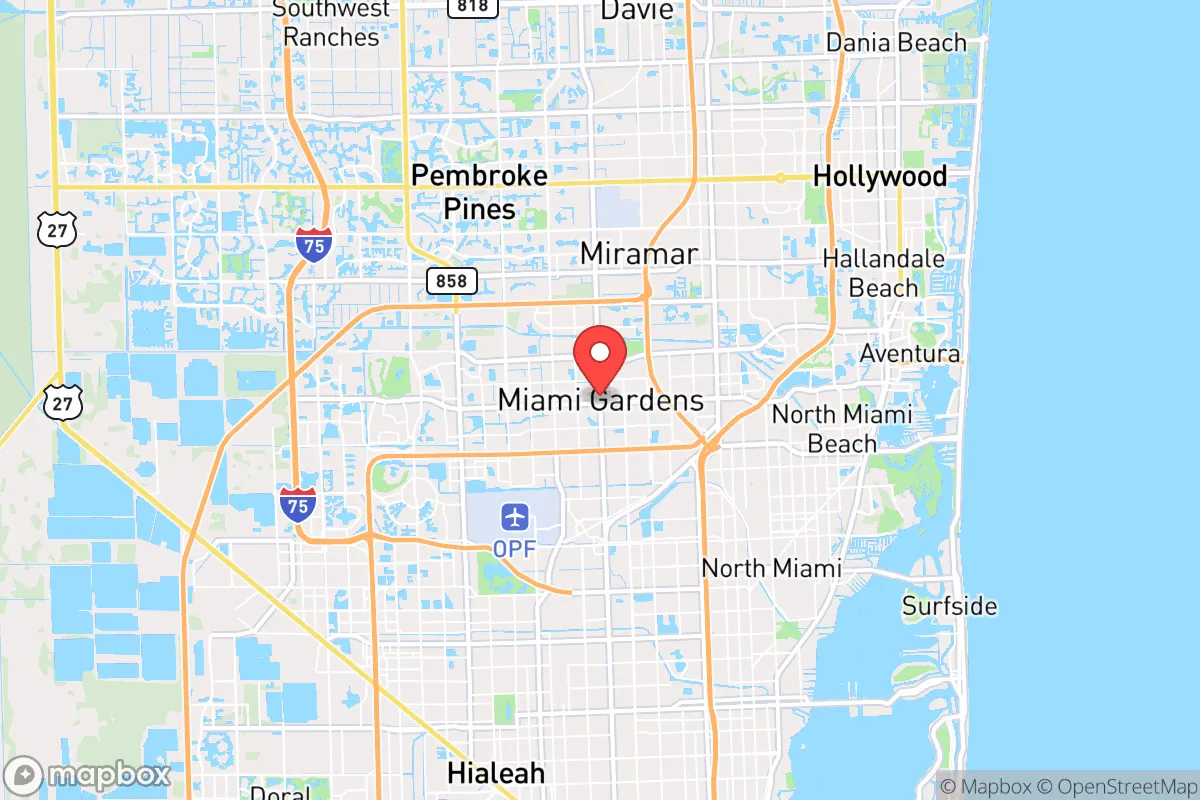
Miami Gardens sits on the Atlantic Coastal Plain, roughly 12 miles northwest of downtown Miami and about 10 miles west of the Atlantic Ocean. Its primary natural advantage is the subtropical climate, which allows for year-round food production. With an average of 248 sunny days per year and a growing season that never truly ends, a relocator can maintain a productive garden—including staples like sweet potatoes, beans, and citrus—without the freeze risks of northern states. The area's flat topography also means no mountainous barriers to movement, though this same flatness creates drainage challenges. The Biscayne Aquifer lies directly beneath the region, providing a shallow, accessible freshwater source, but it is also highly vulnerable to saltwater intrusion and contamination from storm surge. For the prepper, this means rainwater catchment and deep-well drilling are not optional—they are critical infrastructure. The proximity to the Everglades, about 15 miles west, offers a vast, sparsely populated buffer zone for hunting, foraging, and emergency retreat, but it also harbors wildlife (alligators, snakes, mosquitoes) that require respect and preparation.
Risks, exposures, and proximity to fallout-relevant landmarks
The most glaring vulnerability is Miami Gardens' location within the sixth-largest metropolitan area in the United States, with over 6 million people in the greater Miami region. In a scenario of civic unrest, mass casualty events, or a breakdown of supply chains, this density becomes a liability. The city is bordered by major highways—the Florida Turnpike, I-95, and SR 826—which would become chokepoints or escape corridors during an evacuation, but also vectors for looting and hostile movement. Proximity to Miami International Airport (MIA) and PortMiami, both high-value targets for terrorism or logistical collapse, means that any disruption at these nodes would ripple directly into Miami Gardens. Additionally, the area is within the fallout zone of the Turkey Point Nuclear Generating Station, located about 25 miles south. While not an immediate blast danger, a catastrophic failure (e.g., from a hurricane or sabotage) could render large swaths of South Florida uninhabitable for weeks. The city's low elevation—averaging just 10 feet above sea level—also makes it susceptible to storm surge from hurricanes, which can push seawater miles inland, contaminating freshwater supplies and destroying infrastructure. For the conservative relocator, these factors argue against relying on Miami Gardens as a primary bug-out location; it is better suited as a temporary base with a pre-planned inland retreat route.
Practical resilience for a relocator: food, water, energy, and defensibility
Self-sufficiency in Miami Gardens requires a proactive, layered approach. Food is the easiest challenge to address: the climate supports year-round gardening, and local farmers' markets (e.g., the one at the Miami Gardens Farmers Market) provide fresh produce, but a prepper should establish a permaculture system with fruit trees (mango, avocado, banana) and a chicken coop for eggs and meat. Water is the critical vulnerability. Municipal water comes from the Biscayne Aquifer, but treatment plants are vulnerable to power loss and contamination. A minimum of 55 gallons of stored water per person is recommended, plus a Berkey or similar gravity-fed filter for surface water. Rainwater harvesting is viable, but roofs must be kept clean of debris and bird droppings. Energy is a mixed bag: the grid is prone to outages during hurricanes (often lasting days to weeks), so a solar panel system with battery storage (e.g., a 5kW setup) is essential. Natural gas is available in parts of the city, but a propane backup generator is more reliable. Defensibility is the weakest link. Miami Gardens is a suburban grid of single-family homes and townhouses, with many properties on small lots. Hardening a home with reinforced doors, window bars, and a secure perimeter is necessary, but the lack of natural terrain for cover means that a determined group could overwhelm a single residence. The best strategy is to form a neighborhood watch or mutual assistance group with like-minded neighbors—a "tribe" of 3-5 families who share resources and security duties. The city's diverse population (over 75% Black or African American, with a large Hispanic community) means that a conservative prepper must build trust across cultural lines, which is possible but requires genuine community engagement, not isolation.
The overall strategic picture for Miami Gardens is one of calculated risk. It offers a warm-weather base with strong food-growing potential and access to the Everglades for retreat, but it sits in a high-density, low-elevation zone with significant exposure to hurricane, nuclear, and civil unrest threats. For the single individual or family willing to invest in robust water storage, off-grid energy, and a hardened home, it can serve as a temporary staging area—not a permanent fortress. The conservative relocator should view Miami Gardens as a "watchtower" location: close enough to monitor urban trends, but with a pre-planned bug-out route to a more defensible inland property (e.g., in the Lake Okeechobee region or the Florida Panhandle). The key takeaway is that resilience here depends entirely on preparation; without a deep well, solar power, and a trusted local network, the city's advantages are quickly outweighed by its vulnerabilities. For those willing to do the work, it can be a viable base in a region that will remain strategically important—but it is not a place for passive survival.

* Values derived from national, state, county, city and local statistics and may differ in a specific area. Last updated: 2026-05-03T05:02:52.000Z
Narrative content on this page is AI-generated and may contain mistakes. Verify any details that matter before acting on them.
ReloMaps may earn a commission from affiliate links at no extra cost to you.

