Photo: Wikipedia
Demographics of Mcpherson, KS
Affluence Level in Mcpherson, KS
A middle-class area roughly in line with national averages across income, home values, education, and employment.
People of Mcpherson, KS
The people of McPherson, Kansas today number 13,956, forming a community that is 85.7% white, with a notable 7.2% Hispanic population and a small but established East/Southeast Asian presence at 1.4%. The city is characterized by a strong sense of civic identity rooted in its Swedish Lutheran heritage and a modern economic stability driven by manufacturing and healthcare. With 35.9% of adults holding a college degree—well above the national average for a city its size—McPherson’s population is both educated and relatively homogenous, though it is slowly diversifying. The foreign-born share stands at 3.3%, a figure that reflects modest but steady immigration, primarily from Latin America and East Asia.
How the city was settled and grew
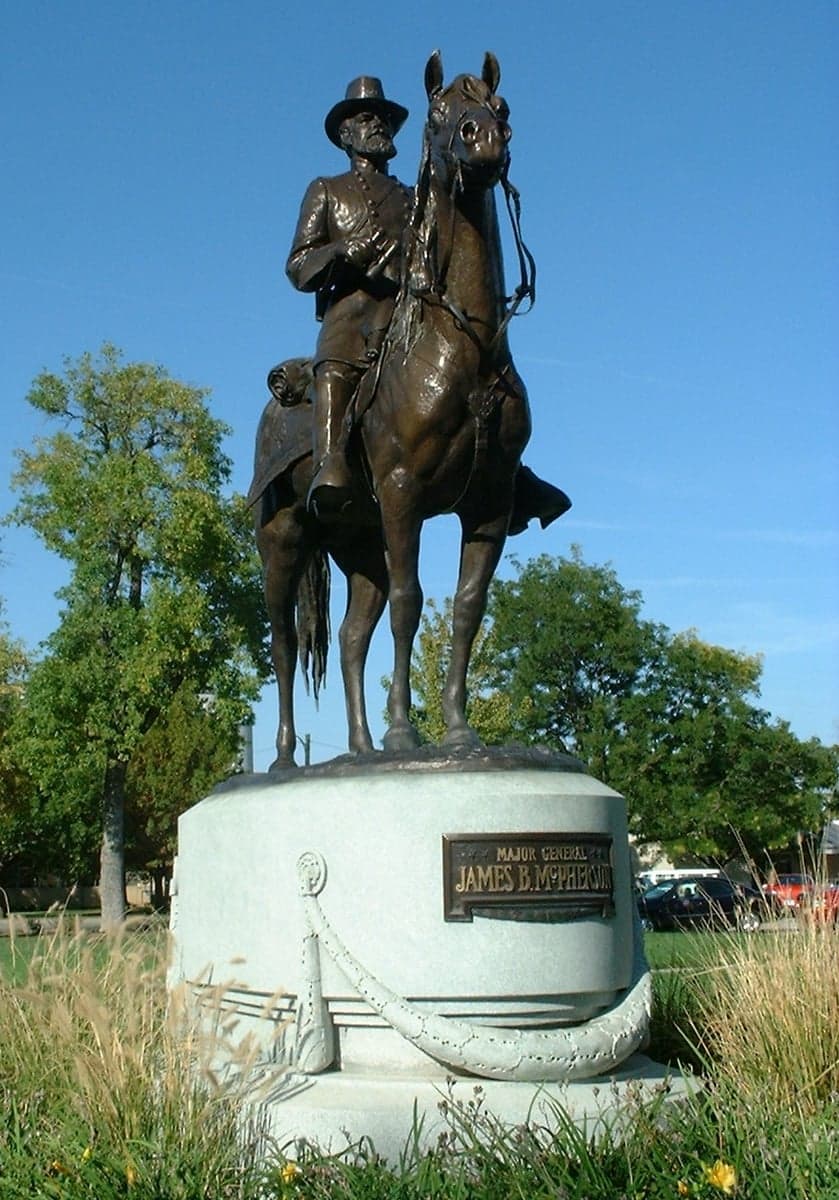
McPherson was founded in 1872 as a railroad town on the plains, named after Union General James B. McPherson. The original settlers were largely Anglo-American homesteaders drawn by the promise of cheap land under the Homestead Act, but the defining population wave arrived in the 1880s: Swedish immigrants fleeing crop failures and religious persecution in Scandinavia. These Swedes, many of whom were Lutherans, built the core of the city around Main Street and the area now known as Old Town McPherson, establishing churches, a college (McPherson College, founded 1887 by the Church of the Brethren), and a tight-knit ethnic enclave. A secondary wave of German-Russian Mennonites, who brought Turkey Red wheat to Kansas, settled in the surrounding farmlands and in the South Central neighborhood near the railroad tracks. By 1900, the city was a thriving agricultural service center, with a population that was overwhelmingly white, Protestant, and Midwestern. The oil boom of the 1920s and 1930s brought a small influx of workers from Oklahoma and Texas, who settled in the West Side near the oil fields, but the Swedish cultural imprint remained dominant through the mid-20th century.
Modern era (post-1965)
After the 1965 Hart-Cellar Act, McPherson saw only a trickle of new immigration, unlike larger Kansas cities. The Hispanic population began to grow in the 1980s and 1990s, driven by labor demand in the city’s expanding manufacturing sector—companies like McPherson Manufacturing and Parker Hannifin recruited workers from Texas and Mexico. These families concentrated in the East Side and Northview neighborhoods, where affordable housing and proximity to industrial jobs created a distinct working-class corridor. The East/Southeast Asian community, primarily of Vietnamese and Filipino origin, arrived in two small waves: first as refugees after the Vietnam War in the late 1970s, and later as skilled workers for the local medical and engineering sectors in the 2000s. They settled mostly in the College Hill area near McPherson College and the hospital. The Black population, at 2.2%, is largely composed of families who moved from Wichita and other Kansas cities for manufacturing jobs in the 1990s, with a small cluster in the South Central neighborhood. The Indian-subcontinent population (0.1%) is negligible, consisting of a handful of professionals at the local hospital and college. Suburbanization within city limits has been minimal; most growth has occurred in the West Side and Northview subdivisions, which have attracted white families from rural areas seeking better schools and amenities.
The future
McPherson’s population is projected to remain stable or grow slowly, with the white share gradually declining as the Hispanic and East/Southeast Asian communities age and have higher birth rates. The city is not tribalizing into distinct ethnic enclaves; rather, the Hispanic and Asian populations are assimilating into the broader community, with second-generation families moving into traditionally white neighborhoods like College Hill and West Side. The foreign-born share (3.3%) is likely to plateau, as McPherson lacks the large-scale immigration networks found in Wichita or Kansas City. The biggest demographic shift will come from domestic in-migration: young families and retirees from rural Kansas, drawn by the city’s low crime rate, strong schools, and stable economy. Over the next 10–20 years, McPherson will likely become slightly more diverse but remain a predominantly white, Midwestern community with a strong Lutheran and manufacturing identity.
For someone moving in now, McPherson offers a stable, safe, and culturally cohesive environment where newcomers are welcomed but expected to integrate into existing community norms. The city is not a melting pot in the traditional sense, but a place where modest diversity is absorbed into a dominant white, conservative, and church-going culture. The population is heading toward a slow, organic diversification rather than rapid change, making it an attractive option for those seeking a predictable, family-oriented community with a clear sense of its own history.

* Values derived from national, state, county, city and local statistics and may differ in a specific area. Last updated: 2026-05-01T01:26:28.000Z
Narrative content on this page is AI-generated and may contain mistakes. Verify any details that matter before acting on them.
ReloMaps may earn a commission from affiliate links at no extra cost to you.

