Photo: Wikipedia
Demographics of Mcdonough, GA
Affluence Level in Mcdonough, GA
A below-average socioeconomic profile. Incomes, home values, and educational attainment trail the U.S., with higher poverty and unemployment.
People of Mcdonough, GA
The people of McDonough, Georgia today form a predominantly Black (72.5%) and family-oriented community of 30,056, with a modest 4.9% foreign-born share and a 27.4% college-educated rate that trails the national average. The city’s identity is rooted in its role as the Henry County seat, blending small-town Southern character with the rapid suburban expansion of metro Atlanta’s southern crescent. Residents are notably younger than the state median, and the population is overwhelmingly native-born, giving McDonough a stable, multigenerational feel where church, school, and local government anchor daily life.
How the city was settled and grew
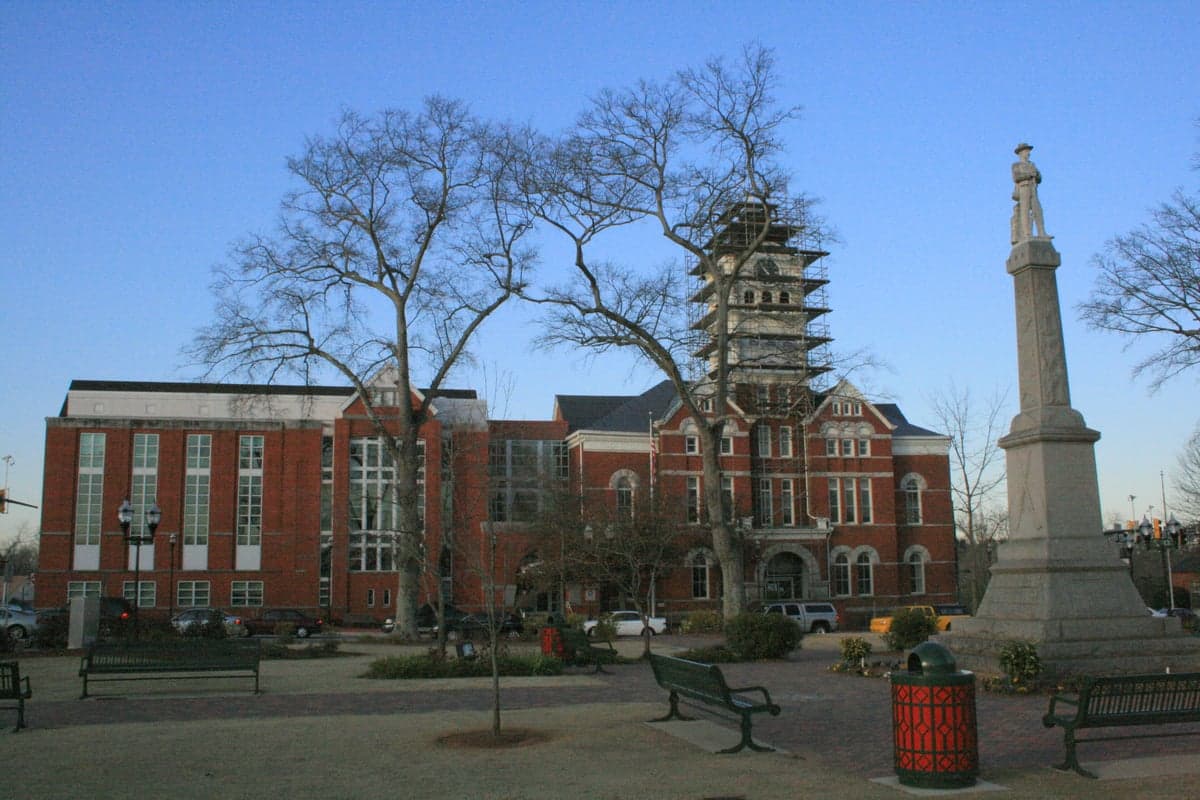
McDonough was founded in 1823 as the county seat of newly formed Henry County, named after naval hero Commodore Thomas Macdonough. The original settlers were primarily yeoman farmers and small-scale planters from the Upper South—Virginia, North Carolina, and Tennessee—drawn by the Georgia Land Lotteries of the 1820s, which distributed former Creek territory in 202.5-acre lots. These early families built the town around the central square, with the historic McDonough Square serving as the commercial and civic hub. The arrival of the Macon & Western Railroad in the 1840s turned McDonough into a cotton-shipping depot, attracting a small but steady influx of merchants, lawyers, and tradesmen. By the late 19th century, the Old Towne district (the blocks immediately surrounding the square) held a mix of white and Black residents, the latter mostly working as sharecroppers, domestic laborers, and railroad hands. The post-Reconstruction era saw the establishment of Racetrack (a historically Black neighborhood southeast of the square), where African American families built churches, schools, and mutual-aid societies. The city remained a quiet agricultural center through the 1950s, with population hovering around 2,000 and little change in its racial composition—roughly 60% white, 40% Black—until the mid-20th century.
Modern era (post-1965)
The 1965 Hart-Cellar Act had a minimal direct effect on McDonough; the city’s foreign-born population today is just 4.9%, and the vast majority of that growth came after 2000. The real demographic transformation began in the 1970s and accelerated through the 1990s as metro Atlanta’s suburban sprawl pushed south along Interstate 75. White flight from Atlanta proper and northern suburbs brought middle-class white families to new subdivisions like Eagle’s Landing (a golf-course community developed in the 1980s) and Heritage Hills, which attracted commuters working in Atlanta’s corporate and logistics sectors. Simultaneously, Black families—many moving from Clayton County and south Atlanta—settled in established neighborhoods like Racetrack and newer subdivisions such as Fairview and Mount Carmel. By 2010, McDonough had become majority-Black, a shift driven by continued Black in-migration and white out-migration to exurban counties like Spalding and Butts. The Hispanic share (8.1%) grew modestly after 2000, concentrated in the West McDonough area near the industrial parks and warehouse corridors along I-75, where construction and logistics jobs drew Mexican and Central American workers. East/Southeast Asian residents (1.8%) are a small but visible presence, with families settling in newer subdivisions near the East Lake area, often drawn by the school system and affordable housing. The Indian-subcontinent population is effectively zero, and Arab residents are statistically negligible.
The future
McDonough’s population is likely to continue growing as metro Atlanta’s southern expansion pushes further into Henry County, but the city is not homogenizing—it is becoming more distinctly Black-majority and native-born. The white share (13.1%) is projected to decline further as older white residents age out and younger white families choose exurban or rural alternatives. The Hispanic share may rise slowly, driven by natural increase and continued labor demand in warehousing and distribution, but McDonough lacks the immigrant gateway infrastructure (ethnic churches, bilingual services, dense social networks) that would accelerate growth. East/Southeast Asian communities are expected to remain a small, stable presence, concentrated in higher-amenity subdivisions. The most significant trend is the deepening of Black middle-class and working-class identity: neighborhoods like Racetrack and Fairview are seeing reinvestment from younger Black families, while Eagle’s Landing is gradually diversifying as older white homeowners sell. The city’s future is one of steady, majority-Black suburban stability—not a melting pot, but a place where a single demographic group increasingly defines the civic and cultural tone.
For a conservative-leaning individual or family moving in now, McDonough offers a predominantly Black, native-born, family-centric environment with strong local institutions and a slow-growth, low-immigration character. The city is becoming more demographically uniform, not more diverse, and the next decade will likely reinforce its identity as a Black-majority Southern suburb where church, school, and community ties matter more than ethnic variety. This is a place for those who want stable, predictable demographic trends and a community that looks and feels like the people who have lived there for generations.

* Values derived from national, state, county, city and local statistics and may differ in a specific area. Last updated: 2026-05-04T02:45:53.000Z
Narrative content on this page is AI-generated and may contain mistakes. Verify any details that matter before acting on them.
ReloMaps may earn a commission from affiliate links at no extra cost to you.

