Photo: Wikipedia
Demographics of Maplewood, MN
Affluence Level in Maplewood, MN
A middle-class area roughly in line with national averages across income, home values, education, and employment.
People of Maplewood, MN
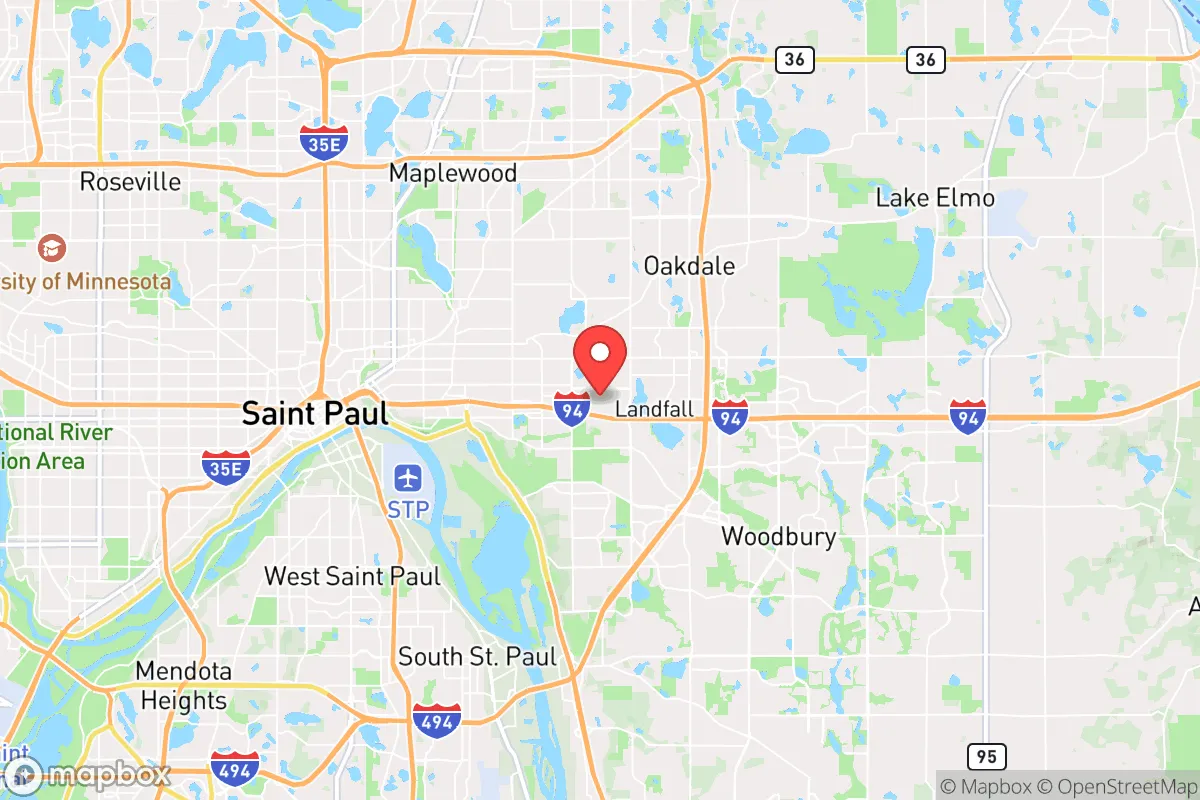
Maplewood, Minnesota, is a first-ring suburb of St. Paul with 40,981 residents, characterized by a dense, established feel and a notably diverse population that has shifted dramatically from its nearly all-white mid-century roots. Today, the city is a majority-minority community where East and Southeast Asian residents make up 21.6% of the population—the largest such concentration in Ramsey County outside of St. Paul itself—alongside a 53.3% white, 9.5% Hispanic, and 8.6% Black population. The city’s identity is shaped by its post-war housing stock, strong public schools, and a growing sense of distinct ethnic enclaves rather than a single melting-pot culture.
How the city was settled and grew
Maplewood’s original population was overwhelmingly white and of Northern European descent, drawn by the promise of affordable farmland and later by the expansion of the Twin Cities’ industrial base. The area was originally part of the St. Paul city limits until the 1880s, when it was annexed by North St. Paul and then gradually developed as a separate township. The first major wave of settlement came in the 1910s and 1920s, when German and Swedish farmers established homesteads along what is now Larpenteur Avenue and Gladstone Street, building the modest frame houses that still line the Gladstone neighborhood. A second wave arrived during the post-World War II boom, when returning GIs and their families bought newly built ramblers and split-levels in the Frost Lake and Carver neighborhoods, drawn by the construction of the 3M headquarters in 1951 and the opening of Maplewood Mall in 1974. By 1960, the city was 99.5% white, with a population of just over 18,000.
Modern era (post-1965)
The 1965 Hart-Cellar Act opened the door for a new wave of immigration that would fundamentally reshape Maplewood’s population. The first non-white arrivals were Hmong refugees from Laos, who began resettling in the Frost Lake and Gladstone neighborhoods in the late 1970s and 1980s, drawn by affordable housing and the presence of Hmong-led social service agencies in nearby St. Paul. By 2000, the Hmong community had grown to roughly 15% of the city’s population, concentrated in the older, denser housing stock east of White Bear Avenue. A second Asian wave followed in the 1990s and 2000s, with Karen refugees from Myanmar and Vietnamese families settling in the Carver and Larpenteur Hills areas, often in the same duplexes and apartment complexes that had housed earlier white working-class families. The Hispanic population, now 9.5%, grew more slowly, with Mexican and Central American families moving into the Gladstone and Frost Lake neighborhoods starting in the 2000s, often working in construction and service jobs. The Black population, at 8.6%, includes both African American families moving from St. Paul and a smaller number of East African immigrants, concentrated in the Frost Lake area. The white population declined from 80% in 1990 to 53.3% today, with many older white residents aging in place in the Carver and Larpenteur Hills neighborhoods while younger white families have largely bypassed Maplewood for outer-ring suburbs.
The future
Maplewood’s population is heading toward greater ethnic consolidation rather than homogenization. The East and Southeast Asian share, already the largest in the metro outside St. Paul, is projected to grow as Hmong and Karen families continue to have higher birth rates and as secondary migration from other states brings more families to the established enclaves in Frost Lake and Gladstone. The white population is expected to continue its slow decline, dropping below 50% within the next decade, as older homeowners pass away or sell to Asian and Hispanic buyers. The Hispanic share is growing steadily but remains smaller than in neighboring suburbs like West St. Paul. The Indian subcontinent population remains tiny at 0.8%, with no signs of a significant influx. The city is not tribalizing into hostile camps, but distinct ethnic neighborhoods are solidifying: Frost Lake is increasingly Hmong and Karen, Gladstone is a mix of Hmong and Hispanic families, and Carver and Larpenteur Hills remain predominantly white and older. The public schools, particularly Frost Lake Elementary and Maplewood Middle School, are now majority non-white, with significant English-language learner populations.
For a conservative-leaning family or individual moving to Maplewood today, the city offers a stable, affordable, and increasingly diverse suburban environment where ethnic enclaves provide strong community ties but also create distinct cultural and linguistic boundaries. The population is not shrinking or in decline, but it is becoming more segmented by origin and generation, with the Asian communities growing and the white population aging. The bottom line: Maplewood is a solid, middle-class suburb that has successfully absorbed multiple immigrant waves, but it is no longer the homogeneous, 3M-employee suburb of the 1960s—it is a place where newcomers should expect to live alongside neighbors from very different backgrounds, particularly in the eastern and central neighborhoods.

* Values derived from national, state, county, city and local statistics and may differ in a specific area. Last updated: 2026-04-19T04:24:20.000Z
Narrative content on this page is AI-generated and may contain mistakes. Verify any details that matter before acting on them.
ReloMaps may earn a commission from affiliate links at no extra cost to you.

