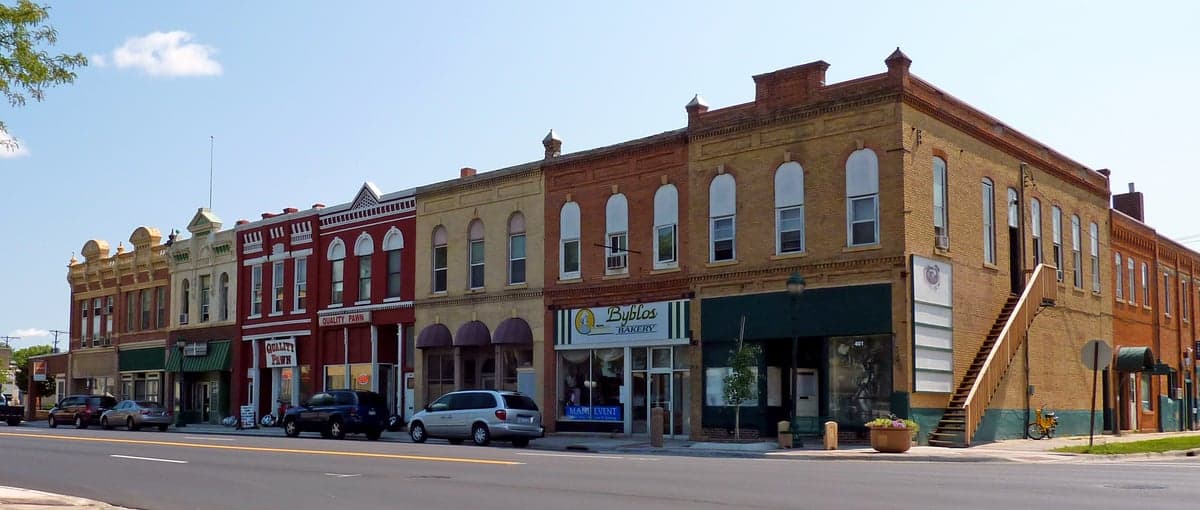
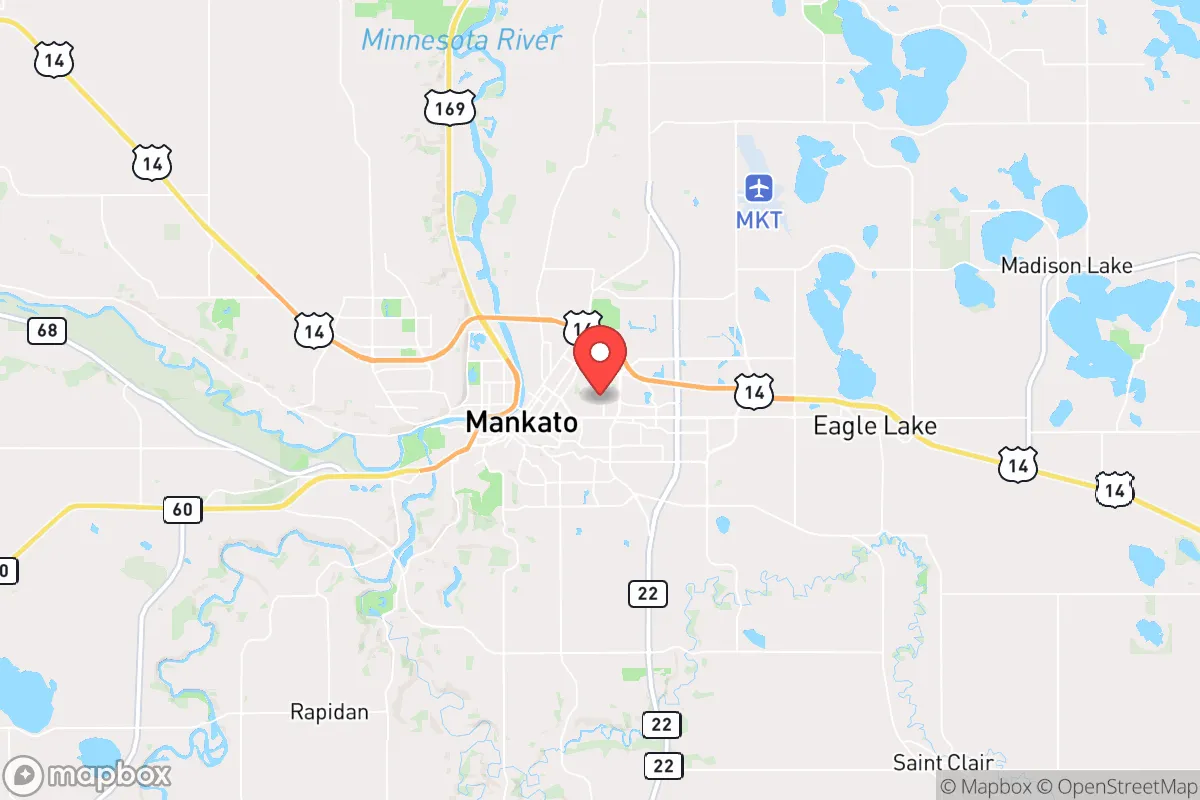
Photo: Wikipedia
Demographics of Mankato, MN
Affluence Level in Mankato, MN
A middle-class area roughly in line with national averages across income, home values, education, and employment.
People of Mankato, MN
The people of Mankato, Minnesota today number 44,882, forming a city that is 81.5% white and notably more diverse than much of south-central Minnesota. With a foreign-born population of 4.7% and a college-educated rate of 36.2%, Mankato’s character blends a historic Scandinavian and German agricultural base with a growing professional class tied to Minnesota State University, Mankato (MSU) and regional healthcare. The city’s identity is shaped by its role as a regional hub—denser and more ethnically varied than surrounding rural towns, yet distinctly more conservative than the Twin Cities metro.
How the city was settled and grew
Mankato’s founding population arrived in the 1850s, drawn by the confluence of the Minnesota and Blue Earth Rivers as a natural transportation and milling center. The original settlers were overwhelmingly Yankee and German immigrants, with the first wave of German Catholics and Lutherans establishing farms and businesses along what is now Riverfront Drive and the Old Town district near the riverbanks. The Dakota people, who had inhabited the area for centuries, were forcibly removed after the U.S.-Dakota War of 1862, a trauma that cleared the way for rapid Euro-American settlement. By the 1870s, Swedish and Norwegian immigrants arrived in large numbers, settling in the Lincoln Park neighborhood and the working-class blocks south of Main Street, where they built the area’s first Lutheran churches and ethnic social halls. The city’s growth through the early 20th century was driven by limestone quarrying, flour milling, and the arrival of the railroad, which cemented Mankato as a commercial center. The Highland Park area, developed in the 1910s and 1920s, became home to the city’s upwardly mobile second-generation German and Scandinavian families, while the Vernon Center area remained more rural and agricultural.
Modern era (post-1965)
After the 1965 Hart-Cellar Act, Mankato’s population began a slow diversification, though the city remained overwhelmingly white through the 1990s. The most significant modern shift came from domestic in-migration: the expansion of MSU and the Mayo Clinic Health System in the 1980s and 1990s drew professionals from across the Midwest, many of whom settled in the Eagle Lake and North Mankato suburbs. These areas, developed as bedroom communities, remain predominantly white and family-oriented. The city’s Black population, now 6.7%, grew primarily through African American families moving from Chicago and Minneapolis for manufacturing and healthcare jobs, concentrating in the West Mankato neighborhoods near the industrial corridor along Highway 169. The Hispanic population, at 5.3%, is largely Mexican-American, with families arriving in the 1990s and 2000s for work in food processing and construction; they are most visible in the South Mankato area near the river. East and Southeast Asian communities (2.5%) are predominantly Hmong and Vietnamese, many resettled through refugee programs in the 1980s and 1990s, with a notable cluster near MSU’s campus. The Indian subcontinent population (1.0%) is newer, largely tied to MSU’s graduate programs and tech-sector jobs, and is dispersed rather than concentrated in a single neighborhood.
The future
Mankato’s population is trending toward modest diversification, but the pace is slow. The white share, while still dominant, is declining gradually as the city’s Hispanic and Black populations grow through both births and continued in-migration. The foreign-born share, at 4.7%, is below the national average but rising, driven by MSU’s international student programs and healthcare recruitment. The city is not tribalizing into stark ethnic enclaves—most neighborhoods remain mixed, with the exception of the more homogeneous suburban tracts in North Mankato and Eagle Lake. The next 10–20 years will likely see Mankato become slightly more diverse, with the Hispanic and Black populations each approaching 8–10%, while the white population drops to the mid-70% range. The Indian and East/Southeast Asian populations are expected to plateau as MSU’s enrollment stabilizes. The city’s character will remain that of a regional hub—more conservative than the Twin Cities, but more liberal than the surrounding farm counties—with a growing professional class and a stable, if slowly diversifying, population base.
For someone moving in now, Mankato offers a community that is still predominantly white and culturally Midwestern, but with visible and growing Hispanic, Black, and Asian threads. It is not a melting pot in the big-city sense, but a place where distinct groups coexist within a shared regional identity. The city’s future is one of gradual demographic change, not rapid transformation, making it a stable choice for families and professionals seeking a smaller city with a solid economic base and a predictable social environment.

* Values derived from national, state, county, city and local statistics and may differ in a specific area. Last updated: 2026-04-24T12:27:15.000Z
Narrative content on this page is AI-generated and may contain mistakes. Verify any details that matter before acting on them.
ReloMaps may earn a commission from affiliate links at no extra cost to you.

