Photo: Wikipedia
Demographics of Malibu, CA
Affluence Level in Malibu, CA
A wealthy area with high-earning, well-educated households. Incomes, home values, and educational attainment meaningfully outpace national averages.
People of Malibu, CA
The people of Malibu, California, today number roughly 10,500, forming a community that is notably affluent, highly educated, and predominantly white. With 71.6% of adults holding a college degree and a foreign-born population of just 3.9%, the city stands as one of the least ethnically diverse coastal communities in Los Angeles County. Its identity is shaped by a unique blend of celebrity seclusion, environmental activism, and a fiercely protected small-town character, where residents prioritize privacy and open space over commercial development.
How the city was settled and grew
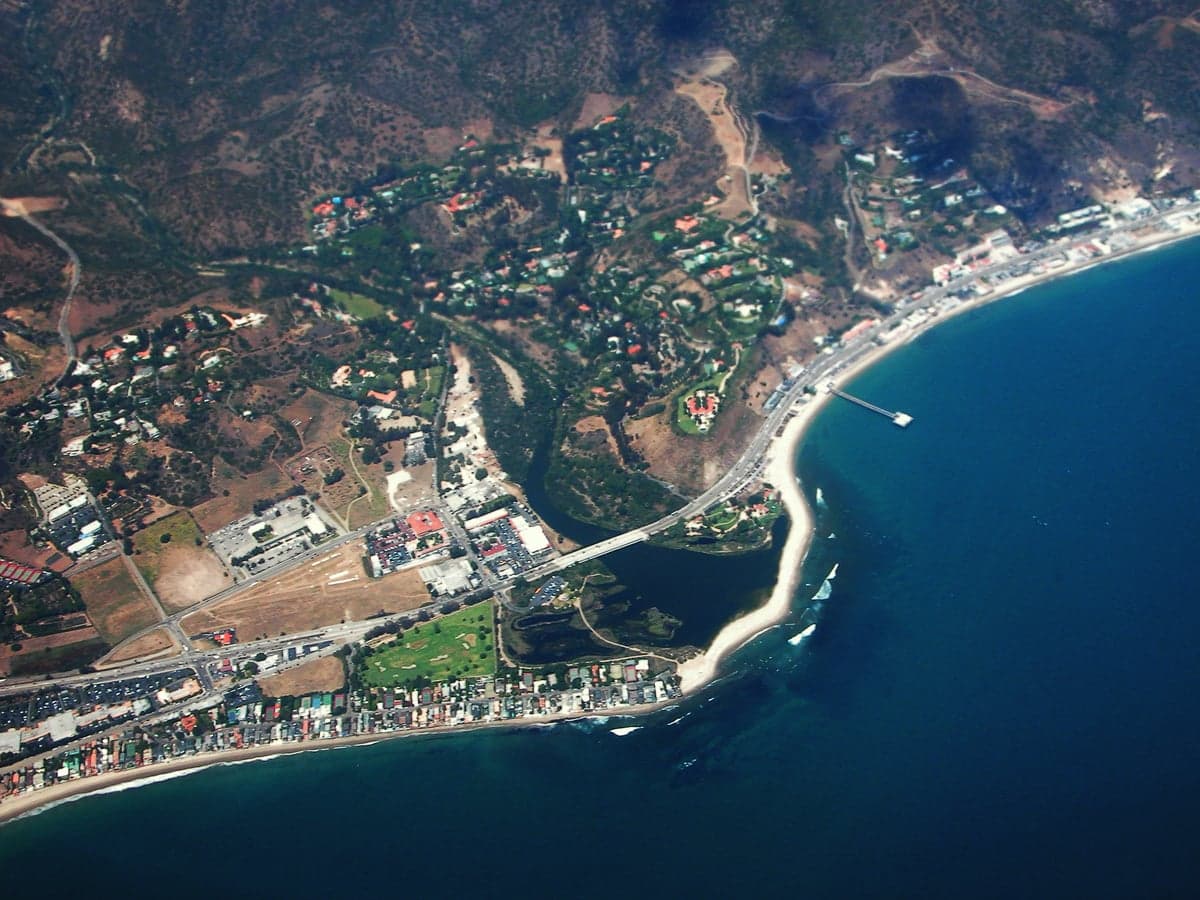
Malibu’s recorded human history begins with the Chumash people, who inhabited the coastline for thousands of years, leaving behind shell middens and village sites near what is now Malibu Lagoon and Point Dume. Spanish colonization in the late 18th century brought the first European settlers, but the area remained a vast, sparsely populated rancho—Rancho Topanga Malibu Sequit—granted to José Bartolomé Tapia in 1804. For most of the 19th century, the land stayed in private hands, used for cattle ranching and agriculture, with no real town forming.
The modern settlement of Malibu began in earnest after 1926, when the Malibu Movie Colony was established along the coast east of the Malibu Pier. This enclave, now known as the Malibu Colony, attracted Hollywood stars seeking privacy and oceanfront living, creating the city’s enduring reputation as a celebrity refuge. The original population was almost entirely white and wealthy, drawn by the seclusion and natural beauty. Through the 1940s and 1950s, development slowly spread west along the Pacific Coast Highway, with modest beach cottages and surf shacks appearing in areas like Surfrider Beach and Zuma Beach, but the population remained small—fewer than 2,000 residents as late as 1960. The 1972 incorporation of the city was driven by residents’ desire to control development and preserve the area’s rural character, a sentiment that still defines local politics.
Modern era (post-1965)
The post-1965 era saw Malibu’s population grow from a few thousand to over 10,000 by the 1990s, driven primarily by domestic in-migration of affluent professionals and entertainment-industry workers. The 1965 Immigration and Nationality Act had little direct effect on Malibu’s demographics; the city’s high housing costs—median home prices consistently above $2 million—created a natural barrier to large-scale immigration. Instead, the growth came from wealthy white families moving from other parts of Los Angeles, seeking larger lots, better schools, and a quieter lifestyle.
Neighborhoods developed distinct characters during this period. Point Dume became a hub for upper-middle-class families, with larger homes and access to state beaches. Malibu Park, inland from the coast, attracted year-round residents who wanted more space and a suburban feel. The Civic Center area, around the intersection of Pacific Coast Highway and Malibu Canyon Road, emerged as the commercial and governmental heart of the city. Hispanic residents, who now make up 9.3% of the population, have historically concentrated in service-industry roles, living in more affordable inland areas like Malibu West and along the canyon roads, though their share has remained relatively stable. East/Southeast Asian residents (2.6%) and Indian-subcontinent residents (0.4%) are present in very small numbers, typically in professional or academic roles, and are dispersed rather than concentrated in any single neighborhood.
The future
Malibu’s population is projected to remain stable or grow very slowly, constrained by strict zoning laws, the California Coastal Commission’s oversight, and a lack of developable land. The city’s demographic profile is unlikely to shift dramatically: the white share (79.5%) may decline slightly as housing costs push out middle-income families, but the city’s high price point will continue to limit in-migration from lower-income or immigrant groups. The Hispanic population may grow modestly as service workers find housing in inland canyons, but the overall foreign-born share (3.9%) is far below the national average and shows no sign of rising.
The cultural identity of Malibu is evolving toward a more permanent, year-round community rather than a seasonal beach retreat. Remote work has allowed more residents to live in Malibu full-time, and the city’s schools—part of the Santa Monica-Malibu Unified School District—are seeing stable enrollment. The next 10-20 years will likely see continued pressure for modest infill development, particularly in the Civic Center area, but the city’s political culture remains staunchly anti-growth. The population will become slightly more diverse at the margins, but Malibu will remain a predominantly white, wealthy, and highly educated enclave.
For someone moving in now, Malibu offers a community that is stable, protective of its environment, and resistant to change. The trade-off is clear: you gain unparalleled natural beauty and privacy, but you join a population that is demographically narrow and economically exclusive. The city’s future is one of careful preservation, not transformation.

* Values derived from national, state, county, city and local statistics and may differ in a specific area. Last updated: 2026-06-08T04:57:00.000Z
Narrative content on this page is AI-generated and may contain mistakes. Verify any details that matter before acting on them.
ReloMaps may earn a commission from affiliate links at no extra cost to you.

