
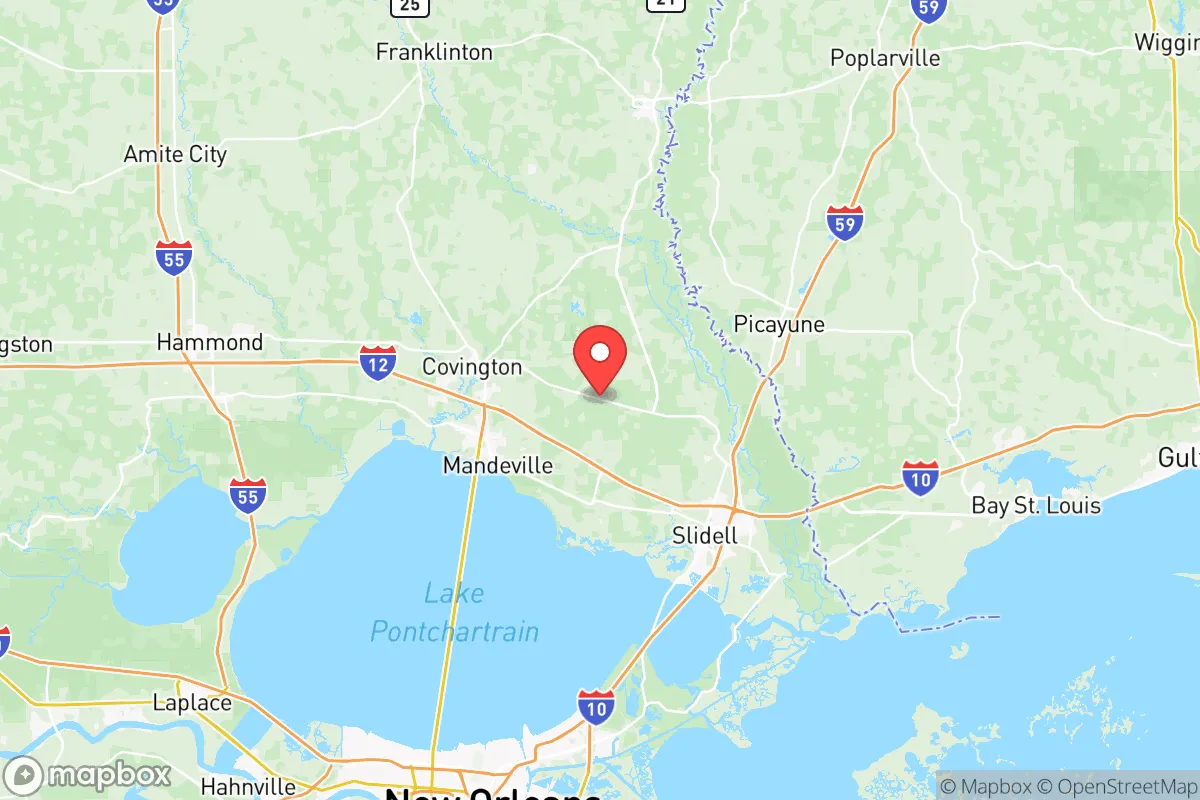
Photo by Joshua J. Cotten on Unsplash
Demographics of St Tammany County
Affluence Level in St Tammany County
A middle-class area roughly in line with national averages across income, home values, education, and employment.
People of St Tammany County
Today, St. Tammany Parish is home to approximately 269,331 residents, a population that is predominantly white (73.3%) with a significant Black minority (12.0%) and a growing Hispanic community (7.9%). The parish is characterized by its suburban character, high educational attainment (36.6% college-educated), and a relatively low foreign-born population of just 2.4%, making it one of the least diverse parishes in the New Orleans metropolitan area. Its identity is shaped by a blend of historic North Shore settlements, post-Katrina migration from New Orleans, and a culture that balances Southern tradition with suburban modernity.
Settlement & growth (pre-1960)
Long before European contact, the area now known as St. Tammany Parish was inhabited by the Choctaw and Acolapissa peoples, who used the region's rivers and bayous for transportation and sustenance. French and Spanish explorers passed through the area in the 17th and 18th centuries, but permanent European settlement did not begin in earnest until after the Louisiana Purchase in 1803. The parish was officially created in 1810, carved from the Florida Parishes region, and named after a Lenape chief, reflecting the area's early frontier character.
The first major wave of American settlers arrived in the early 19th century, primarily Anglo-American Protestants from the Upper South and Georgia, who moved into the piney woods and river bottoms. These settlers established small farming communities such as Covington (founded 1813), Mandeville (founded 1834), and Slidell (founded 1882). Covington became the parish seat and a trading hub, while Mandeville developed as a resort town for wealthy New Orleanians escaping yellow fever and summer heat across Lake Pontchartrain. Slidell grew as a railroad town after the New Orleans and Northeastern Railroad arrived in the 1880s, connecting the parish to national markets.
Throughout the 19th and early 20th centuries, the parish's economy was driven by timber, turpentine, and small-scale agriculture. A notable influx of German and Italian immigrants arrived in the late 1800s, many settling in the Pearl River area and around Lacombe, where they worked in the lumber industry and strawberry farming. These communities remained relatively small and insular, contributing to the parish's enduring rural character. The Black population, which had been present since the antebellum period as enslaved laborers on small plantations, remained concentrated in rural areas and in the Abita Springs and Folsom communities, where many worked as sharecroppers and later as laborers in the timber industry.
By 1960, St. Tammany Parish had a population of roughly 38,000, still predominantly rural and agricultural. The construction of the Lake Pontchartrain Causeway in 1956, connecting Mandeville to Metairie, was the single most transformative infrastructure project in the parish's history, setting the stage for explosive suburban growth that would follow in the coming decades.
Modern era (post-1965)
The post-1965 period in St. Tammany Parish is defined not by international immigration but by massive domestic migration, particularly from the New Orleans metro area. The 1965 Hart-Cellar Act had little direct impact here — the parish's foreign-born population remains among the lowest in Louisiana — but the broader Sun Belt migration patterns reshaped the parish dramatically. As New Orleans experienced white flight and suburbanization in the 1970s and 1980s, thousands of families crossed the Causeway to settle in Mandeville, Covington, and later Slidell, seeking larger lots, better schools, and lower crime rates.
The 1990s and early 2000s saw continued growth, with the population surpassing 190,000 by 2000. New subdivisions spread across the pine forests, and the parish became a classic bedroom community for New Orleans commuters. The most dramatic demographic shift occurred after Hurricane Katrina in 2005, when an estimated 40,000 to 60,000 displaced New Orleanians relocated permanently to St. Tammany Parish. This influx was disproportionately white and middle-class, reinforcing the parish's existing demographic profile while also bringing a wave of new residents from Orleans and Jefferson Parishes who sought higher ground and better infrastructure.
Since 2005, the Hispanic population has grown from roughly 3% to 7.9%, driven largely by construction and service industry workers attracted to the rebuilding boom. These newer residents have concentrated in Slidell and the Pearl River area, where affordable housing and proximity to industrial jobs along the Interstate 12 corridor have drawn families. The East/Southeast Asian community remains small at 0.9%, with a modest concentration in Covington around the medical district. The Indian subcontinent population is even smaller at 0.3%, with no significant enclave. The Black population has remained relatively stable at 12.0%, concentrated in historic communities like Abita Springs and the older neighborhoods of Slidell and Covington.
The future
St. Tammany Parish is projected to continue growing, though at a slower pace than the 1990s and 2000s. The population is expected to reach roughly 300,000 by 2035, driven by continued domestic migration from New Orleans and other parts of Louisiana, as well as some out-of-state retirees attracted to the area's lower cost of living and natural amenities. The parish is becoming slightly more diverse, with the Hispanic share likely to rise to 10-12% over the next decade, while the white share will gradually decline from its current 73.3%.
New residential development is increasingly concentrated in the northern part of the parish, around Folsom and Bush, where land is cheaper and larger lots are available. The Interstate 12 corridor from Slidell to Covington continues to attract commercial and residential growth, while the older lakefront communities of Mandeville and Abita Springs are largely built out and seeing infill development. The parish's cultural identity is evolving from a purely rural-suburban bedroom community toward a more self-contained economy, with growing healthcare, education, and professional services sectors reducing dependence on New Orleans employment.
For someone moving in now, St. Tammany Parish offers a stable, predominantly white, family-oriented suburban environment with strong schools and low crime relative to the New Orleans metro area. The parish is becoming more diverse slowly, but remains far less multicultural than the city across the lake. The next 10-20 years will likely see continued suburban expansion northward, a gradual increase in Hispanic and Asian populations, and a steady influx of retirees and remote workers drawn by the area's quality of life and proximity to New Orleans amenities.

* Values derived from national, state, county, city and local statistics and may differ in a specific area. Last updated: 2026-08-08T14:13:58.000Z
Narrative content on this page is AI-generated and may contain mistakes. Verify any details that matter before acting on them.
ReloMaps may earn a commission from affiliate links at no extra cost to you.

