 Popular
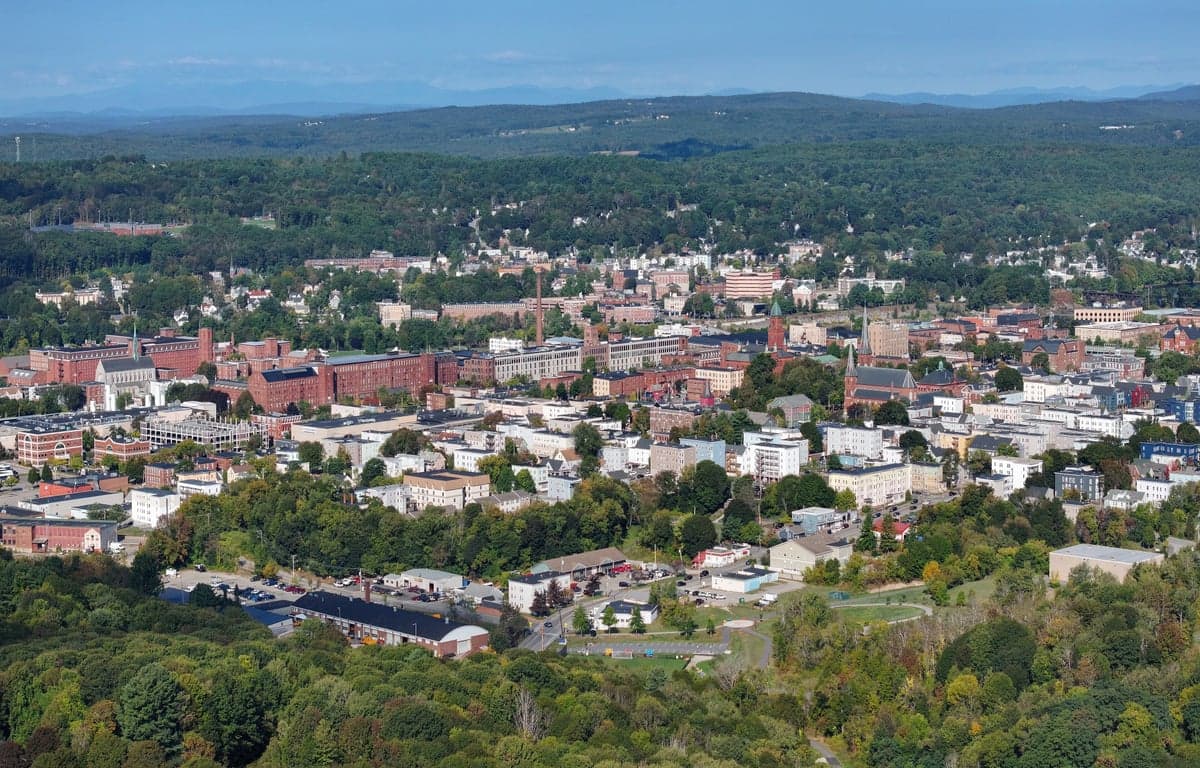
Photo: Wikipedia
Demographics of Lewiston, ME
Affluence Level in Lewiston, ME
A below-average socioeconomic profile. Incomes, home values, and educational attainment trail the U.S., with higher poverty and unemployment.
People of Lewiston, ME
Lewiston, Maine, is a city of roughly 37,900 residents that has reinvented itself multiple times through successive waves of immigration. Today, it is a predominantly white (80.1%) working-class city with a significant Black minority (10.9%), a small but established Somali community, and a modest foreign-born population of 4.9%. Its identity is shaped by a history of industrial boom and decline, followed by a recent, sometimes contentious, demographic transformation centered in its downtown and riverfront neighborhoods.
How the city was settled and grew
Lewiston’s population history begins with its founding as a mill town. The Androscoggin River’s water power drove the city’s explosive 19th-century growth, attracting waves of French-Canadian immigrants who crossed from Quebec to work in the textile mills. These families settled in the Little Canada neighborhood, a dense, working-class enclave just west of the river that remains the historic heart of Lewiston’s Franco-American community. By 1900, French-speakers made up a majority of the city’s population, giving Lewiston a distinct cultural character that persists today in local surnames, Catholic parishes, and the annual Festival de Joie. A smaller wave of Irish and German immigrants also arrived during this period, settling in the Tree Streets area (named for streets like Ash, Elm, and Birch) and the Downtown core near the mills. The city’s population peaked at around 41,000 in the 1970s before the textile industry collapsed, triggering decades of decline and out-migration.
Modern era (post-1965)
The post-1965 immigration reforms had little immediate effect on Lewiston. The city’s population remained overwhelmingly white and Franco-American through the 1980s and 1990s, even as the mills closed and jobs disappeared. The most dramatic modern shift began in the early 2000s, when a wave of Somali refugees—fleeing civil war in Somalia—relocated from other U.S. cities to Lewiston, drawn by cheap housing and a low cost of living. This community concentrated in the Downtown and Kennedy Park neighborhoods, where vacant mill housing and older apartment buildings offered affordable entry points. The arrival of several thousand Somali residents transformed the city’s demographics: the Black population rose from under 1% in 2000 to nearly 11% today. This rapid change sparked public tensions, including a 2002 letter from then-Mayor Laurier Raymond asking Somali leaders to discourage further migration, which drew national media attention. A smaller but growing Hispanic population (3.0%) has also settled in the Downtown area, while East/Southeast Asian residents (1.2%) and Indian-subcontinent residents (0.4%) remain very small communities, largely dispersed across the city rather than forming distinct ethnic enclaves.
The future
Lewiston’s population is slowly stabilizing after decades of decline, but it is not homogenizing. The Franco-American majority is aging and shrinking, while the Somali community is younger and growing through both births and continued secondary migration from other U.S. cities. The Downtown and Kennedy Park neighborhoods are becoming increasingly diverse, while outlying areas like New Auburn (across the river) and the Tree Streets remain predominantly white. The city’s foreign-born share (4.9%) is below the national average, but the Somali community’s high fertility rate and continued chain migration suggest that the Black population will continue to grow as a share of the total. The Hispanic and Asian populations are likely to remain small, as Lewiston lacks the job base or ethnic infrastructure to attract large numbers from those groups. The city’s college attainment rate (21.7%) is well below the national average, reflecting its working-class character and limited white-collar job growth.
For a newcomer, Lewiston is a city in demographic transition—still majority-white and Franco-American in character, but with a growing, visible Somali minority concentrated in the downtown core. The city remains affordable and relatively safe, but its schools and social services have been strained by rapid change. The next decade will likely see continued diversification of the downtown and Kennedy Park areas, while the outlying neighborhoods remain more homogeneous. This is not a city that is blending into a single melting pot, but rather one where distinct ethnic enclaves are solidifying alongside each other.

* Values derived from national, state, county, city and local statistics and may differ in a specific area. Last updated: 2026-05-01T18:10:10.000Z
Narrative content on this page is AI-generated and may contain mistakes. Verify any details that matter before acting on them.
ReloMaps may earn a commission from affiliate links at no extra cost to you.

