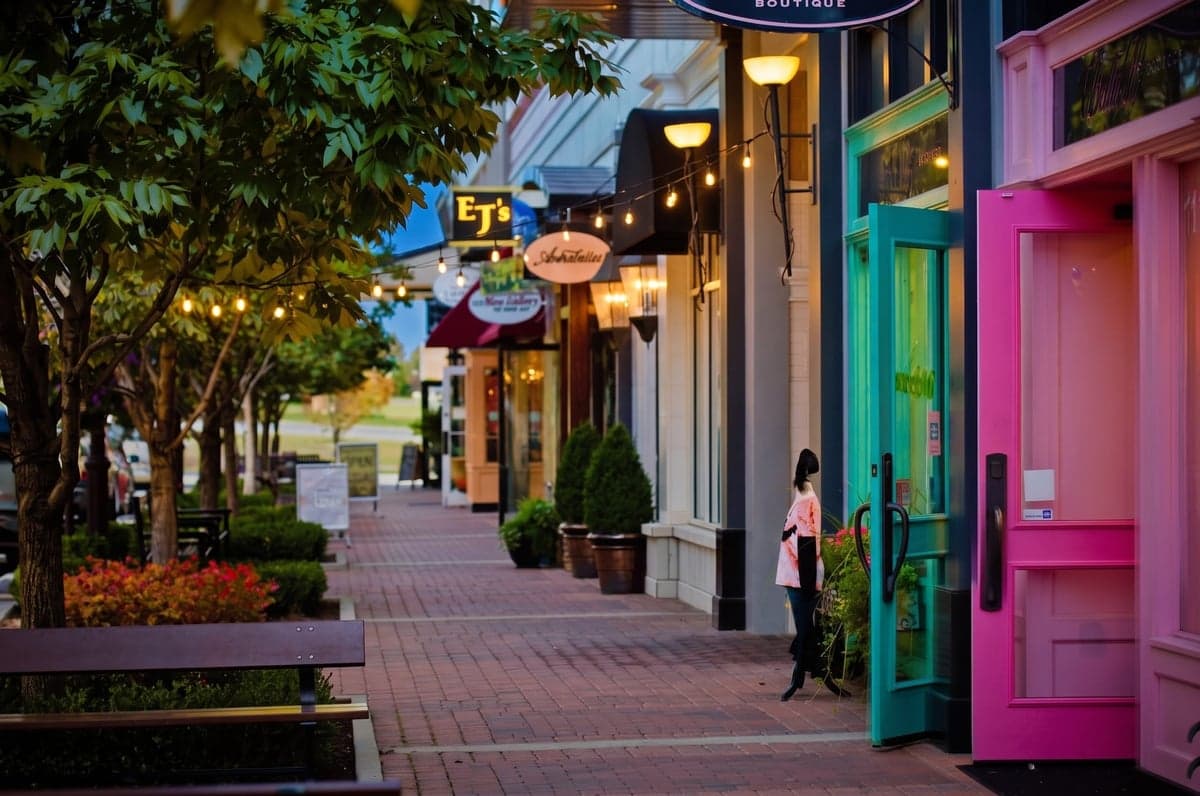
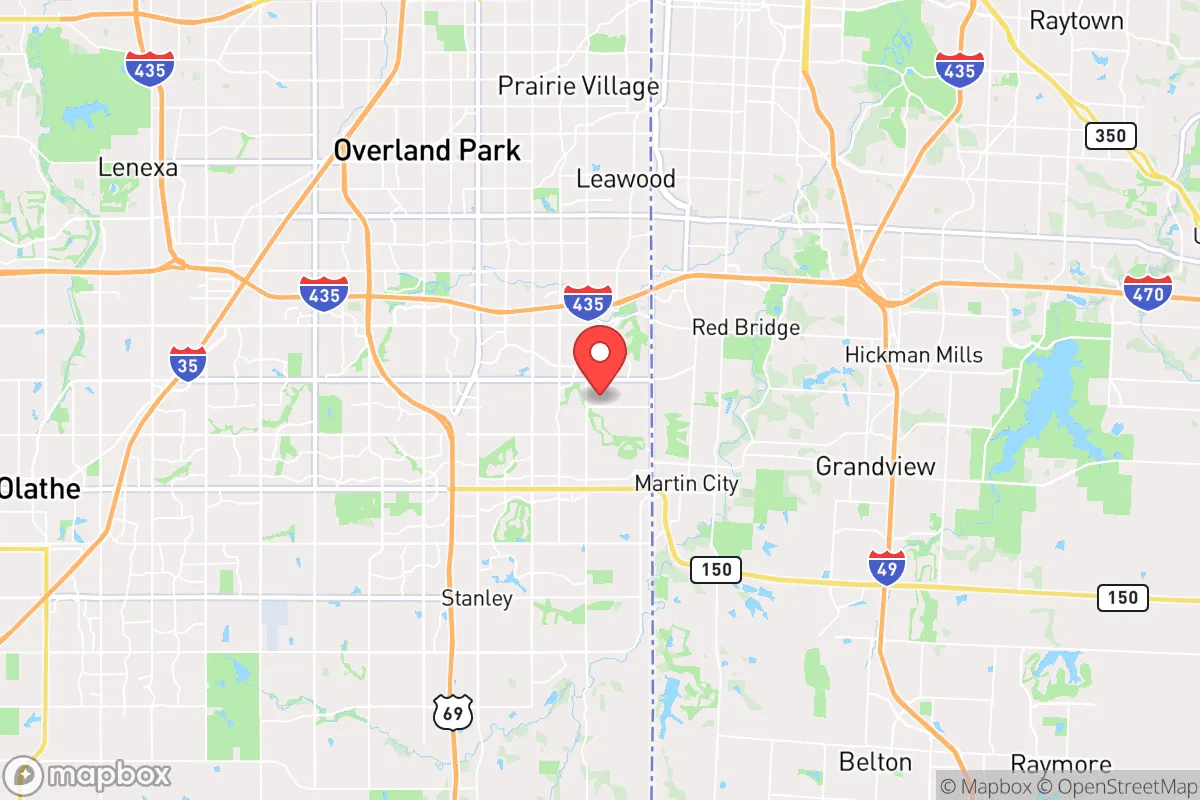
Strategic Assessment of Leawood, KS
Multiple tactical vulnerabilities. Population density, target proximity, or disaster risk are likely compounding. A retreat property and exit planning is required.
What does the Strategic Assessment tell us?
Our Strategic Assessment grades tactical survivability of an area. Major population centers, military targets, fallout zones, natural disasters, and border exposure all drive risk — lower exposure means a more defensible position in a crisis.
This is heavily inspired by Joel Skousen's Strategic Relocation book. Highly recommended you checkout the book ($)What does this tell us?
Our Strategic Assessment grades tactical survivability of an area. Major population centers, military targets, fallout zones, natural disasters, and border exposure all drive risk — lower exposure means a more defensible position in a crisis.
This is heavily inspired by Joel Skousen's Strategic Relocation book. Highly recommended you checkout the book ($)Strategic Pillars

Key Distances
Regional Safe Places
Below is our recommended "safe zones" in Kansas and the surrounding area based on our strategic heuristics. For most people, it's unrealistic to live in a “safe zone” full-time due to work, family or other personal reasons. They tend to be more rural. However, many of these areas are perfect for second homes and retreat properties that double as a vacation home or even a short-term rental.
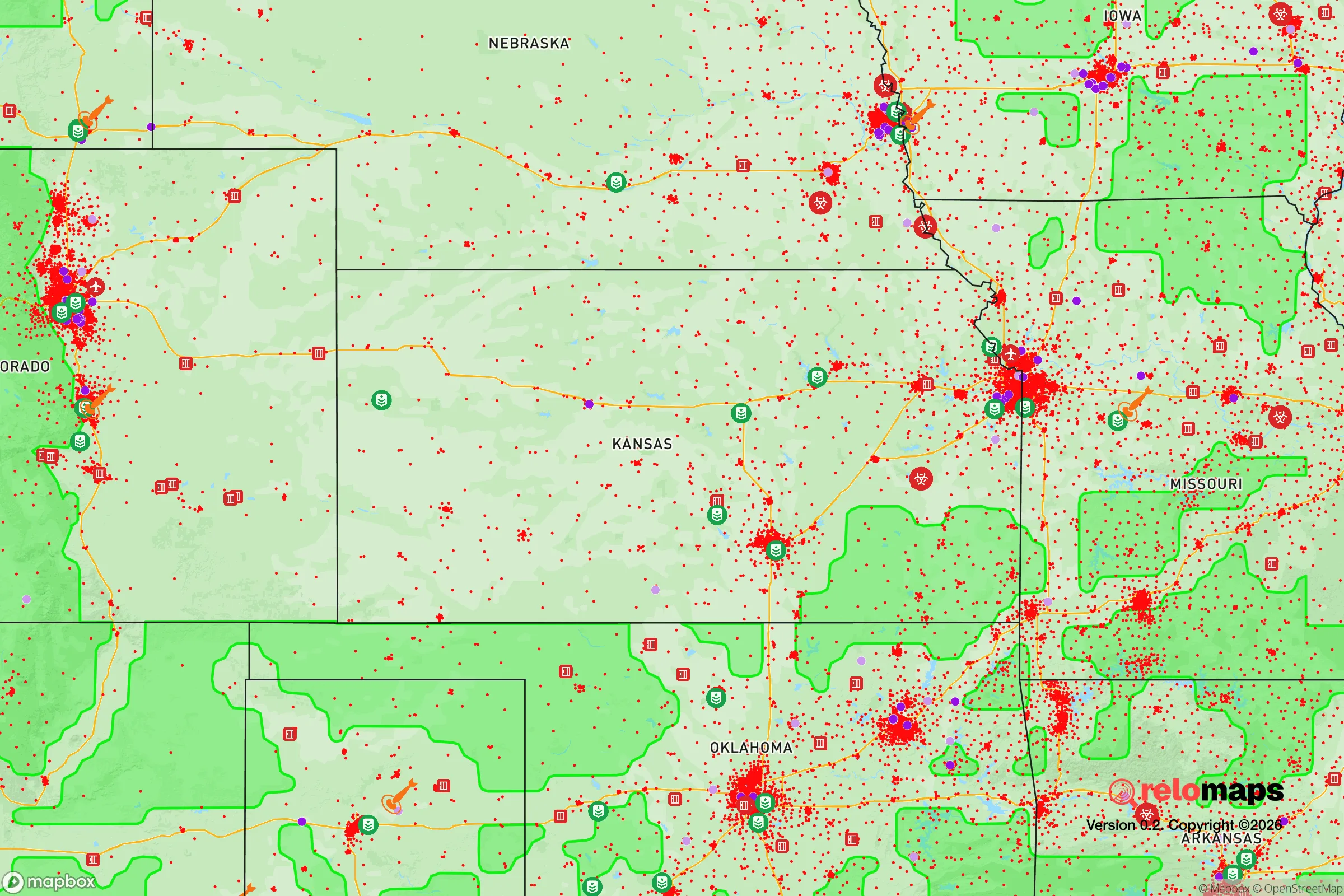
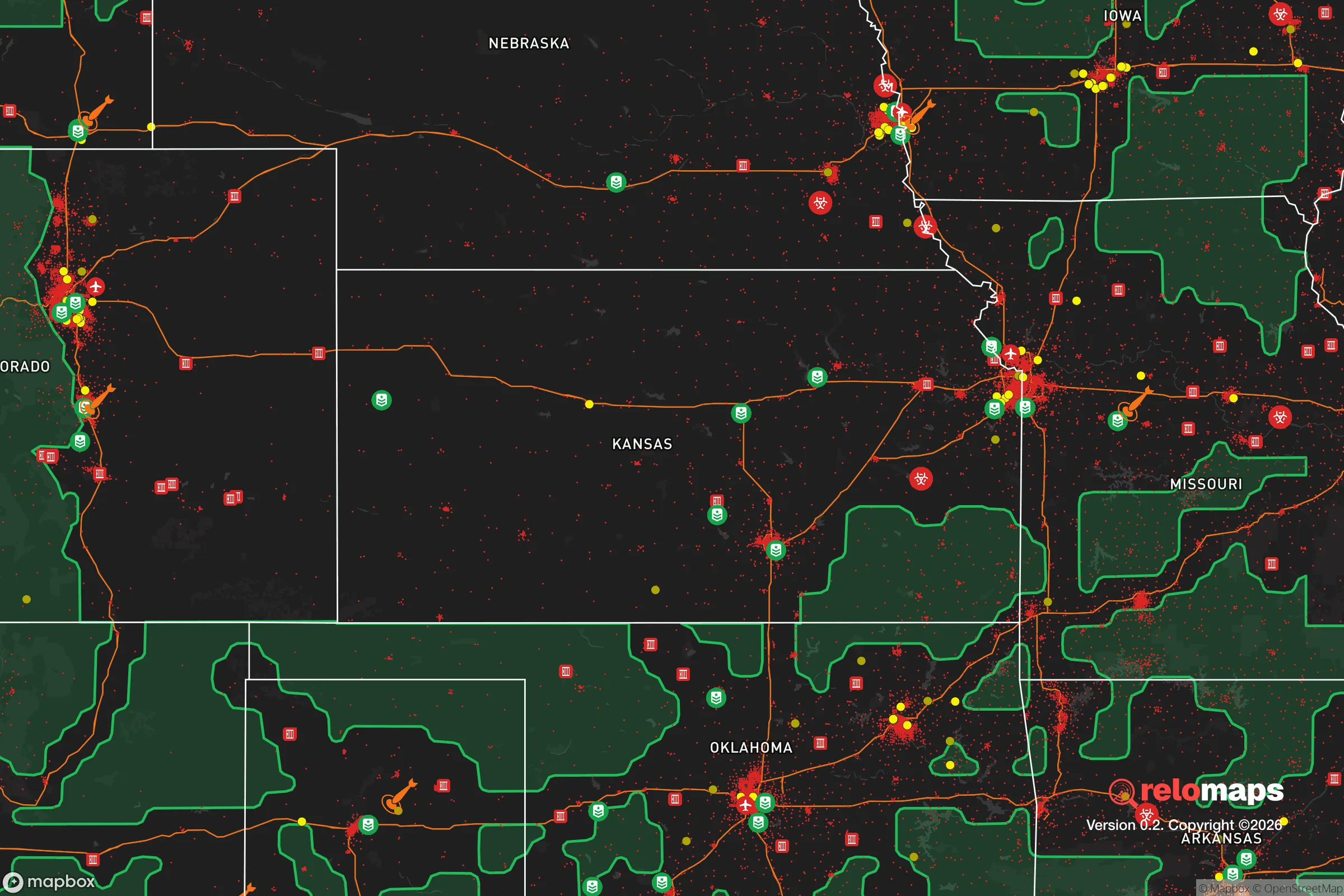


Important Note: For informational purposes only. This does not mean nothing bad ever happens in the green zones. Please use common sense. This is based on public data and modeled with AI. We tried to take a conservative approach but mistakes happen. We update this regularly as new information becomes available.
Solar Generator Recommendations
Backup power matters more here than in safer locations. We've picked three solar generators across budgets and capacity tiers — start with the budget unit if you only need a few essentials, or step up if you want to run a fridge and HVAC for days at a time.

Jackery Portable Power Station Explorer 300
Budget OptionPower on the Go: Weighing only 11 lbs, it's convenient to set up and store with book-sized foldable solar panels

BLUETTI Portable Power Station AC180
Designed for both indoor and outdoor scenarios, AC180 is highly capable as it has a robost capacity and continuous output power.

EF ECOFLOW DELTA Pro Ultra Power Station
Upgraded PickEcoFlow DELTA Pro Ultra is a whole-home energy system designed to grow with your family. Integrated with the Smart Home Panel 2, it scales to meet your evolving energy needs — keeping your home powered, intelligent, and secure through every stage of life.
We earn a commission, at no additional cost to you.
Strategic Assessment Analysis
Leawood, Kansas, presents a complex strategic picture for the conservative prepper or survival-minded relocator. On the surface, it’s an affluent, well-managed suburb of Kansas City, offering excellent schools and low crime rates within its borders. However, its core vulnerability is its location: it sits squarely within the Kansas City metropolitan area, a major population and logistics hub that would be a primary target for civil unrest, supply chain disruption, or, in a worst-case scenario, a nuclear or EMP event. The resilience of Leawood is therefore not about isolation or self-sufficiency, but about leveraging its high socioeconomic status and local governance to weather short-to-medium-term disruptions, while accepting the inherent risks of proximity to a major city. For the relocator who cannot or will not go fully rural, Leawood offers a calculated trade-off: high day-to-day security and community stability in exchange for significant exposure to regional-scale threats.
Geographic position and natural advantages for long-term stability
Leawood’s geographic position is a double-edged sword. The positive side is its location in Johnson County, Kansas, which is one of the wealthiest and most politically stable counties in the Midwest. The area is not prone to natural disasters like hurricanes, earthquakes, or wildfires. The climate is continental, with hot summers and cold winters, but it lacks the extreme weather volatility of the Gulf Coast or the West. The land is gently rolling, well-drained, and sits atop the Ogallala Aquifer, though municipal water comes from the Missouri River via Kansas City’s system. For a relocator, the natural advantages are primarily about low risk of catastrophic natural events and a temperate climate that supports basic gardening and livestock on larger residential lots. The area’s agricultural hinterland—the Kansas and Missouri breadbaskets—is a massive strategic asset. In a prolonged disruption, Leawood residents would be closer to food production than those in coastal cities, though they would still compete with the entire KC metro for those resources.
Risks, exposures, and proximity to fallout-relevant landmarks
This is where the analysis gets serious. Leawood’s primary strategic weakness is its proximity to multiple high-value targets. Kansas City is home to Whiteman Air Force Base (home of the B-2 Spirit bomber), the Federal Reserve Bank of Kansas City, major transportation hubs (rail and interstate), and a concentration of critical infrastructure including power plants and fuel refineries. In a conflict scenario, these are tier-one targets for conventional or nuclear strikes. Leawood is roughly 15-20 miles from downtown Kansas City and about 60 miles from Whiteman AFB. While not in the immediate blast zone of a ground burst, the fallout plume from a strike on Whiteman or the city center could easily drift over Johnson County depending on prevailing winds. Furthermore, the area’s dense suburban layout—with its interconnected roads, shopping centers, and housing developments—offers very little natural defensibility. There are no mountains, dense forests, or natural chokepoints to control access. In a civil unrest scenario, Leawood’s wealth could make it a target for looting or organized crime, though its local police force is well-funded and professional. The real risk is being trapped in a suburban grid if highways are blocked or if a mass evacuation is ordered.
Practical resilience for a relocator: food, water, energy, and defensibility
For the individual or family looking to be prepared, Leawood offers a mixed bag. Water is the biggest vulnerability. The municipal supply is dependent on the Kansas City Water Services system, which draws from the Missouri River. A prolonged power outage or contamination event would cut off water to the entire metro. A well is not an option in most Leawood subdivisions, so a prepper must rely on stored water, rainwater catchment (which is legal in Kansas), and filtration systems. Food is a similar story. Local grocery stores are excellent but rely on just-in-time delivery. A two-week supply is a minimum; a three-month supply is prudent. Community gardens and backyard chickens are allowed in many Leawood neighborhoods, but HOA restrictions can be a barrier—check the covenants carefully. Energy is provided by Evergy, a regional utility. The grid is moderately reliable but vulnerable to cyberattack and physical sabotage. Solar panels with battery backup are a viable option, though HOAs may have aesthetic restrictions. Natural gas is widely available for heating and cooking, which is a plus. Defensibility is the weakest link. Leawood is a suburban grid of cul-de-sacs and arterial roads. There is no natural high ground or perimeter. Security relies entirely on community cohesion and law enforcement. For the prepper, this means building a strong neighborhood network is more important than physical fortifications. A “go bag” and a pre-planned bug-out location to the rural areas south or west of the metro (e.g., toward Emporia or the Flint Hills) are essential.
The overall strategic picture for Leawood is one of calculated risk. It is not a survivalist’s paradise, nor is it a disaster zone waiting to happen. For the conservative relocator who values excellent schools, low crime, and a stable local economy, Leawood offers a high baseline quality of life. Its resilience comes from community wealth, competent local governance, and proximity to agricultural resources. Its vulnerabilities are dependence on a fragile urban infrastructure and proximity to high-value targets. The wise relocator will treat Leawood as a “prep-forward” suburb: invest in home storage, renewable energy, and community ties, but maintain a viable escape plan for the worst-case scenarios. It is a place to live well while preparing for the possibility that the world outside its manicured lawns may not stay so orderly. For the single individual or family willing to put in the work, Leawood can be a solid base of operations—just don’t mistake its comfort for true security.

* Values derived from national, state, county, city and local statistics and may differ in a specific area. Last updated: 2026-05-01T06:59:59.000Z
Narrative content on this page is AI-generated and may contain mistakes. Verify any details that matter before acting on them.
ReloMaps may earn a commission from affiliate links at no extra cost to you.

