Photo: Wikipedia
Demographics of Las Vegas, NM
Affluence Level in Las Vegas, NM
A below-average socioeconomic profile. Incomes, home values, and educational attainment trail the U.S., with higher poverty and unemployment.
People of Las Vegas, NM
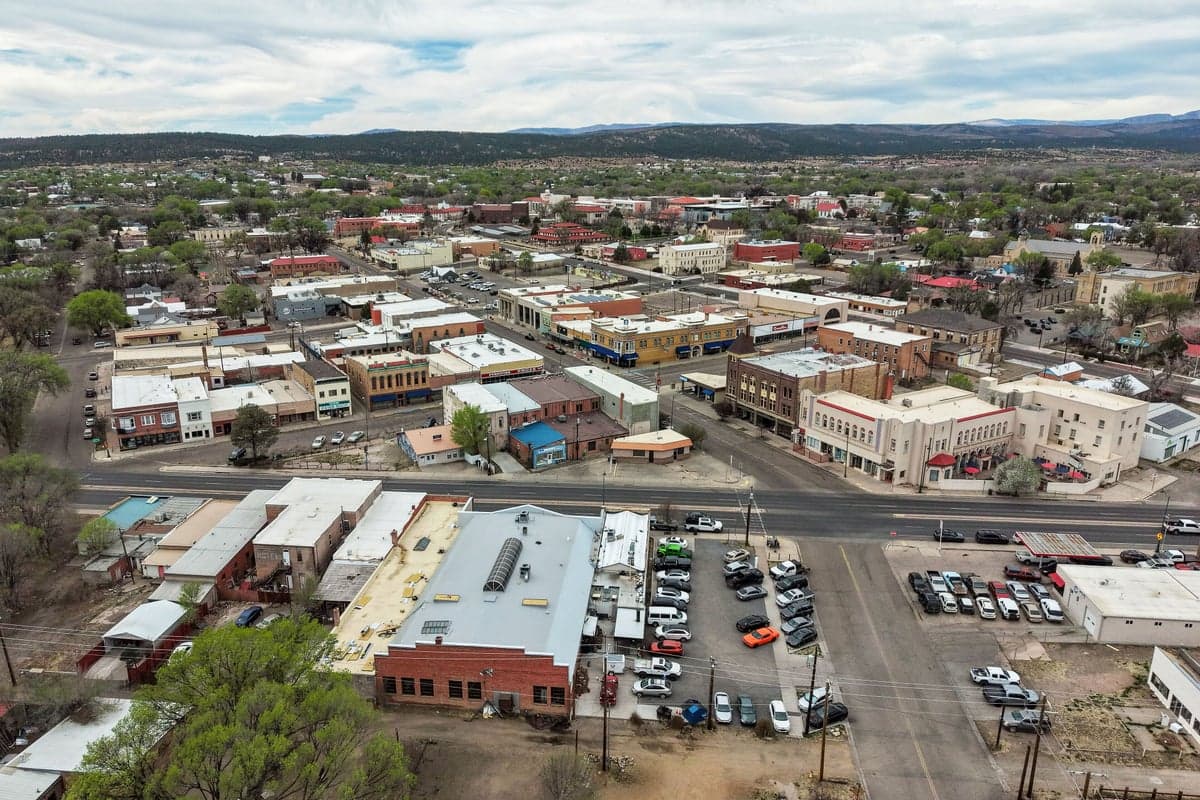
The people of Las Vegas, New Mexico today number 13,120, forming a deeply rooted community where 77.7% identify as Hispanic and 14.7% as White. The city’s population density is moderate, and its distinctive identity is shaped by a centuries-old Hispano heritage, a historic African American presence tied to the railroad, and a small but growing influx of outsiders drawn by low costs and mountain scenery. Unlike many Western towns, Las Vegas retains a strong sense of place, with distinct neighborhoods that still reflect the settlement patterns of the 19th and early 20th centuries.
How the city was settled and grew
Las Vegas was founded in 1835 when the Mexican government granted a large tract of land—the Las Vegas Land Grant—to a group of settlers from the Rio Abajo region. These original settlers, primarily Spanish-speaking ranchers and farmers, built the Plaza (now the Old Town Plaza) as the civic and commercial heart. The Plaza and surrounding Old Town neighborhoods, with their narrow streets and adobe homes, remain the historic core of the Hispano community. The arrival of the Atchison, Topeka and Santa Fe Railway in 1879 transformed the city. The railroad built its depot and yards east of the Gallinas River, creating a new, Anglo-dominated district known as New Town. This area, centered around Douglas Avenue and Railroad Avenue, attracted merchants, railroad workers, and a significant number of African American porters and laborers, who settled in the South Pacific neighborhood near the tracks. By 1900, Las Vegas had a population of about 7,000, with a clear geographic and cultural split: Old Town remained predominantly Hispano, while New Town was Anglo and railroad-oriented. A smaller wave of Italian and Eastern European immigrants arrived in the early 1900s, settling in the North New Town area, but the city’s demographic foundation was set by the Hispano and Anglo populations.
Modern era (post-1965)
The post-1965 period saw Las Vegas’s population peak at roughly 15,000 in the 1970s, then decline slightly as railroad jobs disappeared and younger residents moved to Albuquerque or Denver. The city’s Hispanic share grew steadily, from about 60% in 1970 to 77.7% today, driven by higher birth rates and the out-migration of non-Hispanic Whites. The White population, now 14.7%, has aged and shrunk, concentrated in New Town and the newer subdivisions east of Interstate 25, such as Sunset Park. The African American community, once a visible presence in South Pacific, has dwindled to 1.3% as railroad employment declined. Foreign-born residents are just 1.3%, a very low figure, indicating that immigration from Mexico or elsewhere has been minimal. The city’s small East/Southeast Asian population (0.3%) and Indian subcontinent population (0.1%) are mostly professionals associated with New Mexico Highlands University, which sits on the border between Old Town and New Town. The university has also drawn a modest number of out-of-state students and faculty, but Las Vegas has not experienced the rapid suburbanization seen in Santa Fe or Albuquerque. Most growth has been infill within existing neighborhoods, with a few new subdivisions like Vista del Rio attracting retirees and remote workers.
The future
Las Vegas’s population is likely to remain stable or grow slowly, reaching perhaps 14,000 by 2040. The Hispanic share will continue to rise, possibly to 82-85%, as the White population ages and younger White families are not replacing them. The city is not homogenizing into a single enclave; rather, Old Town remains overwhelmingly Hispano, while New Town and the newer subdivisions are more mixed but still majority-Hispanic. The immigrant communities are not growing—the foreign-born share is static—so the city’s character is being shaped by native-born Hispanos, not new arrivals. The small East/Southeast Asian and Indian populations are likely to remain tiny, tied to the university. The biggest demographic wildcard is remote work: Las Vegas’s low housing costs and mountain setting could attract more out-of-state migrants, especially from expensive Colorado or California, but this inflow is currently modest and concentrated in the Vista del Rio and Sunset Park areas. These newcomers are mostly White and college-educated, which could slightly slow the Hispanicization trend but not reverse it.
For someone moving in now, Las Vegas is becoming a more uniformly Hispano community with a stable, low-density feel. The city is not tribalizing into hostile enclaves, but the historic Old Town/New Town divide persists in subtle ways. Newcomers, especially those who are not Hispanic, will find a welcoming but culturally distinct environment where Spanish is commonly heard and community life revolves around family, the Catholic Church, and local traditions. The bottom line: Las Vegas is a place where deep roots matter, and the population story is one of continuity, not rapid change.

* Values derived from national, state, county, city and local statistics and may differ in a specific area. Last updated: 2026-05-01T00:47:21.000Z
Narrative content on this page is AI-generated and may contain mistakes. Verify any details that matter before acting on them.
ReloMaps may earn a commission from affiliate links at no extra cost to you.

