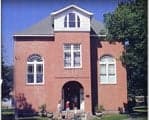
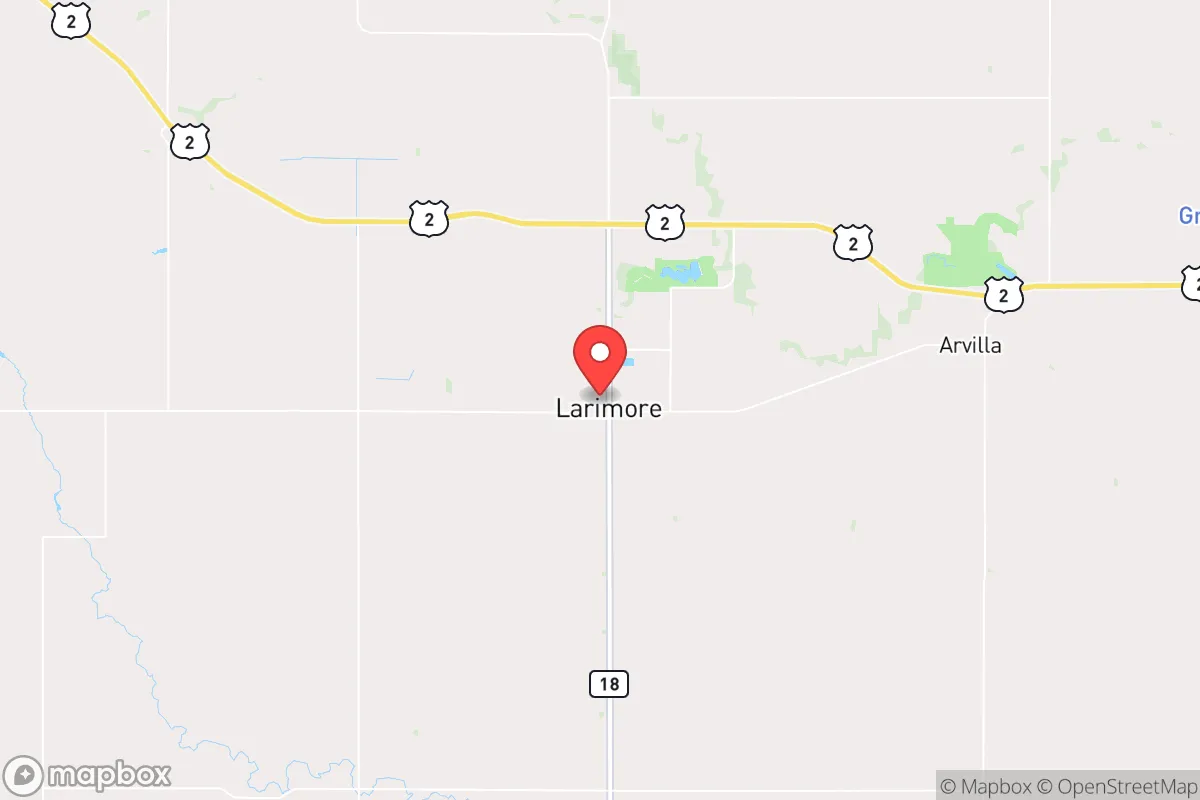
Photo: Wikipedia
Demographics of Larimore, ND
Affluence Level in Larimore, ND
An upper-middle-class area. Household wealth, education levels, and homeownership run ahead of national benchmarks.
People of Larimore, ND
The people of Larimore, North Dakota, today number 1,262, forming a tightly-knit, predominantly white community with a strong agricultural and railroad heritage. The city’s character is defined by its quiet, family-oriented atmosphere, a low crime rate, and a population density of roughly 1,200 people per square mile. Distinctive identity markers include a deep-rooted sense of local pride centered on the annual Larimore Days celebration and a visible presence of the Grand Forks Air Force Base workforce among residents. With a foreign-born population of 4.6% and a Hispanic share of 4.4%, Larimore is slightly more diverse than many neighboring Grand Forks County towns, yet remains overwhelmingly homogenous.
How the city was settled and grew
Larimore’s human history begins with the arrival of the Great Northern Railway in the 1880s, which transformed the open prairie into a bustling grain-shipping hub. The city was platted in 1881 and named after railroad executive J. J. Larimore, drawing a first wave of settlers primarily of Norwegian, German, and Irish stock. These early homesteaders built the Original Townsite (roughly bounded by Main Street and the railroad tracks), where simple wood-frame houses and grain elevators still mark the historic core. A second wave arrived between 1900 and 1920, fueled by the expansion of the Larimore Dam and the fertile Red River Valley farmland. This group, largely second-generation Scandinavian-Americans, established the North Side Addition (north of the tracks), a neighborhood of modest bungalows and larger farmhouses that remains a stable, family-dominated area today. By 1930, the population had reached 1,100, and the city’s ethnic composition was nearly 100% white, a pattern that held for decades.
Modern era (post-1965)
The post-1965 period brought only modest demographic change to Larimore, as the city did not experience the large-scale immigration shifts seen in larger metropolitan areas. The most significant domestic in-migration occurred in the 1970s and 1980s, when families from rural Grand Forks County moved into the South Ridge Estates subdivision (south of Highway 15), drawn by newer housing stock and proximity to Grand Forks. This area remains the most affluent neighborhood, with larger lots and a higher share of college-educated residents (17.3% citywide). The Hispanic population, now 4.4%, began to grow slowly in the 2000s, primarily with workers employed in local agriculture and meatpacking plants. These families have concentrated in the West End (west of the railroad tracks), a mixed-use area with older rental properties and mobile homes. The Black population (0.8%) and East/Southeast Asian population (0.0%) remain negligible, reflecting the city’s limited economic pull for non-white groups. The Indian subcontinent population is also 0.0%. The foreign-born share of 4.6% is almost entirely Hispanic, with a small number of European-origin residents.
The future
Larimore’s population is projected to remain stable or decline slightly over the next decade, as out-migration of young adults to Grand Forks and Fargo offsets any new arrivals. The city is not homogenizing further—it is already near the ceiling of white homogeneity—but it is slowly tribalizing into distinct enclaves: the historic Norwegian-German core in the Original Townsite, the newer commuter families in South Ridge Estates, and the growing Hispanic workforce in the West End. The Hispanic community is growing slowly, not plateauing, but is likely to assimilate into the broader population over time, given the small numbers and lack of ethnic institutions. The Black and Asian populations are not expected to increase significantly, as Larimore lacks the job base or housing diversity to attract them. The next 10-20 years will likely see a continuation of the current trend: an aging white population, a small but stable Hispanic minority, and a gradual loss of young families to larger cities.
For someone moving in now, Larimore is becoming a quiet, affordable, and safe rural community with a clear social structure. It is a place where newcomers will find a welcoming but insular environment, where the dominant culture is white, Christian, and conservative, and where the small Hispanic community is integrated but not yet fully visible in civic life. The city offers stability and low cost of living, but limited diversity and economic opportunity beyond agriculture, the Air Force base, and local services.

* Values derived from national, state, county, city and local statistics and may differ in a specific area. Last updated: 2026-04-19T07:19:21.000Z
Narrative content on this page is AI-generated and may contain mistakes. Verify any details that matter before acting on them.
ReloMaps may earn a commission from affiliate links at no extra cost to you.

