Photo: Wikipedia
Demographics of Langdon, ND
Affluence Level in Langdon, ND
A middle-class area roughly in line with national averages across income, home values, education, and employment.
People of Langdon, ND
The people of Langdon, North Dakota, today number 1,835, forming a tight-knit, predominantly white community with a strong agricultural and small-town identity. The city is 92.7% white, with a Hispanic population of 4.5% and no measurable foreign-born, Black, East/Southeast Asian, or Indian-subcontinent residents. With 25.1% holding a college degree, the population is slightly less educated than state averages, reflecting a workforce rooted in farming, manufacturing, and local services. Langdon’s character is one of deep generational roots, low diversity, and a stable, family-oriented social fabric.
How the city was settled and grew
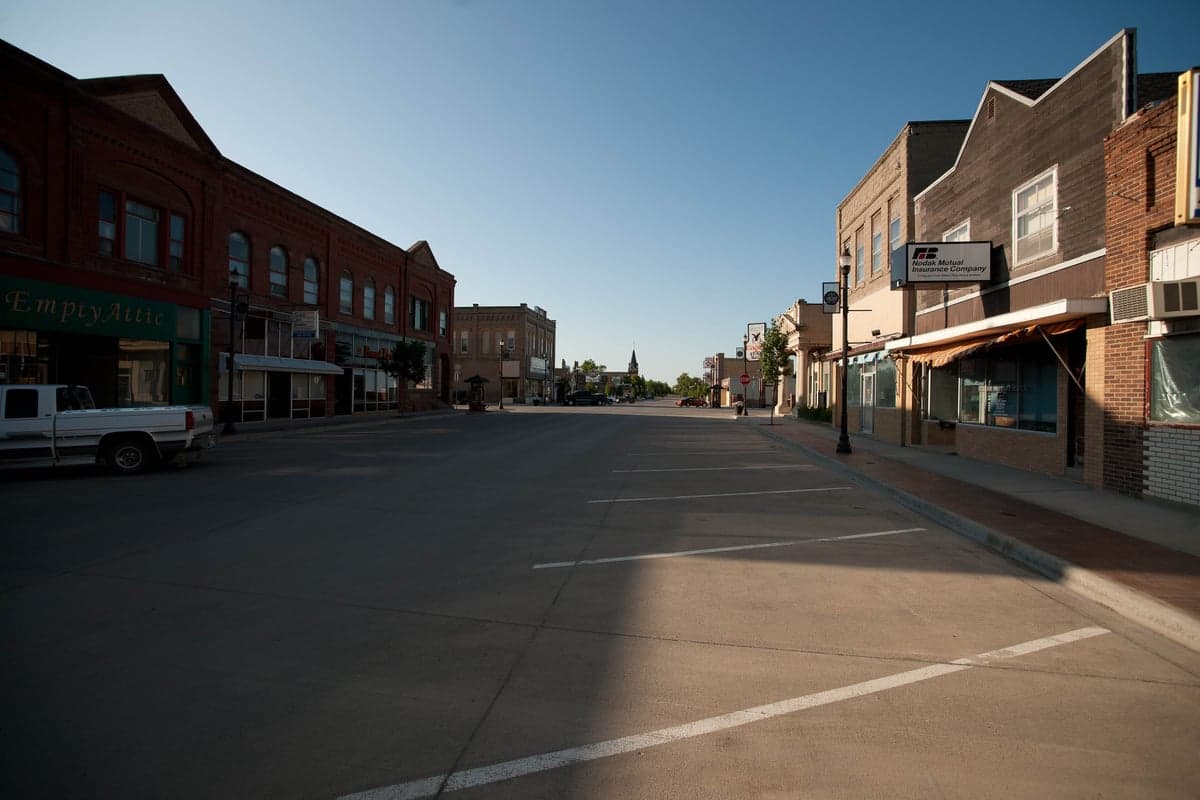
Langdon’s settlement began in the 1880s, driven by the arrival of the Great Northern Railway and the federal Homestead Act, which offered 160-acre parcels to settlers willing to farm the northern plains. The original wave was overwhelmingly Northern European—primarily Norwegian, German, and Irish immigrants—who established farms and small businesses. The city was formally platted in 1884 and named after railroad official Robert Langdon. The Original Townsite, centered around Main Street and the railroad depot, became the commercial and social hub for these early homesteaders. A second wave of German-Russian immigrants, fleeing religious persecution and land scarcity in the Russian Empire, arrived in the 1890s and early 1900s, settling in the South Side neighborhood near the grain elevators and stockyards. By 1910, Langdon’s population had reached 1,200, and the city served as a regional trade center for wheat, barley, and cattle. The North End, developed after World War I, housed second-generation families and professionals, with larger homes and tree-lined streets reflecting the prosperity of the 1920s farm economy.
Modern era (post-1965)
After the 1965 Immigration and Nationality Act, Langdon saw virtually no new foreign-born arrivals—the city’s foreign-born share remains 0.0% today. Instead, the modern era has been defined by domestic out-migration and aging. Young adults have left for larger cities like Grand Forks and Fargo, drawn by college and job opportunities, while retirees have stayed. The West Acres subdivision, developed in the 1970s and 1980s, attracted families seeking newer, larger homes, but its growth was modest. The East Side, near the hospital and school campus, became a stable middle-class area with a mix of older ranch homes and 1990s infill construction. The Hispanic population, now 4.5%, began arriving in the 1990s and 2000s, primarily as seasonal agricultural workers in potato and sugar beet fields, with some settling year-round in rental properties near the Industrial Park on the city’s western edge. No Black, East/Southeast Asian, or Indian-subcontinent communities have formed; the city remains nearly monoracial. The population peaked at 2,241 in 1980 and has since declined steadily, reflecting the broader rural depopulation of the northern Plains.
The future
Langdon’s population is projected to continue a slow decline, with the 2020 census showing 1,835 residents, down from 1,907 in 2010. The city is homogenizing rather than diversifying: the white share has remained above 90% for decades, and the Hispanic share, while growing slightly, is unlikely to exceed 6-8% in the next decade due to limited economic opportunities and housing stock. The Downtown Historic District has seen some reinvestment in small businesses and a new public library, but it does not attract new residents. The Lake Region area, a small cluster of homes near the municipal golf course, remains a retirement enclave. No significant immigrant or minority enclaves are forming. The next 10-20 years will likely see further aging of the population, with the median age rising from 46.5 (2020) toward 50, and continued out-migration of young adults. The city may stabilize if remote work or niche industries (e.g., specialty crops, renewable energy) create new jobs, but current trends point to a smaller, older, and whiter community.
For someone moving in now, Langdon offers a safe, predictable, and deeply rooted community with low crime and strong schools, but little demographic change or cultural diversity. It is a place where family history and land ownership define social standing, and where newcomers are welcomed if they integrate into the existing civic and church networks. The city is not becoming more diverse or dynamic; it is consolidating around its core white, agricultural identity. A move here is a choice for stability and tradition, not for growth or change.

* Values derived from national, state, county, city and local statistics and may differ in a specific area. Last updated: 2026-04-19T05:42:57.000Z
Narrative content on this page is AI-generated and may contain mistakes. Verify any details that matter before acting on them.
ReloMaps may earn a commission from affiliate links at no extra cost to you.

