Photo: Wikipedia
Demographics of Kodiak, AK
Affluence Level in Kodiak, AK
A below-average socioeconomic profile. Incomes, home values, and educational attainment trail the U.S., with higher poverty and unemployment.
People of Kodiak, AK
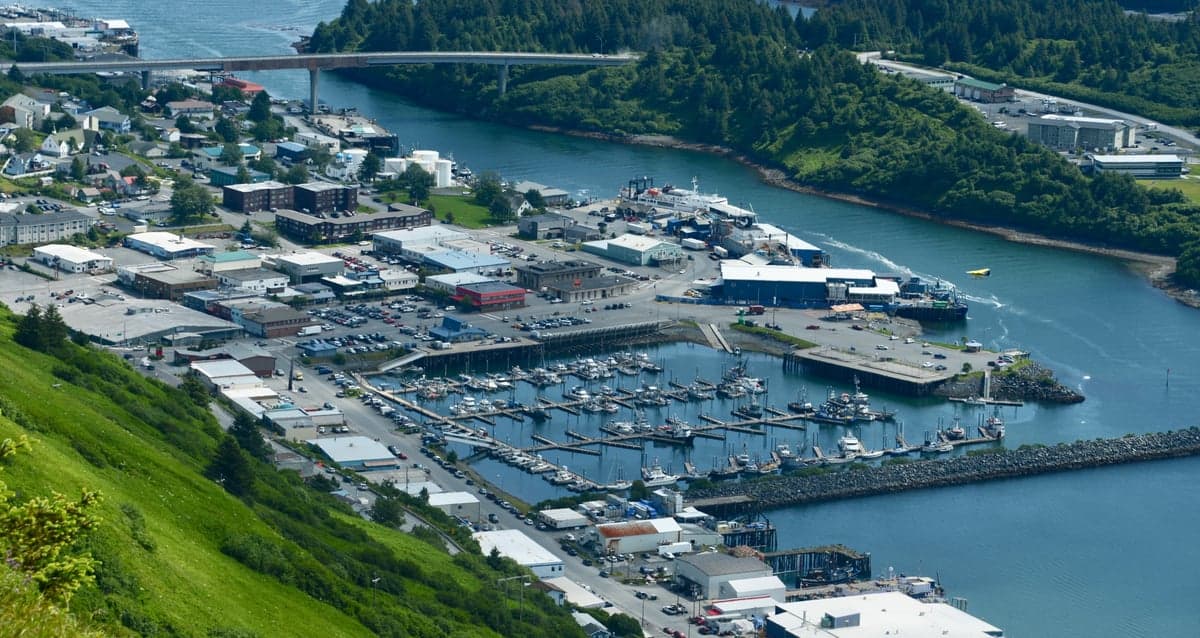
The people of Kodiak, Alaska, today form a uniquely diverse community of 5,497 residents, characterized by a striking demographic profile where East and Southeast Asian communities make up the largest single group at 43.4% of the population, followed by White residents at 31.4%. With a foreign-born share of 17.9%—nearly triple the national average—and a Hispanic population of 9.7%, Kodiak is a compact, working-class city defined by its fishing industry, military presence, and Alutiiq Native heritage. The city’s identity is neither homogenously rural nor suburban; it is a tight-knit, multiethnic port town where seafood processing plants and Coast Guard families shape daily life.
How the city was settled and grew
Kodiak’s human history begins with the Alutiiq (Sugpiaq) people, who inhabited the archipelago for over 7,000 years, living in seasonal villages along the coast. Russian fur traders arrived in 1784, establishing the first permanent Russian settlement in Alaska at what is now the St. Paul Harbor area, forcibly relocating Alutiiq people and introducing Orthodox Christianity. The Russian-American Company built a fort, warehouses, and a church, and the mixed-race Creole population—descendants of Russian men and Alutiiq women—became a distinct social group concentrated in the historic Russian Town neighborhood near the harbor. After the U.S. purchased Alaska in 1867, American commercial fishing operations expanded, drawing Scandinavian, German, and Irish fishermen who settled in the Mission Road and Near Island areas. The 1940s brought a major shift: the U.S. Navy built a base on Womens Bay, and the Coast Guard established Air Station Kodiak, bringing military families and civilian workers. The 1964 Good Friday Earthquake devastated the original downtown, but federal rebuilding funds modernized the city, and the fishing industry—particularly king crab and salmon—boomed in the 1970s, attracting a new wave of workers.
Modern era (post-1965)
The 1965 Hart-Cellar Act opened immigration from Asia, and Kodiak’s seafood processing plants became a primary draw. Filipino fishermen and cannery workers arrived first, settling in the Mill Bay and Chiniak areas, where they established the Kodiak Filipino-American Association. Vietnamese refugees began arriving after 1975, many sponsored by fishing companies, and concentrated in Downtown and along Rezanof Drive. Today, East and Southeast Asian communities—predominantly Filipino and Vietnamese, with smaller numbers of Chinese, Japanese, and Korean residents—make up 43.4% of the population, the largest ethnic bloc. The White population, at 31.4%, includes Coast Guard personnel (who rotate through every 2-4 years), long-time fishing families, and a small number of remote workers. The Hispanic population of 9.7% is largely Mexican and Central American, many working in seafood processing and living in Bells Flats and the Buskin River area. The Alutiiq Native population, while not separately tracked in the data above, remains a culturally significant minority concentrated in the Old Harbor and Larsen Bay neighborhoods within city limits. The Black population is negligible at 0.1%, and the Indian subcontinent population is 0.0%.
The future
Kodiak’s population is aging and slowly declining—down from roughly 6,300 in 2010—driven by the volatile fishing industry and limited economic diversification. The East and Southeast Asian communities, particularly Filipino families, are stabilizing through second-generation assimilation; younger adults are more likely to speak English as a primary language and work outside the seafood plants, in healthcare or the school district. The Hispanic population is growing modestly, drawn by year-round processing jobs, and is beginning to form a visible community in the Buskin River area. The White population is the most transient, heavily influenced by Coast Guard rotations; permanent White residents are mostly older fishing families or retirees. The Alutiiq population is stable but faces outmigration of young adults to Anchorage for education and jobs. Over the next 10-20 years, Kodiak is likely to become more ethnically Asian-majority, with a smaller, older White population and a growing Hispanic minority. The city is not tribalizing into distinct enclaves—neighborhoods remain mixed—but social networks often follow ethnic lines, particularly around churches (Catholic, Orthodox, and Protestant) and community organizations.
For someone moving to Kodiak now, the city offers a genuinely multicultural, working-class environment where the fishing industry and Coast Guard are the economic anchors. The population is stable but not growing; newcomers should expect a tight-knit community where ethnic diversity is the norm, but economic opportunity is narrowly tied to seafood processing, maritime trades, and military service. The city is becoming more Asian-majority, more bilingual, and more rooted in its Alutiiq and Russian Orthodox heritage, making it a distinctive—if isolated—place to live.

* Values derived from national, state, county, city and local statistics and may differ in a specific area. Last updated: 2026-04-19T19:29:00.000Z
Narrative content on this page is AI-generated and may contain mistakes. Verify any details that matter before acting on them.
ReloMaps may earn a commission from affiliate links at no extra cost to you.

