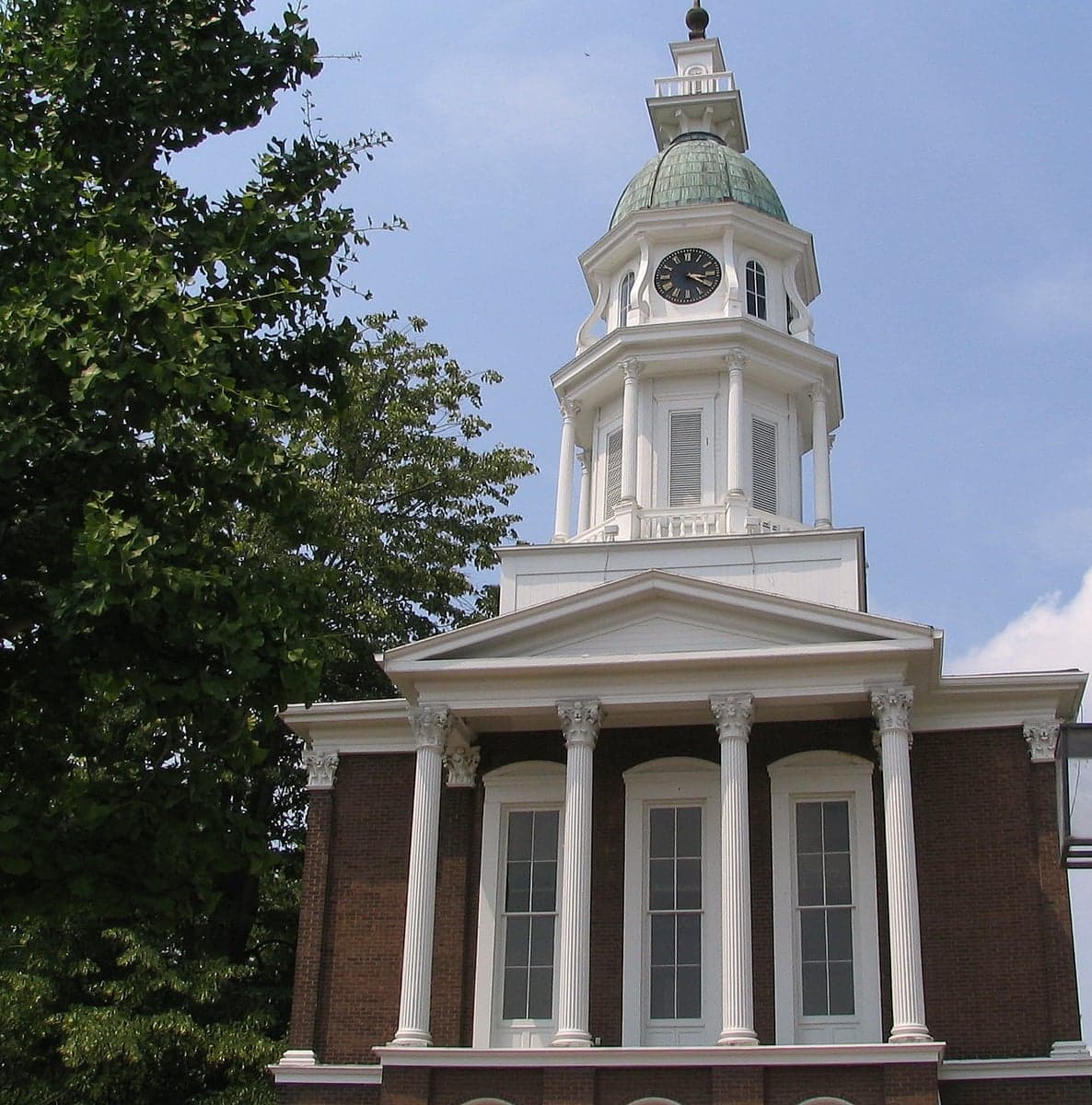
Photo: Wikipedia
Demographics of Boyle County
Affluence Level in Boyle County
A middle-class area roughly in line with national averages across income, home values, education, and employment.
People of Boyle County
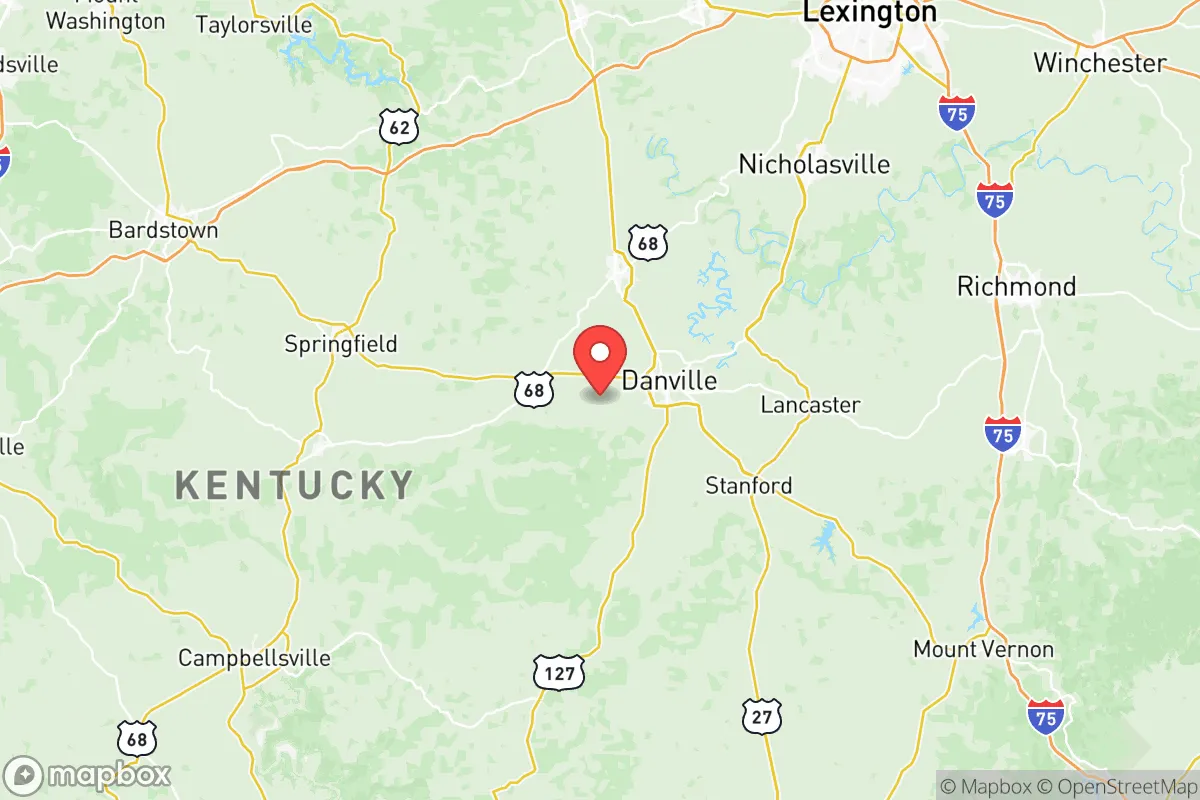
Boyle County, Kentucky, is home to 30,708 residents who form a predominantly white (83.0%) and historically rooted community, with a small but established Black population (7.4%) and a growing Hispanic presence (4.7%). The county’s character is defined by its central Kentucky location, a mix of agricultural heritage and small-city life centered on Danville, and a population that is slightly less diverse than the national average but more diverse than many surrounding rural counties. With only 1.5% foreign-born residents and a 27.4% college-educated rate, Boyle County leans conservative and traditional, shaped by generations of families who have lived there for decades.
Settlement & growth (pre-1960)
Before European settlement, the area that is now Boyle County was part of the traditional hunting grounds of the Shawnee and Cherokee nations. These groups used the region’s abundant game and salt licks, but no permanent Native American villages existed within the county’s modern boundaries. The first European Americans to arrive were of Scots-Irish and English descent, migrating through the Cumberland Gap in the late 18th century. They were drawn by the promise of fertile land under Virginia’s land grant system, and by 1792, the settlement of Danville was established as a key frontier outpost. Danville quickly became a political and educational hub, hosting the Kentucky constitutional conventions and, in 1783, the founding of Transylvania University, the first institution of higher learning west of the Allegheny Mountains.
Throughout the 19th century, Boyle County’s population grew steadily through natural increase and modest domestic migration. The county was officially formed in 1842 from parts of Lincoln and Mercer counties, with Danville as its seat. Agriculture—particularly tobacco, hemp, and livestock—dominated the economy, and the labor force included a significant number of enslaved African Americans. By 1860, Black residents made up roughly 30% of the county’s population. After the Civil War and Emancipation, many freedmen remained in the area, establishing communities such as Forkland and the Black neighborhoods of Danville, where they worked as sharecroppers, laborers, and small business owners. The late 19th and early 20th centuries saw little new immigration; the county’s population remained overwhelmingly native-born white and Black, with only a handful of German and Irish immigrants settling in Danville to work in the emerging tobacco warehouses and distilleries.
The early 20th century brought modest industrial growth, with the construction of the Danville & Western Railroad and the establishment of textile mills and a foundry. However, the Great Depression and the mechanization of agriculture led to out-migration, particularly among Black residents moving north during the Great Migration. By 1950, the Black population share had fallen to about 12%. The post-World War II period saw a small influx of returning veterans and their families, but Boyle County remained a stable, slow-growing community with a population of roughly 20,000. The county’s rural character persisted, with most residents living on farms or in the small towns of Danville, Perryville, and Mitchellsburg.
Modern era (post-1965)
The 1965 Hart-Cellar Act, which opened immigration to non-European countries, had a minimal direct impact on Boyle County. The foreign-born population today stands at just 1.5%, well below the national average. The county’s demographic changes since 1965 have been driven primarily by domestic migration and natural population shifts, not international immigration. The most significant change has been the growth of the Hispanic population, which rose from near zero in 1980 to 4.7% today. This growth is largely the result of Mexican and Central American immigrants moving to the region for work in agriculture, particularly tobacco and horse farming, and in construction and service industries. These families have concentrated in Danville, especially in the western and southern parts of the city, and in the rural areas around Perryville, where they work on horse farms and in nurseries.
The Black population has remained relatively stable at 7.4%, a decline from its historical peak but a higher share than in most surrounding counties. Today’s Black residents are concentrated in Danville’s historic neighborhoods, such as the West End and the area around Bate Middle School, and in the unincorporated community of Forkland. The East/Southeast Asian population is very small at 0.8%, consisting mostly of a handful of families employed at Centre College or in the medical field at Ephraim McDowell Regional Medical Center. The Indian subcontinent population is statistically negligible at 0.0%. Domestic migration since 1965 has been modest, with some retirees and professionals moving to Danville for its lower cost of living and historic charm, and a small number of families relocating from Lexington and Louisville for quieter, more affordable living. Suburbanization has been limited; Danville has expanded its city limits modestly, but the county remains largely rural, with no major suburban subdivisions.
The future
Boyle County’s population is projected to grow slowly, reaching roughly 32,000 by 2040, driven by natural increase and continued modest domestic in-migration. The county is becoming slightly more diverse, with the Hispanic share expected to rise to 6-7% as families grow and new workers arrive for agricultural and service jobs. The Black population share is likely to remain stable or decline slightly, as younger Black residents continue to move to larger cities for education and employment. The white population share will decrease gradually, but will remain the overwhelming majority. New residents are likely to continue concentrating in Danville, particularly in newer housing developments on the city’s north and east sides, while the rural areas around Perryville and Mitchellsburg will see little change. The county’s cultural identity will remain rooted in its conservative, agricultural, and small-town character, with a growing Hispanic influence in local cuisine, festivals, and churches. For someone moving in now, Boyle County offers a stable, safe, and affordable community with a strong sense of place, but with limited diversity and a slow pace of change.
Boyle County is becoming a slightly more diverse, slowly growing community that retains its historic character as a central Kentucky agricultural and small-city hub. For a relocating family or individual, it offers a low-cost, low-crime environment with good schools and a strong sense of community, but with fewer amenities and less cultural variety than larger metropolitan areas. The county’s future is one of gradual, modest change, not transformation.

* Values derived from national, state, county, city and local statistics and may differ in a specific area. Last updated: 2026-07-30T23:51:38.000Z
Narrative content on this page is AI-generated and may contain mistakes. Verify any details that matter before acting on them.
ReloMaps may earn a commission from affiliate links at no extra cost to you.

