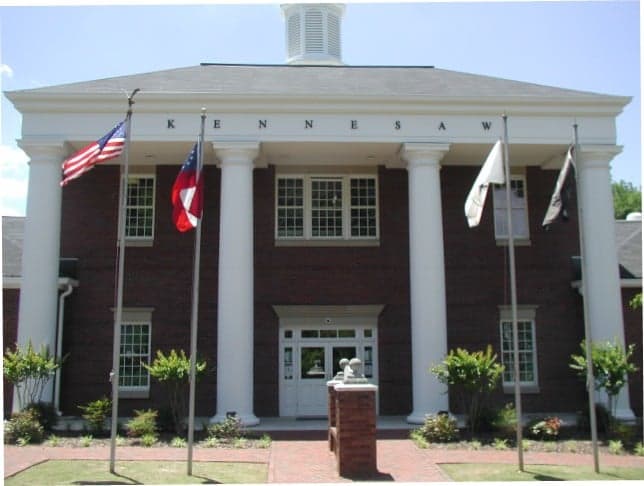
Photo: Wikipedia
Demographics of Kennesaw, GA
Affluence Level in Kennesaw, GA
A middle-class area roughly in line with national averages across income, home values, education, and employment.
People of Kennesaw, GA
The people of Kennesaw, Georgia, today form a diverse, family-oriented suburban community of 33,627 residents, characterized by a notable mix of White (53.0%), Black (20.5%), and Hispanic (15.4%) populations, alongside smaller but distinct East/Southeast Asian (3.2%) and Indian-subcontinent (2.9%) communities. With 47.1% of adults holding a college degree, the city leans professional and educated, yet retains a strong sense of local identity rooted in its railroad and Civil War history. Kennesaw is neither a transient bedroom community nor a homogenized suburb; its neighborhoods reflect distinct settlement waves, from historic downtown enclaves to newer master-planned subdivisions.
How the city was settled and grew
Kennesaw’s human history begins not with colonial settlement but with the Western & Atlantic Railroad, which drove the city’s founding in the 1830s. The original population was overwhelmingly White, drawn by railroad construction jobs and later by the region’s cotton economy. The community was originally called "Big Shanty" and served as a critical supply point during the Civil War, most famously during the Great Locomotive Chase of 1862. After the war, the town rebuilt around the railroad depot, and the Downtown Kennesaw historic district—centered on Main Street and Cherokee Street—became the heart of a small, largely Anglo-Protestant population of merchants, farmers, and railroad workers. By the early 20th century, a small Black population had settled in the Pine Mountain area, a historically African American neighborhood south of the railroad tracks, where families worked as domestic laborers and farmhands. The city remained a small, racially segregated railroad town through the 1950s, with a population under 5,000.
Modern era (post-1965)
The post-1965 era transformed Kennesaw from a sleepy railroad town into a rapidly growing Atlanta exurb. The 1965 Hart-Cellar Act opened immigration channels, but Kennesaw’s modern growth was driven primarily by domestic in-migration—White and Black families moving from Atlanta and other parts of the South for affordable housing and good schools. The completion of Interstate 75 in the 1970s made Kennesaw a commuter destination, and the city’s population exploded from roughly 5,000 in 1970 to over 21,000 by 2000. The Green Acres subdivision, built in the 1970s and 1980s, absorbed many of these early White and Black middle-class families. The 1990s and 2000s saw a surge in Hispanic migration, largely from Mexico and Central America, drawn by construction and service jobs in the booming metro area. Many settled in the Barrett Parkway corridor, where apartment complexes and townhomes offered affordable entry points. The 2010s brought a new wave: East/Southeast Asian families (Chinese, Korean, Vietnamese) and Indian-subcontinent families (Indian, Pakistani) moved into newer subdivisions like Olde Town at Kennesaw and Lakes at Stilesboro, attracted by top-rated Cobb County schools and proximity to tech and healthcare employers. Today, these groups remain geographically distinct: Hispanic families are concentrated in the Barrett Parkway and Chastain Meadows areas, while East/Southeast Asian and Indian families are more dispersed across the city’s newer, higher-priced subdivisions.
The future
Kennesaw’s population is heading toward greater diversity, but not toward a single melting pot. The White share has declined from roughly 70% in 2000 to 53% today, while Hispanic and Black shares have grown steadily. The East/Southeast Asian and Indian populations, though small, are growing faster than the city average, driven by professional-class families seeking good schools and safe neighborhoods. The city is not homogenizing; rather, it is tribalizing into distinct enclaves. The Downtown Kennesaw area remains predominantly White and older, while the Barrett Parkway corridor is increasingly Hispanic and younger. The newer subdivisions in the city’s west and north are more mixed, with Black, White, Asian, and Indian families living side by side. Over the next 10-20 years, Kennesaw will likely see its White share continue to decline to around 45-48%, with Hispanic and Black shares each approaching 20-22%, and East/Southeast Asian and Indian shares each rising to 4-5%. The city will remain a solidly middle-to-upper-middle-class suburb, but its neighborhoods will become more ethnically defined, not less.
For someone moving in now, Kennesaw offers a choice of distinct communities: a historic, walkable downtown with a small-town feel; newer, diverse subdivisions with top-rated schools; or more affordable, denser areas along the highway corridor. The city is becoming a patchwork of ethnic and economic enclaves, not a uniform suburb. That means a newcomer can find a neighborhood that matches their background and priorities, but should expect the city’s identity to remain fragmented rather than unified.

* Values derived from national, state, county, city and local statistics and may differ in a specific area. Last updated: 2026-04-30T05:58:06.000Z
Narrative content on this page is AI-generated and may contain mistakes. Verify any details that matter before acting on them.
ReloMaps may earn a commission from affiliate links at no extra cost to you.

