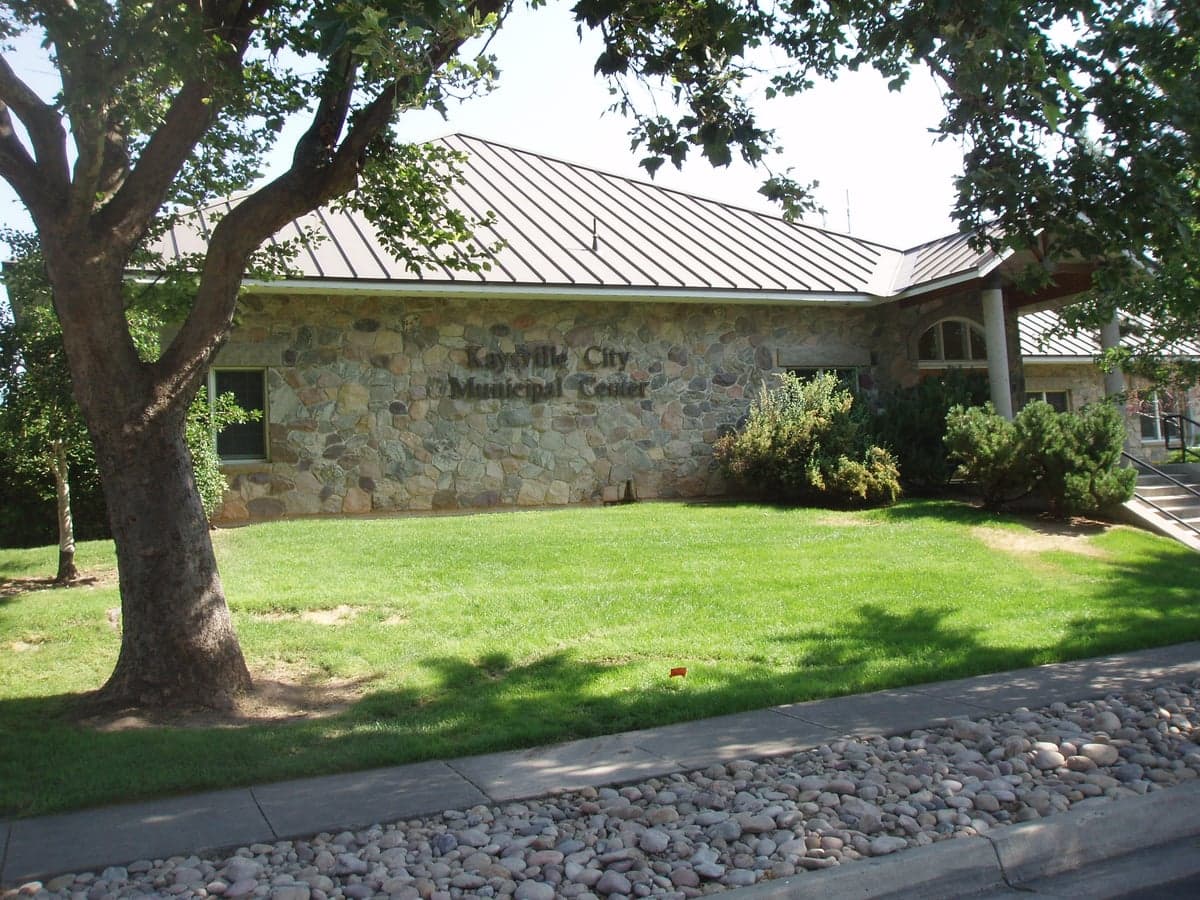
Photo: Wikipedia
Demographics of Kaysville, UT
Affluence Level in Kaysville, UT
An upper-middle-class area. Household wealth, education levels, and homeownership run ahead of national benchmarks.
People of Kaysville, UT
Kaysville, Utah, is a predominantly white, family-oriented city of 32,861 residents, characterized by a strong Latter-day Saint cultural influence and a notably low foreign-born population of just 1.4%. The city’s identity is rooted in its agricultural pioneer heritage, with modern growth driven by domestic in-migration from other parts of Utah and the Intermountain West. With 48.9% of adults holding a college degree, Kaysville is an educated, upper-middle-class suburb where single individuals and parents alike find a safe, community-focused environment. The population is overwhelmingly native-born and English-speaking, with Hispanic residents making up 5.3% and East/Southeast Asian communities at 1.4%, while Black and Indian subcontinent populations are negligible at 0.5% and 0.0%, respectively.
How the city was settled and grew
Kaysville was settled in 1849 by Mormon pioneers dispatched by Brigham Young to farm the fertile land along the Wasatch Front. The original settlers were predominantly families from the British Isles and Scandinavia who had converted to the LDS Church and gathered in Utah Territory. They established a grid of small farms centered around what is now Heritage Park and the historic Kaysville Downtown District, where many original pioneer homes still stand. The city was named after William Kay, an early LDS bishop who led the settlement. Agriculture—especially fruit orchards, grain, and livestock—drove the economy through the late 19th and early 20th centuries, with the arrival of the railroad in the 1870s connecting Kaysville to Salt Lake City markets. The population remained small and homogeneous through the mid-20th century, growing slowly from a few hundred in 1900 to about 2,500 by 1950, as families stayed in the same wards and neighborhoods like East Kaysville and West Kaysville.
Modern era (post-1965)
After the 1965 Hart-Cellar Act, Kaysville saw virtually no immigration-driven diversification; its foreign-born share remains among the lowest in Utah. Instead, the city’s modern growth came from domestic in-migration during the 1990s and 2000s as the Wasatch Front suburbanized. Families from Salt Lake City and Davis County moved north seeking larger lots and newer homes, filling subdivisions like Barnes Meadow and Foxboro—a master-planned community built in the 2000s that now houses many young families and professionals. The city’s white share (88.1%) reflects this domestic migration pattern, with most newcomers being white LDS families from elsewhere in Utah. The small Hispanic population (5.3%) is concentrated in older rental housing near the Kaysville City Center and along the Legacy Highway corridor, working in construction, landscaping, and service jobs. East/Southeast Asian residents (1.4%) are scattered across newer subdivisions like Foxboro and Barnes Meadow, often employed in tech or healthcare in nearby Layton or Salt Lake City. The Black and Indian subcontinent populations remain statistically negligible, with no distinct ethnic enclaves forming.
The future
Kaysville’s population is projected to continue growing modestly, driven by natural increase and domestic in-migration from other Utah counties. The city is homogenizing rather than diversifying: the foreign-born share is unlikely to rise significantly given the lack of immigrant-attracting industries and the high cost of housing (median home values exceed $500,000). Hispanic and East/Southeast Asian communities may grow slowly through second-generation births, but they are assimilating into the broader white LDS culture rather than forming separate enclaves. The next 10–20 years will likely see Kaysville become more affluent and educated, with new developments like Kaysville Crossing attracting upper-middle-class families. Single individuals may find the social scene limited to church and family networks, while parents will continue to value the city’s top-rated Davis County schools and low crime rates.
Kaysville is becoming an increasingly homogeneous, prosperous, and family-centric suburb where domestic in-migration reinforces its white LDS character. For a conservative-leaning single person or parent moving in now, the city offers stability, safety, and strong community ties—but little racial or cultural diversity. The population trajectory points toward continued growth in affluence and education, with no major demographic disruption on the horizon.

* Values derived from national, state, county, city and local statistics and may differ in a specific area. Last updated: 2026-04-21T09:51:21.000Z
Narrative content on this page is AI-generated and may contain mistakes. Verify any details that matter before acting on them.
ReloMaps may earn a commission from affiliate links at no extra cost to you.

