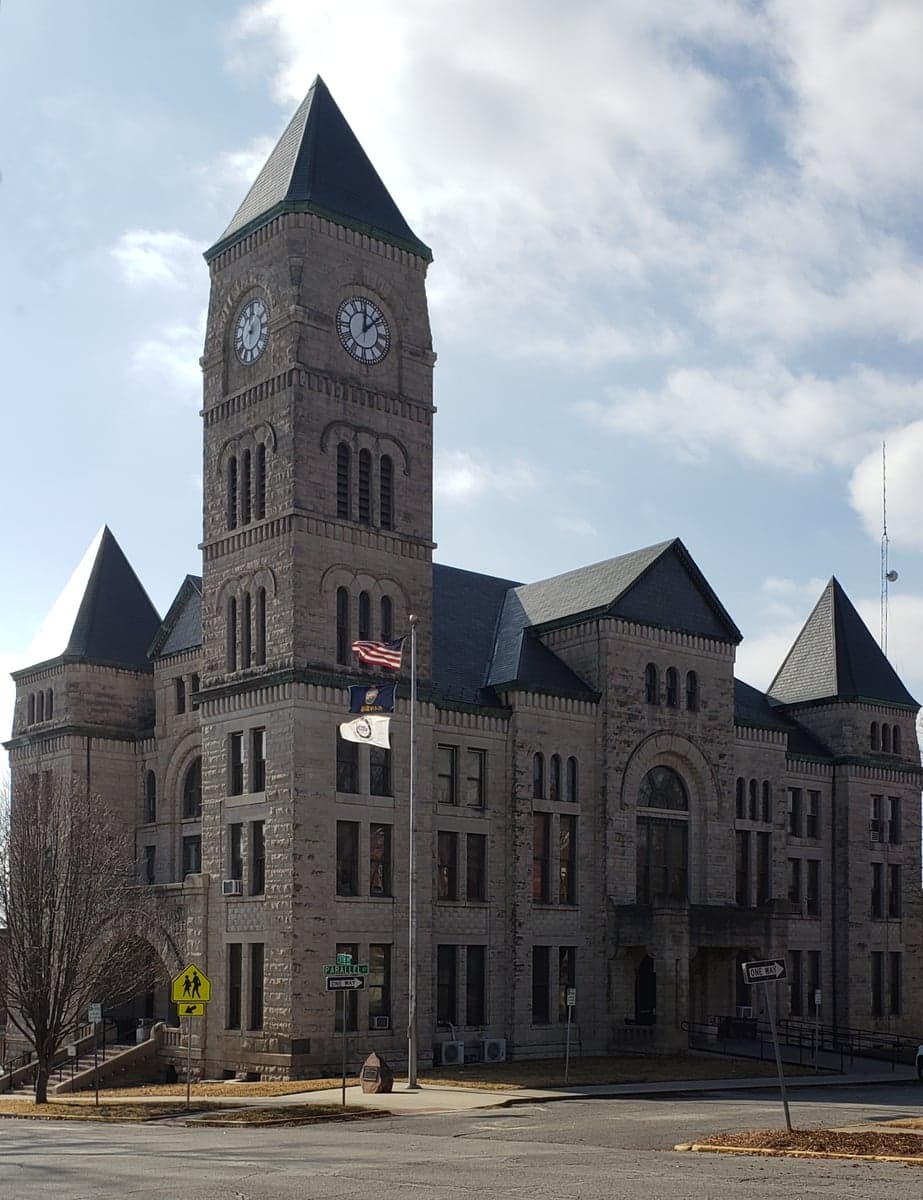
Photo: Wikipedia
Demographics of Atchison County
Affluence Level in Atchison County
A middle-class area roughly in line with national averages across income, home values, education, and employment.
People of Atchison County
The people of Atchison County, Kansas, today number just over 16,200, making it one of the state's smaller counties by population. The county is overwhelmingly white (86.3%) with a small Black population (4.2%) and a modest Hispanic community (3.6%), while foreign-born residents account for less than 1% of the total. Its identity is rooted in a 19th-century settlement pattern of European immigrants and a later African American migration tied to the railroad, producing a conservative, rural character that persists despite decades of population decline. The county seat, Atchison, anchors most of the population, with smaller towns like Effingham, Lancaster, and Muscotah dotting the agricultural landscape.
Settlement & growth (pre-1960)
Before American settlement, the area that became Atchison County was home to the Kansa and Osage nations, who used the Missouri River bottomlands for hunting and seasonal camps. The region was part of the Louisiana Purchase and remained largely uncolonized by Europeans until the 1830s, when the U.S. government forcibly removed the native tribes to reservations further west. The first permanent American settlers arrived in the 1850s, drawn by the promise of cheap land under the Kansas-Nebraska Act and the Missouri River's potential for trade.
The county's founding wave was overwhelmingly white and native-born, with families migrating from Missouri, Kentucky, and Ohio. They established the town of Atchison in 1854 as a river port and proslavery stronghold during the Bleeding Kansas era. The town's location on the Missouri River made it a natural hub for steamboat traffic and, later, the railroad. By the 1860s, Irish immigrants arrived to work on the railroad lines and settled in Atchison's working-class neighborhoods near the tracks. German immigrants followed in the 1870s and 1880s, drawn by agricultural opportunities; they formed tight-knit farming communities in the townships around Effingham and Lancaster, where German-language churches and schools operated into the early 20th century.
The most significant demographic event of the pre-1960 period was the Great Migration of African Americans from the South. Between 1910 and 1930, Black families moved to Atchison to work for the Atchison, Topeka and Santa Fe Railway, which had a major repair shop and switching yard in the city. This created a distinct Black neighborhood in Atchison's east side, centered around 5th and 6th Streets, where a small but stable community built churches, a school, and social organizations. By 1940, Black residents made up roughly 8% of the county's population, a share that has since declined. The county's population peaked at around 22,000 in 1900 and then began a slow, steady decline as agricultural consolidation reduced the need for farm labor and younger generations left for urban jobs.
Modern era (post-1965)
The 1965 Hart-Cellar Act had almost no effect on Atchison County. The foreign-born population today is just 0.7%, and there is no significant immigrant enclave anywhere in the county. The small Hispanic population (3.6%) is largely composed of Mexican-American families who arrived in the 1990s and 2000s to work in agriculture and meatpacking, primarily settling in Atchison and the rural areas around Effingham. These families have not formed a concentrated ethnic neighborhood but are dispersed across the county's housing stock.
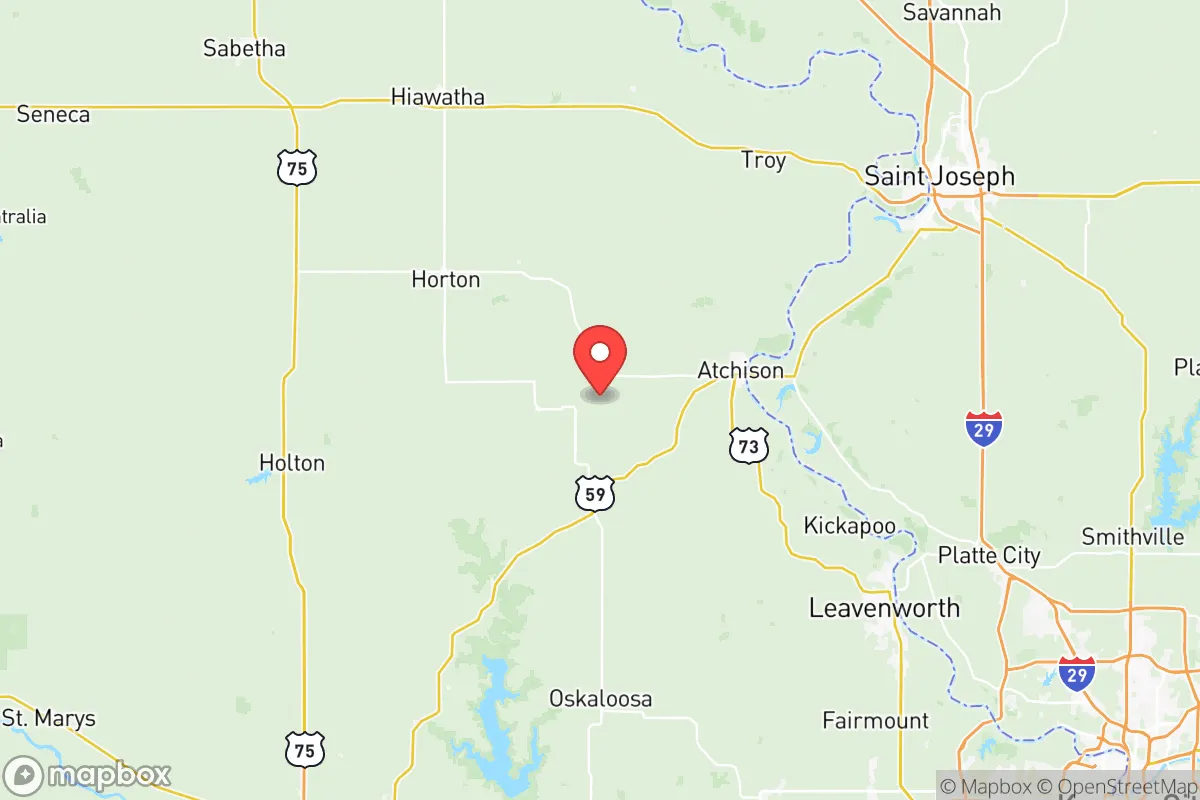
Domestic migration has been the dominant force since 1965, and it has been almost entirely outward. The county lost population in every decade after 1960, dropping from 16,500 in 1970 to 16,211 in 2020. Young adults leave for college or jobs in Kansas City (about 50 miles south) and do not return. The Black population has declined from its mid-century peak as railroad employment shrank; many Black families moved to larger cities like Kansas City or Topeka. The white population has aged in place, with a median age of 43.6, well above the national average. Suburbanization has not occurred in any meaningful way; the county remains rural, with no new subdivisions or exurban development to speak of. The town of Atchison has seen some infill housing, but the county's housing stock is predominantly older single-family homes and farmhouses.
The future
Atchison County's population is projected to continue its slow decline over the next 10-20 years, likely falling below 15,000 by 2040. The county is homogenizing rather than tribalizing: the small Hispanic community is assimilating into the white majority, with English becoming the dominant language in second-generation households. The Black population is expected to shrink further as older residents pass away and younger generations do not return. There is no sign of significant in-migration from any group, and the county's cultural identity — conservative, rural, and rooted in 19th-century European-American traditions — is likely to persist unchanged. The small Benedictine College in Atchison brings a transient population of students, but few stay after graduation.
For someone moving in now, Atchison County offers a stable, low-crime, and culturally homogeneous environment where the population is shrinking but not collapsing. The people are overwhelmingly native-born, English-speaking, and politically conservative, with a strong sense of local history and community. The county is not becoming more diverse or more urban; it is quietly aging in place, and new residents will find a place that looks and feels much as it did in 1960, only smaller and quieter.

* Values derived from national, state, county, city and local statistics and may differ in a specific area. Last updated: 2026-05-29T10:03:32.000Z
Narrative content on this page is AI-generated and may contain mistakes. Verify any details that matter before acting on them.
ReloMaps may earn a commission from affiliate links at no extra cost to you.

