Photo: Wikipedia
Demographics of Kansas City, KS
Affluence Level in Kansas City, KS
A below-average socioeconomic profile. Incomes, home values, and educational attainment trail the U.S., with higher poverty and unemployment.
People of Kansas City, KS
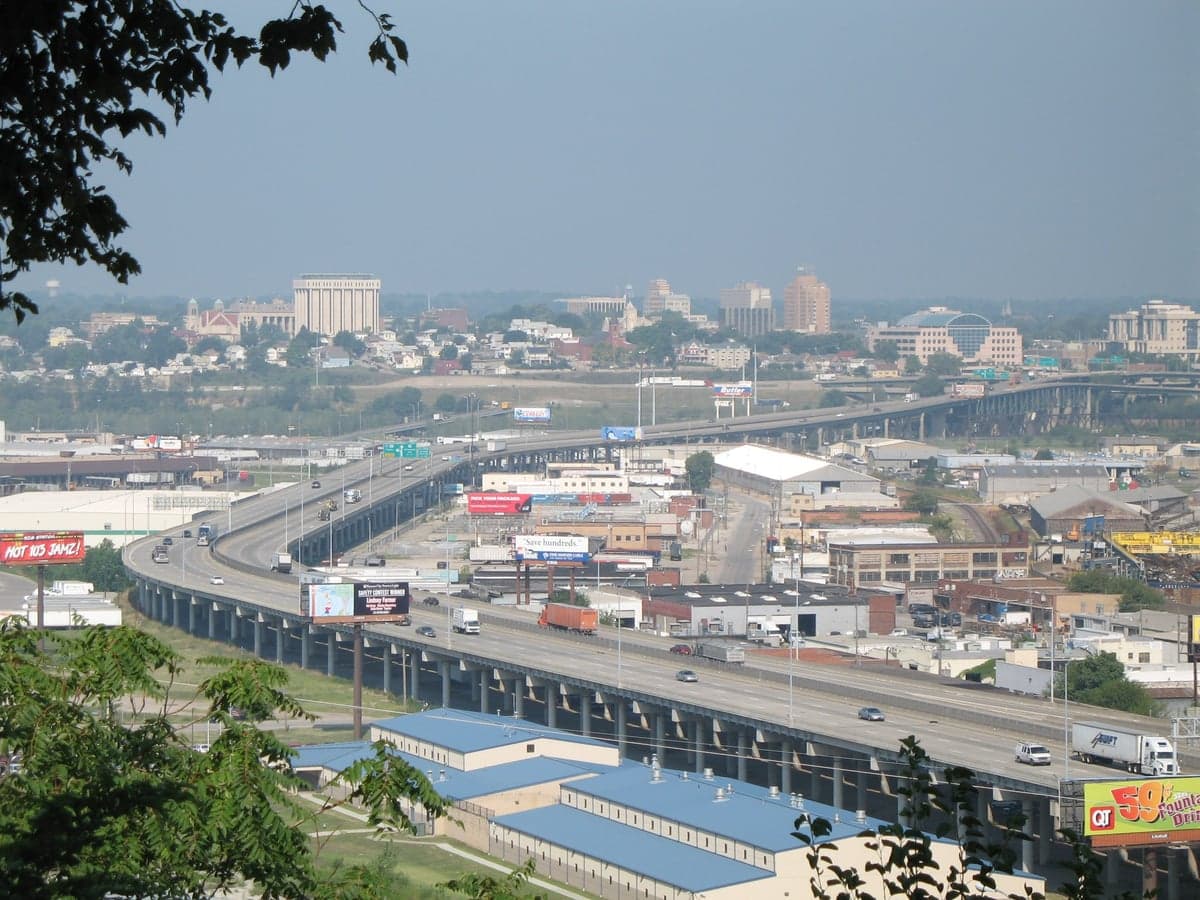
Kansas City, Kansas, is a dense, working-class city of 154,776 residents with a distinctive tri-ethnic character: roughly equal shares of White (34.4%) and Hispanic (35.0%) populations, a substantial Black community (20.0%), and a growing East/Southeast Asian presence (4.6%). It is younger and less college-educated than the national average (20.2% hold a bachelor’s degree), and its foreign-born population of 13.3% is notably higher than the Kansas state average. The city’s identity is rooted in industrial labor, immigrant neighborhoods, and a pragmatic, family-oriented conservatism that values stability and local community over rapid change.
How the city was settled and grew
Kansas City, Kansas, was founded in the 1860s as a railroad and industrial hub, deliberately positioned across the Kansas River from its larger Missouri namesake. The city’s early growth was driven by the meatpacking and railroad industries, which drew waves of European immigrants. German and Irish laborers settled in the Strawberry Hill neighborhood, building the city’s first Catholic parishes and union halls. By the early 1900s, the meatpacking plants in the Armourdale district attracted Slovak, Croatian, and Polish immigrants, who formed tight-knit ethnic enclaves with their own churches, fraternal societies, and small businesses. The Rosedale area, near the Kansas-Missouri state line, became a stronghold for Italian and Lithuanian families, many of whom worked in the nearby stockyards and rail yards. The city’s Black population grew significantly during the Great Migration (1910–1970), with African Americans from the rural South settling in the Junction neighborhood and the Quindaro area, a historically Black community that once housed a free-state university. By 1950, Kansas City, Kansas, was a classic industrial city: dense, ethnically segmented, and dominated by blue-collar union jobs.
Modern era (post-1965)
The post-1965 era brought profound demographic change. The Immigration and Nationality Act of 1965 opened the door to new waves of non-European immigrants, while deindustrialization reshaped the city’s economy. Hispanic immigration, primarily from Mexico and Central America, accelerated in the 1970s and 1980s as meatpacking and food-processing plants remained a draw. Today, the Argentine neighborhood and the Central Avenue corridor are the heart of the Hispanic community, with vibrant tiendas, taquerias, and Spanish-language churches. The East/Southeast Asian population (4.6%) is concentrated in the Strawberry Hill and Rosedale areas, where Vietnamese and Cambodian families arrived as refugees after the Vietnam War and later as chain migrants. The city’s Black population, which peaked at around 30% in the 1990s, has declined slightly to 20.0% as some families moved to suburbs like Olathe and Lenexa. The White population, once a majority, has fallen to 34.4%, with many older European-ethnic families aging in place or relocating to exurban Johnson County. The city’s foreign-born share (13.3%) is nearly double the Kansas average, driven almost entirely by Hispanic and East/Southeast Asian immigration.
The future
The population of Kansas City, Kansas, is trending toward a Hispanic-plurality future. The Hispanic share (35.0%) is the fastest-growing segment, driven by both immigration and higher birth rates, and is projected to become the majority within 15–20 years. The White population is aging and declining, while the Black population is stable but slowly shrinking. The East/Southeast Asian community is growing modestly, primarily through family reunification and small-business entrepreneurship. The city is not homogenizing; instead, it is tribalizing into distinct enclaves: Argentine and Central Avenue are overwhelmingly Hispanic, Quindaro remains predominantly Black, and Strawberry Hill retains a mixed White and Asian character. The Indian-subcontinent population (0.7%) is negligible and concentrated in scattered households rather than a distinct neighborhood. The city’s low college-attainment rate (20.2%) and heavy reliance on manufacturing, warehousing, and logistics jobs suggest that future growth will be driven by working-class immigrant families seeking affordable housing and industrial employment, not by white-collar professionals.
For a conservative-leaning mover today, Kansas City, Kansas, offers a stable, family-oriented environment with strong ethnic neighborhoods, low housing costs, and a pragmatic, blue-collar culture. The city is becoming more Hispanic and more immigrant-heavy, but it remains a place where traditional values—church, family, hard work—are visible in every neighborhood. The trade-off is limited economic mobility and a school system that struggles with poverty, but for those who value community rootedness over rapid change, the city’s trajectory is one of steady, organic evolution rather than disruption.

* Values derived from national, state, county, city and local statistics and may differ in a specific area. Last updated: 2026-04-30T00:39:22.000Z
Narrative content on this page is AI-generated and may contain mistakes. Verify any details that matter before acting on them.
ReloMaps may earn a commission from affiliate links at no extra cost to you.

