Photo: Wikipedia
Demographics of Jackson, WY
Affluence Level in Jackson, WY
A wealthy area with high-earning, well-educated households. Incomes, home values, and educational attainment meaningfully outpace national averages.
People of Jackson, WY
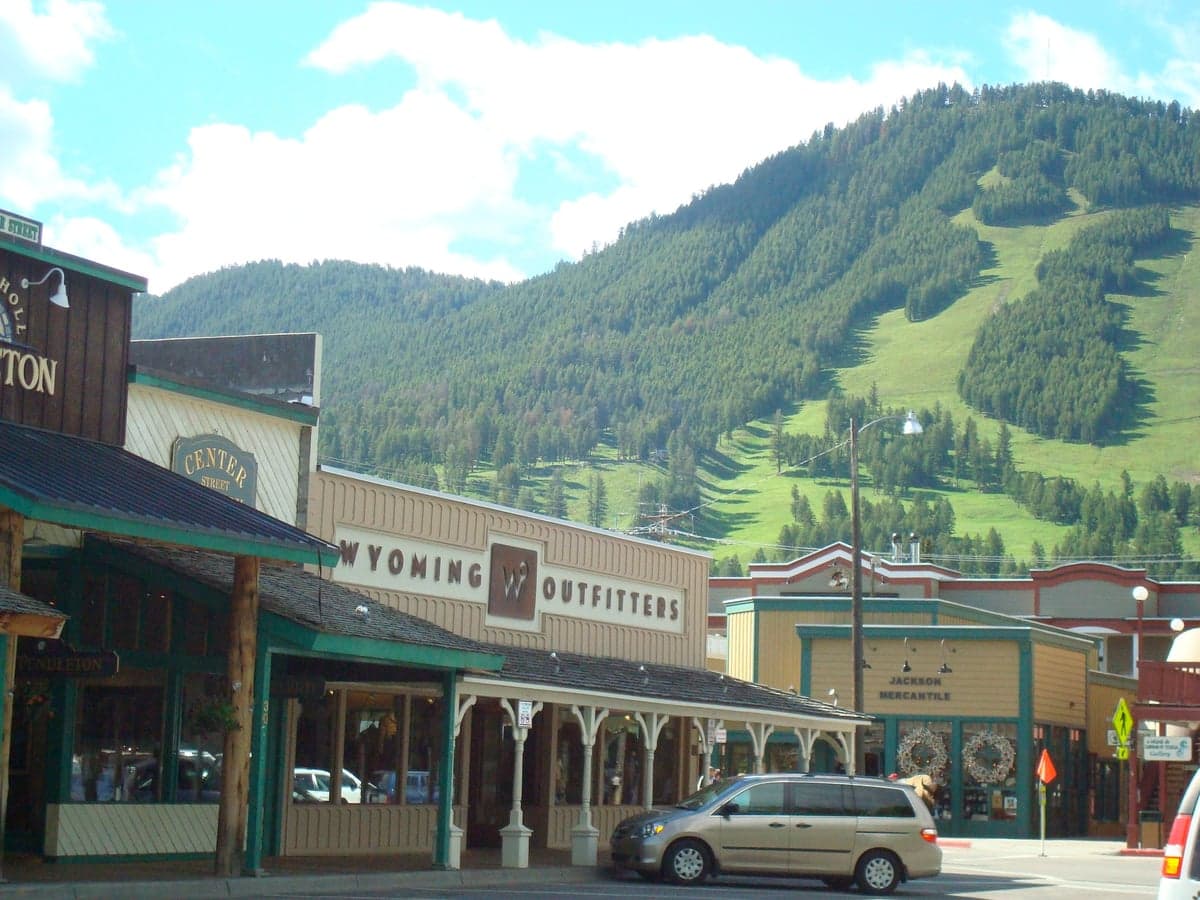
Jackson, Wyoming, today is a small, high-cost mountain town of 10,746 residents defined by its stark economic and cultural contrasts. The population is predominantly white (67.6%) with a significant Hispanic minority (23.5%) and a small but growing East/Southeast Asian community (1.2%), while the foreign-born share stands at 14.7%. The city’s character is split between a wealthy, college-educated (55.0%) service and tourism economy and a long-established Latino workforce that underpins the hospitality and construction sectors. Distinct neighborhoods reflect these divisions, with historic districts housing old ranching families and newer subdivisions absorbing recent arrivals.
How the city was settled and grew
Jackson’s human history begins with the Shoshone and Bannock tribes, who used the valley as a seasonal hunting ground before forced removal in the late 19th century. White settlement began in the 1880s with cattle ranchers drawn by open range and the 1892 Homestead Act, establishing the West Bank area along the Snake River as the first permanent homesteads. The town was formally platted in 1914, and the arrival of the railroad in the 1920s spurred a small wave of homesteaders and merchants, who built the Downtown Historic District around Town Square. These early residents were almost entirely of Northern European descent—English, Scots-Irish, and Scandinavian—and the population remained under 1,000 through the 1940s. The creation of Grand Teton National Park in 1929 and Jackson Hole Mountain Resort in 1965 shifted the economy from ranching to tourism, drawing a second wave of seasonal workers, many of them Mexican immigrants, who settled in the Indian Springs neighborhood and the unincorporated area of Hoback Junction south of town.
Modern era (post-1965)
After the 1965 Immigration and Nationality Act, Jackson’s Hispanic population grew steadily, rising from negligible levels to 23.5% by 2024. This wave consisted primarily of Mexican and Central American workers recruited by the ski resort, hotels, and construction firms, who concentrated in Indian Springs and the South Park subdivision—areas with lower housing costs and multi-generational family networks. Meanwhile, domestic in-migration accelerated after 2000, driven by wealthy retirees, second-home buyers, and remote workers attracted to the mountain lifestyle. These newcomers—overwhelmingly white and college-educated—settled in the East Jackson neighborhoods near the resort and in the luxury subdivisions of Rafter J and Melody Ranch. The white population share dropped from roughly 85% in 1990 to 67.6% today, not due to white flight but because Hispanic growth outpaced white in-migration. The East/Southeast Asian community (1.2%) is small and largely composed of professionals in hospitality management and tech-adjacent roles, living in East Jackson and Rafter J. The Indian subcontinent population (0.5%) is negligible, mostly medical professionals at St. John’s Health. The Black population (0.9%) remains tiny, reflecting the town’s lack of industrial or urban pull factors.
The future
Jackson’s population is heading toward greater economic stratification rather than racial homogenization. The Hispanic community is growing through natural increase and continued immigration, but high housing costs—median home prices above $2 million—are pushing younger Latino families to Hoback Junction and the town of Victor, Idaho, 30 miles away. The white population is bifurcating: wealthy newcomers are consolidating in East Jackson and Rafter J, while longer-term white residents without real estate equity are being priced out. The East/Southeast Asian and Indian communities are likely to remain small, as Jackson lacks the ethnic enclaves and job diversity that attract larger immigrant populations. Over the next 10–20 years, the city will likely become more Hispanic in its workforce and more white and wealthy in its voter base, with the two groups living increasingly separate lives—one in affordable fringe areas, the other in gated subdivisions. The foreign-born share (14.7%) may plateau as immigration policy tightens and housing constraints intensify.
For a conservative-leaning mover, Jackson is a place where traditional Western values of self-reliance and outdoor recreation coexist with a high cost of living and a growing service underclass. The town is not becoming a diverse melting pot but a two-tiered community: a wealthy, white, college-educated core and a Hispanic working-class periphery. New arrivals should expect a tight-knit, politically conservative environment in the historic districts and a more transient, seasonal atmosphere in the newer subdivisions. The bottom line is that Jackson rewards those who can afford it and offers limited upward mobility for those who cannot, making it a stable but stratified destination for relocation.

* Values derived from national, state, county, city and local statistics and may differ in a specific area. Last updated: 2026-04-21T11:34:32.000Z
Narrative content on this page is AI-generated and may contain mistakes. Verify any details that matter before acting on them.
ReloMaps may earn a commission from affiliate links at no extra cost to you.

