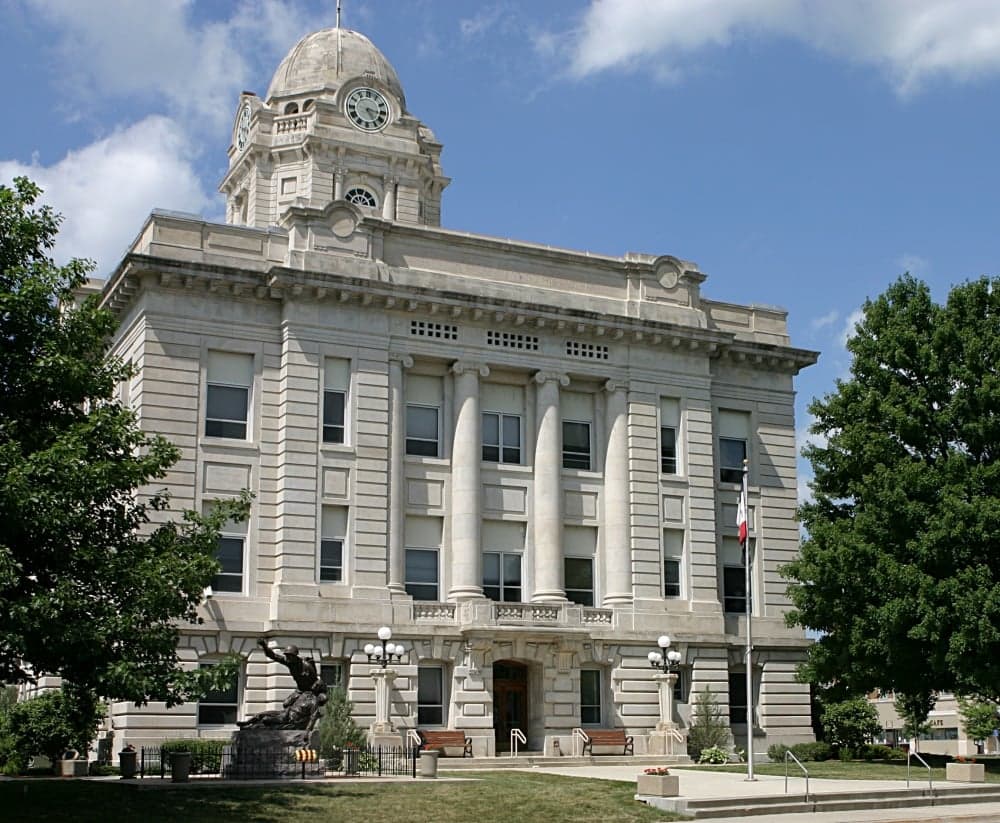
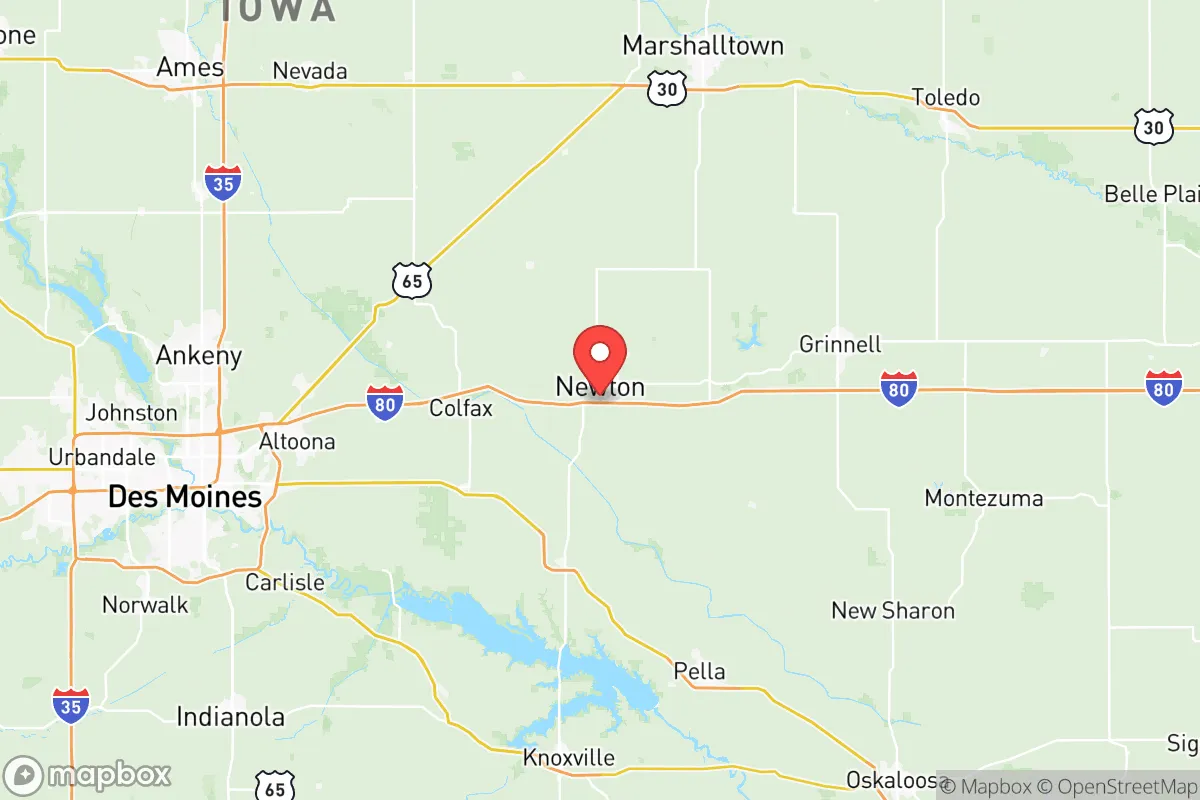
Photo: Wikipedia
Demographics of Jasper County
Affluence Level in Jasper County
A middle-class area roughly in line with national averages across income, home values, education, and employment.
People of Jasper County
Jasper County, Iowa, is home to 37,864 residents who form one of the state's most ethnically homogeneous rural populations, with 91.9% of the county identifying as white and a foreign-born share of just 1.9%. The county's character is defined by its agricultural roots, small-town civic life centered around the county seat of Newton, and a population density of roughly 35 people per square mile that preserves a quiet, family-oriented pace of life. Distinctive markers include a strong manufacturing legacy tied to the Maytag Corporation's historic presence in Newton, a deeply ingrained work ethic, and a political culture that leans conservative in local elections while maintaining a pragmatic, non-ideological streak on practical matters like school funding and infrastructure.
Settlement & growth (pre-1960)
The land that became Jasper County was originally inhabited by the Sauk and Meskwaki (Fox) nations, who used the region for hunting and seasonal encampments along the Skunk River and its tributaries. The United States acquired the area through the 1842 Treaty of the Sauk and Fox, which opened the Iowa Territory to American settlement. The first permanent white settlers arrived in the mid-1840s, predominantly from the Upper South—Kentucky, Tennessee, and southern Ohio—bringing with them a Scots-Irish and English yeoman-farmer culture that valued self-sufficiency and local governance.
The county was officially organized in 1846, and the town of Newton was platted in 1847 as the county seat. The earliest settlers were drawn by the promise of rich, prairie soil for corn and livestock farming, with land available through federal preemption claims and later the Homestead Act of 1862. A second wave of immigrants arrived in the 1850s and 1860s, this time from Germany and the Netherlands, who established farming communities in the townships around Baxter, Colfax, and Prairie City. These German and Dutch settlers brought with them a tradition of cooperative grain elevators, dairy farming, and Lutheran and Reformed church congregations that still anchor those communities today.
The arrival of the Chicago, Rock Island and Pacific Railroad in the 1860s transformed Jasper County from a purely agricultural economy into a regional transportation and manufacturing hub. The railroad spurred the growth of Newton as a commercial center and attracted a small but significant population of Irish laborers who worked on track construction and later settled in the county's railroad towns. By 1900, the county's population had reached 26,976, with the vast majority still engaged in farming or farm-related businesses.
The single most transformative event in Jasper County's human history was the relocation of the Maytag Company from Chicago to Newton in 1893. Frederick Maytag, a German-American entrepreneur, began manufacturing farm implements and later washing machines, turning Newton into a company town that attracted skilled machinists, electricians, and assembly-line workers from across the Midwest. The Maytag plant's expansion through the 1920s and 1930s drew a wave of internal migrants from rural Iowa and neighboring states—many of them second- and third-generation German and Scandinavian farmers' sons seeking steady industrial wages. This manufacturing base gave Newton a distinctly blue-collar, union-influenced character that coexisted uneasily with the county's conservative agrarian culture. The population peaked at 37,864 in the 2020 census, but the county had already reached a similar high of 37,796 in 1930, reflecting a century of stability rather than explosive growth.
Modern era (post-1965)
The 1965 Hart-Cellar Act had minimal direct impact on Jasper County, as the region never attracted significant post-1965 immigration. The foreign-born population today stands at just 1.9%, and the county's racial composition remains overwhelmingly white at 91.9%. The most notable demographic shift since the 1960s has been domestic out-migration of young adults to Iowa's larger cities—Des Moines, Iowa City, and Cedar Rapids—combined with a modest influx of Hispanic workers, who now make up 2.9% of the population. These Hispanic residents are primarily of Mexican origin and work in agricultural processing, meatpacking, and construction, with small clusters forming in Newton and Monroe.
The closure of the Maytag plant in 2006—after Whirlpool acquired the company and moved production to Mexico—was a demographic earthquake. Newton lost roughly 1,800 manufacturing jobs overnight, triggering a decade of population decline and out-migration. The county's population dropped from 37,213 in 2000 to 36,842 in 2010, as displaced workers relocated to Des Moines or left the state entirely. The recovery has been slow but real: the county rebounded to 37,864 by 2020, driven by a combination of new manufacturing employers (such as TPI Composites, which opened a wind-turbine blade factory in Newton in 2008) and a growing number of retirees and remote workers drawn by low housing costs and small-town safety.
The Black population remains very small at 1.6%, concentrated almost entirely in Newton, with roots tracing back to a small number of families who moved to the county during the Great Migration of the 1940s and 1950s to work at Maytag. The East/Southeast Asian population is negligible at 0.5%, and there is no measurable Indian-subcontinent population. The county's racial homogeneity is reinforced by the absence of any major refugee resettlement program or ethnic enclave infrastructure.
The future
Jasper County's population is projected to remain stable or decline slightly over the next two decades, as the county's birth rate falls below replacement level and out-migration of young adults continues. The Hispanic share of the population is likely to grow gradually—possibly reaching 5-7% by 2040—as agricultural and manufacturing employers continue to recruit immigrant labor, but the county will remain overwhelmingly white and native-born. The most significant demographic trend is aging: the median age in Jasper County is 42.3, several years above the national median, and the proportion of residents over 65 is rising as younger generations leave for urban job markets.
The county is not tribalizing into distinct ethnic enclaves; rather, it is slowly homogenizing as the small Hispanic and Black populations assimilate into the broader white-majority culture through intermarriage and geographic dispersion. The cultural identity of Jasper County is being reshaped less by immigration than by the gradual replacement of its manufacturing heritage with a commuter-and-retirement economy. Towns like Sully and Kellogg are seeing an influx of former Des Moines residents seeking cheaper land and slower living, while Newton is positioning itself as a bedroom community for the state capital, 35 miles to the west.
For a conservative-leaning individual or family considering a move to Jasper County, the bottom line is this: you will find a place that is demographically stable, culturally traditional, and politically conservative in the Midwestern, non-ideological sense. The county offers low crime rates, good public schools in Newton and Colfax, and a cost of living roughly 15% below the national average. The trade-off is limited ethnic diversity, a shrinking pool of young adults, and a local economy that remains dependent on manufacturing and agriculture rather than professional services or technology. Jasper County is not a place of rapid change or demographic dynamism—it is a place where the population is slowly aging in place, and where new arrivals are most likely to be retirees or remote workers seeking the quiet, neighborly life that has defined this corner of Iowa for 175 years.

* Values derived from national, state, county, city and local statistics and may differ in a specific area. Last updated: 2026-05-14T19:12:13.000Z
Narrative content on this page is AI-generated and may contain mistakes. Verify any details that matter before acting on them.
ReloMaps may earn a commission from affiliate links at no extra cost to you.

