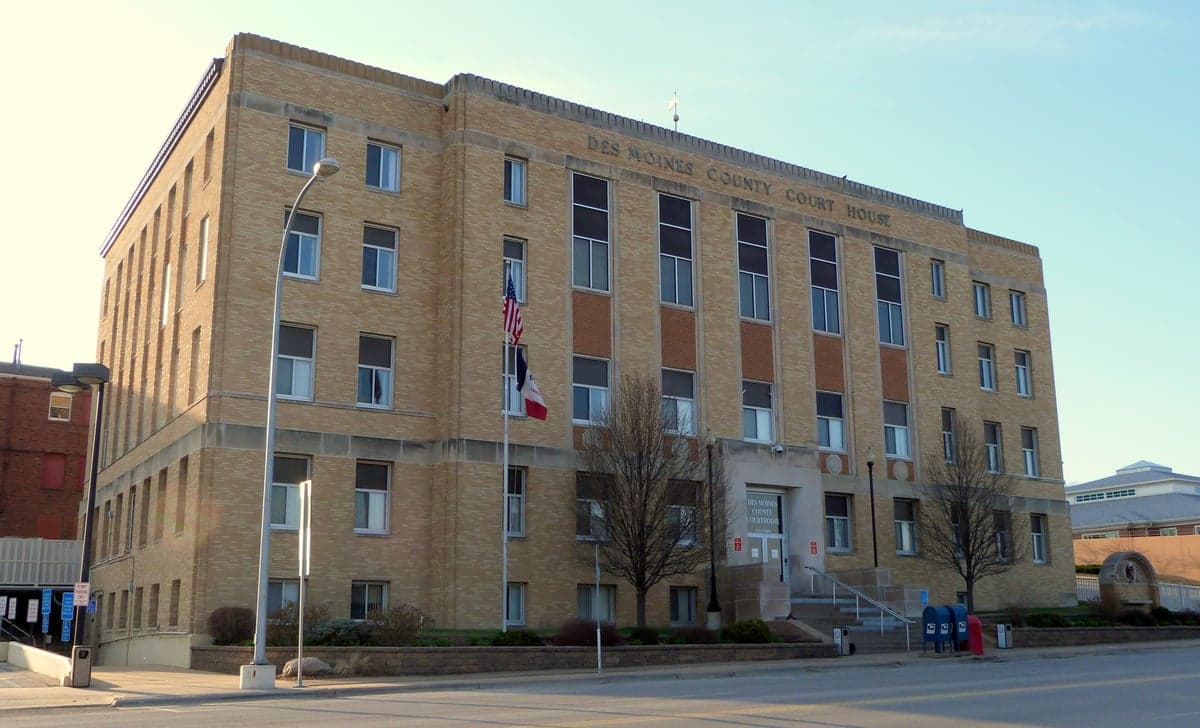
Photo: Wikipedia
Demographics of Des Moines County
Affluence Level in Des Moines County
A middle-class area roughly in line with national averages across income, home values, education, and employment.
People of Des Moines County
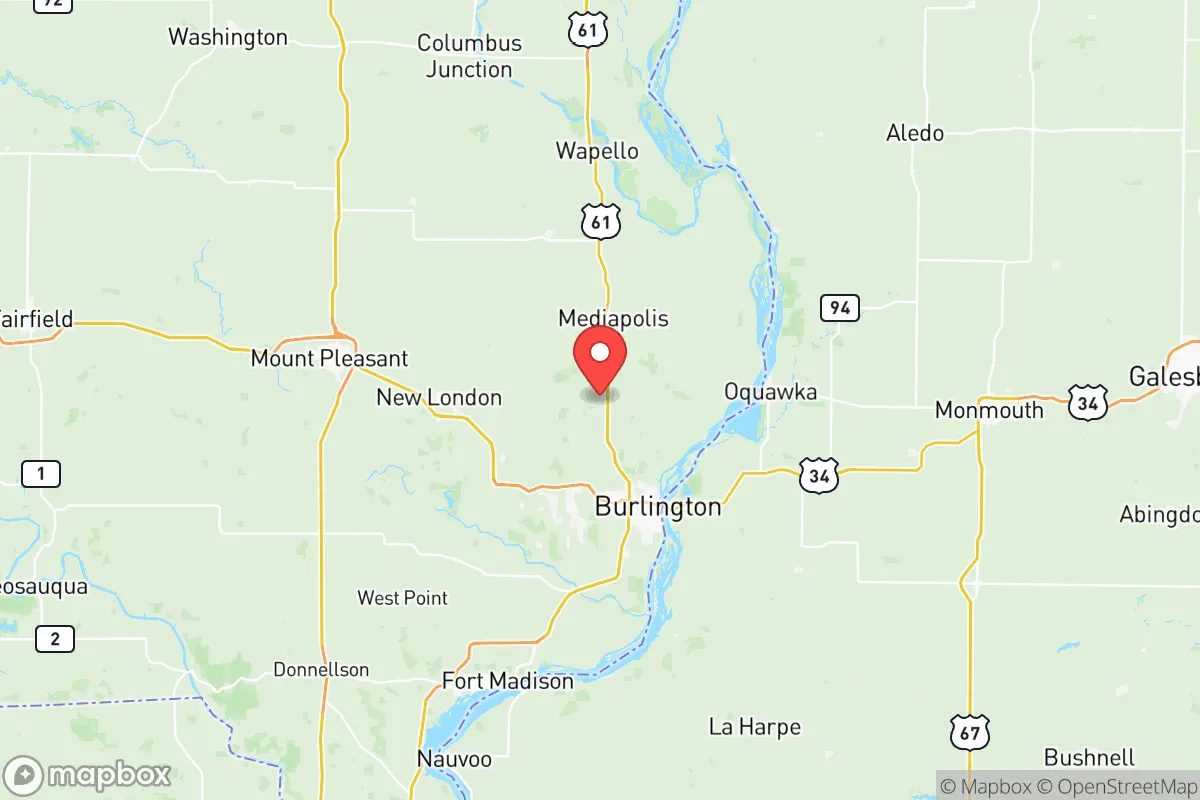
Today, Des Moines County, Iowa, is home to roughly 38,600 residents, a population that is 85.2% white and notably older and more rooted than the national average. The county’s identity is shaped by its historic Mississippi River towns—Burlington, the county seat and largest city, along with smaller communities like West Burlington, Danville, and Mediapolis—where a manufacturing and agricultural heritage still defines daily life. With only 1.6% foreign-born and a modest 23.8% college-educated rate, the population is predominantly native-born, working-class, and culturally Midwestern, with a conservative-leaning character that reflects its slow, organic growth over two centuries.
Settlement & growth (pre-1960)
Before American settlement, the land that became Des Moines County was home to the Sauk and Meskwaki (Fox) nations, who used the Mississippi River floodplains for seasonal hunting and agriculture. French explorers and traders passed through the region in the late 1600s, but no permanent European settlement occurred until after the Black Hawk Purchase of 1832, which forced the Sauk and Meskwaki west of the Mississippi. The first American settlers were primarily Yankees from New England and New York, drawn by the promise of fertile prairie land and river access. Burlington, platted in 1833, quickly became a territorial capital and a bustling steamboat port, attracting merchants, lawyers, and speculators from the Northeast.
The next major wave arrived in the 1840s and 1850s: German immigrants, who settled heavily in Burlington and the surrounding farmlands. They established Catholic and Lutheran churches, breweries, and tight-knit rural communities in places like Danville and Sperry. A smaller but significant group of Irish immigrants came during the same period, working on the railroad and in the riverfront industries, settling in Burlington’s working-class neighborhoods near the rail yards. By 1860, Des Moines County’s population had surged past 20,000, with Germans and Irish making up roughly a third of the total.
After the Civil War, the county saw a modest influx of Swedish and Norwegian immigrants, who took up farming in the northern townships around Mediapolis and Kingston. The late 19th century also brought a small number of African American families, mostly former slaves from the Upper South, who settled in Burlington and found work as domestic servants, laborers, and later in the city’s growing manufacturing sector. The county’s population peaked around 1900 at nearly 36,000, then plateaued as the agricultural economy mechanized and young people left for cities. The Dust Bowl and Great Depression of the 1930s caused little net migration here—unlike the Great Plains—but the county’s growth stalled. By 1960, the population had settled at roughly 38,000, a number it has held with only minor fluctuations ever since.
Modern era (post-1965)
The 1965 Hart-Cellar Act had minimal impact on Des Moines County. Unlike Iowa’s larger cities—Des Moines, Cedar Rapids, or Iowa City—Burlington and its surroundings did not attract significant post-1965 immigration. The foreign-born population today sits at just 1.6%, far below the national average. The small Hispanic community (3.5% of the county) began forming in the 1990s and 2000s, primarily Mexican immigrants and their descendants who came to work in Burlington’s meatpacking plants and agricultural processing facilities. They are concentrated in Burlington’s south side and in West Burlington, where a handful of Spanish-language churches and small businesses have emerged.
The Black population (4.2%) is largely composed of families who have been in the county for generations, with roots stretching back to the post-Civil War era and a smaller number of arrivals during the Great Migration of the 1910s-1940s. Today, Burlington’s Black community is centered in the city’s older neighborhoods near the river, with little recent in-migration. The East/Southeast Asian population (0.5%) and Indian-subcontinent population (0.6%) are tiny, mostly professionals employed at the county’s largest employer, the Iowa Army Ammunition Plant in Burlington, or at the local hospital and university. No distinct ethnic enclaves exist for these groups; they are scattered across the county.
Domestically, Des Moines County has experienced a slow but steady out-migration of young adults since the 1970s, as manufacturing jobs declined and the agricultural sector consolidated. The county has not seen the Sun Belt-style suburbanization that reshaped much of the Midwest; instead, Burlington’s population has slowly aged, with the median age rising to 43.5. The only notable in-migration has been a trickle of retirees from Chicago and the Quad Cities, drawn by lower housing costs and the Mississippi River lifestyle, settling in Burlington’s historic districts and along the river bluffs.
The future
Demographic projections suggest Des Moines County will continue to shrink slowly, with the population likely falling below 37,000 by 2040. The county is homogenizing rather than tribalizing: the small Hispanic and Black communities are not growing rapidly, and the white population is aging in place. The foreign-born share is unlikely to rise significantly, as the county lacks the job growth or ethnic networks that attract new immigrants. The college-educated share (23.8%) is below the state average and is not expected to increase without a major economic shift.
The cultural identity of the county is likely to remain stable—rooted in its Midwestern, working-class, and predominantly white character. The small Hispanic community is slowly assimilating, with second-generation families increasingly speaking English and moving into the mainstream economy. The biggest demographic change will be the continued aging of the population, which will strain local services and housing markets. For a conservative-leaning individual or family moving in now, Des Moines County offers a predictable, low-diversity environment where community ties are strong but economic opportunities are limited.
Des Moines County is becoming a quieter, older, and more insular place—a Mississippi River community that has largely missed the demographic churn reshaping America. For someone seeking a stable, low-cost, and culturally traditional environment, it remains a viable choice, but the county’s future is one of gentle decline rather than renewal.

* Values derived from national, state, county, city and local statistics and may differ in a specific area. Last updated: 2026-05-28T01:27:25.000Z
Narrative content on this page is AI-generated and may contain mistakes. Verify any details that matter before acting on them.
ReloMaps may earn a commission from affiliate links at no extra cost to you.

