
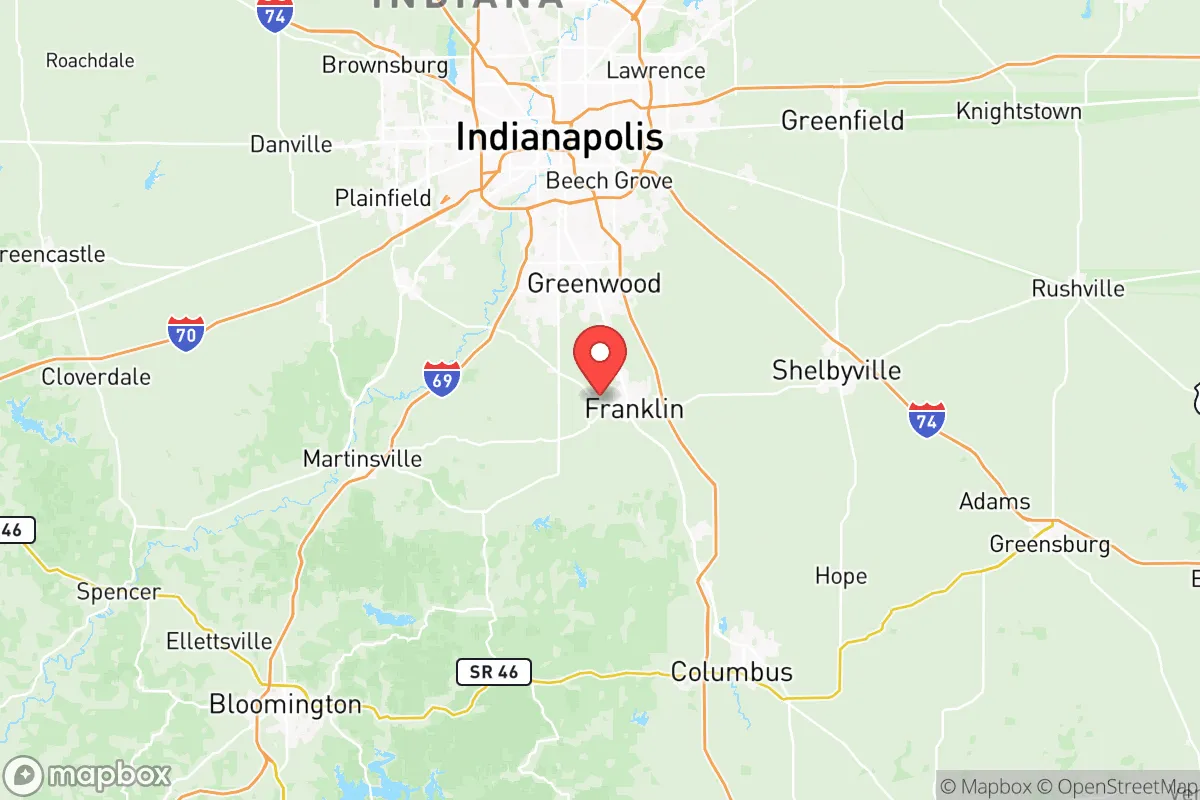
Photo: Wikipedia
Personal Sovereignty in Johnson County
Viable for self-reliance. Generally workable, though some barriers may limit total independence.
What does Personal Sovereignty tell us?
Personal Sovereignty measures your capacity for self-reliance and independence with minimal government friction. Higher scores mean fewer barriers between you and the way you want to live... but it assumes you have the space you need and good neighbors.
What does this tell us?
Personal Sovereignty measures your capacity for self-reliance and independence with minimal government friction. Higher scores mean fewer barriers between you and the way you want to live... but it assumes you have the space you need and good neighbors.
State Policy
Energy independence: Importer (35% of energy produced in-state)
Personal Liberty
Homesteading

Personal Liberty Analysis
Johnson County, Indiana offers a solid baseline of personal sovereignty compared to much of the Midwest, but the level of autonomy you’ll actually experience depends heavily on which end of the county you plant your flag. Northern towns like Greenwood and Whiteland lean suburban with more HOAs and municipal codes, while the southern stretch through Trafalgar and Edinburgh still feels like a place where you can mind your own business without a government official peering over your shoulder. For the survivalist or prepper who wants to be within striking distance of Indianapolis but not under its thumb, this county is worth a hard look—provided you pick the right spot and understand exactly what you’re buying into.
Tax burden and regulatory posture in Johnson County: what a self-reliant individual actually pays and faces
Indiana’s state-level tax structure is already friendly to anyone who resents sending hard-earned money to the government. The state’s flat income tax rate sits at 3.05% after recent cuts, and property taxes are capped by the state constitution at 1% of assessed value for homesteads, 2% for residential rentals, and 3% for businesses. Johnson County adds its own local rates on top of that, but the total effective property tax rate still hovers around 0.8% to 0.9% for owner-occupied homes—well below the national average. Greenwood and Franklin carry slightly higher levies due to municipal services and school bonds, but rural areas near Trafalgar and Edinburgh see lower mill rates and fewer special district assessments. On the regulatory side, Indiana is a right-to-work state, which matters if you run a small shop or plan to hire even one helper. There is no state-level occupational licensing mandate for most trades, and building codes in unincorporated parts of the county are minimal. If you buy land in the unincorporated stretches south of Franklin, you can erect a pole barn or a workshop without the permitting gauntlet that plagues parts of the West Coast. The county planning department does have a say on subdivision and septic permits, but generally, they leave rural landowners alone.
Self-defense and gun law specifics: constitutional carry, castle doctrine, and local culture across the county
Indiana is a constitutional carry state with no permit required to carry a handgun openly or concealed for anyone legally allowed to possess a firearm. That right exists uniformly from Franklin’s courthouse square to the back roads of Needham. The state also has a strong castle doctrine law—no duty to retreat in your home, vehicle, or place of business. Johnson County itself is heavily pro-2A in culture. The sheriff’s office in Franklin issues lifetime carry permits for those who still want one for reciprocity, and there is no local ordinance that restricts magazine capacity, ammunition types, or carry in county parks. Greenwood is the only municipality where you’ll find slightly more friction—the city has posted "no firearms" signage on some public buildings and sports venues, though it remains far less restrictive than anything you’d see in Cook County or the coastal states. Edinburgh and Trafalgar are essentially free-fire zones in terms of local tolerance; you can walk into a gas station or a diner with a holstered sidearm and get a nod, not a stare. For the prepper building a firearms cache, there are no state-level registration or storage laws, and private transfers between individuals—including at gun shows in Franklin and Edinburgh—remain unregulated.
Self-reliance and homesteading viability: lot sizes, zoning, off-grid feasibility in Johnson County’s townships
If your vision of personal sovereignty involves growing your own food, storing water, and running a generator without a county inspector knocking, look south of the Franklin city limits. Nineveh and the Blue River Township area have parcels ranging from 1 to 10 acres that are zoned agricultural-residential, meaning chickens, goats, and a large vegetable garden are outright permitted with no special permits. Trafalgar and Needham offer 5-acre and 10-acre lots at prices that are still under $20,000 an acre—affordable for a family wanting to build a self-sufficient homestead. Off-grid feasibility is mixed: Indiana code requires a septic system for any habitable structure, and the county health department enforces that, so composting toilets are not a legal workaround. However, solar panels are unregulated at the county level, and rainwater collection for irrigation is allowed without restriction. The biggest constraint is that many rural lots in Johnson County are served by rural electric cooperatives (Nineveh-Hensley-Jackson REMC), which means you can stay grid-tied for backup while primarily running off solar and battery. In the northern towns like Greenwood and Bargersville, homeowners' associations and 1-acre minimum lot sizes make serious homesteading difficult—you can have a garden, but forget about livestock or significant off-grid infrastructure. The real play here is to buy raw land in the southern townships, build a modest home, and live quietly without attracting attention from regulators.
Personal liberties beyond guns and taxes: parental rights, medical autonomy, freedom of speech, and property rights
Indiana has a robust parental rights law that prevents schools from hiding a child's medical or mental health information from parents, and Johnson County school districts—especially in Franklin and Edinburgh—tend to respect that letter of the law more than districts in blue states. The state also banned vaccine passports in 2021, so no employer or government entity can require proof of vaccination for access to services or jobs. Medical autonomy is similarly strong: Indiana does not have a state-level medical board actively going after alternative or holistic practitioners in the way some coastal states do, and Franklin and Trafalgar have several private clinics that offer direct-primary-care memberships without insurance involvement. Freedom of speech in everyday life is effectively unfettered; you can post political signs on your property, speak out at school board meetings, or criticize local officials without reprisal. Property rights are protected under Indiana’s strong regulatory takings laws, which require compensation if a new regulation devalues your land. The one area where personal liberty gets constrained is in the northern suburbs: Greenwood and Whiteland have aggressive code enforcement for unkempt lawns, inoperable vehicles, and boats visible from the street. If you want to keep a project truck in the driveway or let your grass grow for the bees, those towns will issue citations. The solution is to buy in unincorporated Johnson County or in the small towns south of Franklin, where the ordinance presence is essentially zero.
Overall, Johnson County ranks well above average for personal sovereignty relative to most of the United States, especially when stacked against the regulatory-heavy coasts. You get constitutional carry, a low tax burden, and the ability to homestead in the southern half without constant government interference. The main trade-off is that the northern third—Greenwood, Bargersville, and Whiteland—feels more like a standard Midwestern suburb with HOA governance and municipal codes, which may be tolerable for some but chafing for those with a prepper mindset. For the individual or family serious about self-reliance and keeping the government out of their daily lives, the smart play is to focus land searches on the townships around Trafalgar, Nineveh, and Needham, where the county's conservative character still translates into actual freedom on the ground.

* Values derived from national, state, county, city and local statistics and may differ in a specific area. Last updated: 2026-06-06T07:39:54.000Z
Narrative content on this page is AI-generated and may contain mistakes. Verify any details that matter before acting on them.
ReloMaps may earn a commission from affiliate links at no extra cost to you.

