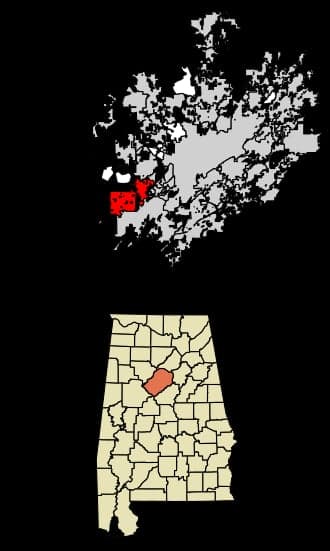
Photo: Wikipedia
Strategic Assessment of Hueytown, AL
Workable tactical position. Some exposure to population density or targets, but generally defensible in a crisis.
What does the Strategic Assessment tell us?
Our Strategic Assessment grades tactical survivability of an area. Major population centers, military targets, fallout zones, natural disasters, and border exposure all drive risk — lower exposure means a more defensible position in a crisis.
This is heavily inspired by Joel Skousen's Strategic Relocation book. Highly recommended you checkout the book ($)What does this tell us?
Our Strategic Assessment grades tactical survivability of an area. Major population centers, military targets, fallout zones, natural disasters, and border exposure all drive risk — lower exposure means a more defensible position in a crisis.
This is heavily inspired by Joel Skousen's Strategic Relocation book. Highly recommended you checkout the book ($)Strategic Pillars

Key Distances
Regional Safe Places
Below is our recommended "safe zones" in Alabama and the surrounding area based on our strategic heuristics. For most people, it's unrealistic to live in a “safe zone” full-time due to work, family or other personal reasons. They tend to be more rural. However, many of these areas are perfect for second homes and retreat properties that double as a vacation home or even a short-term rental.
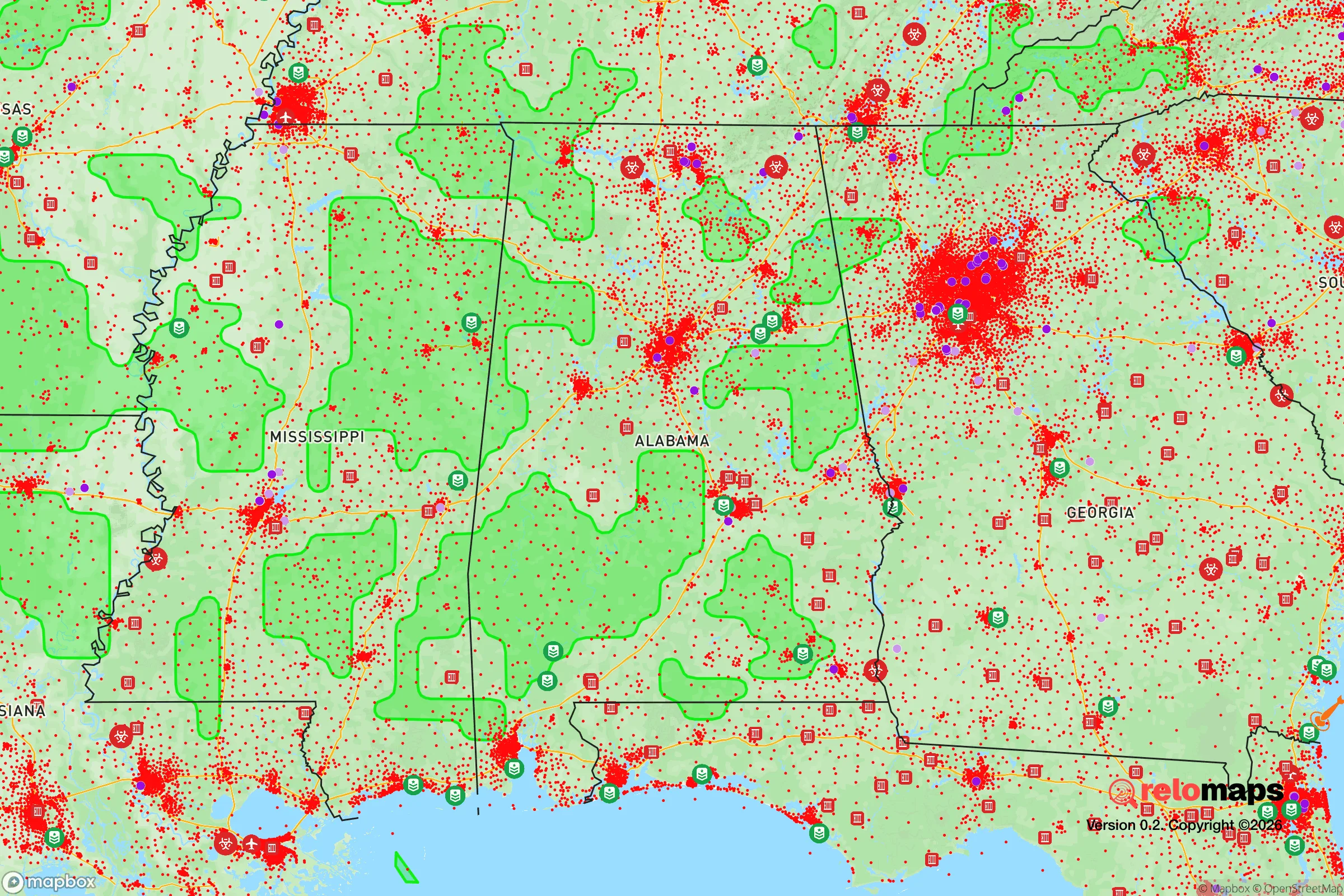
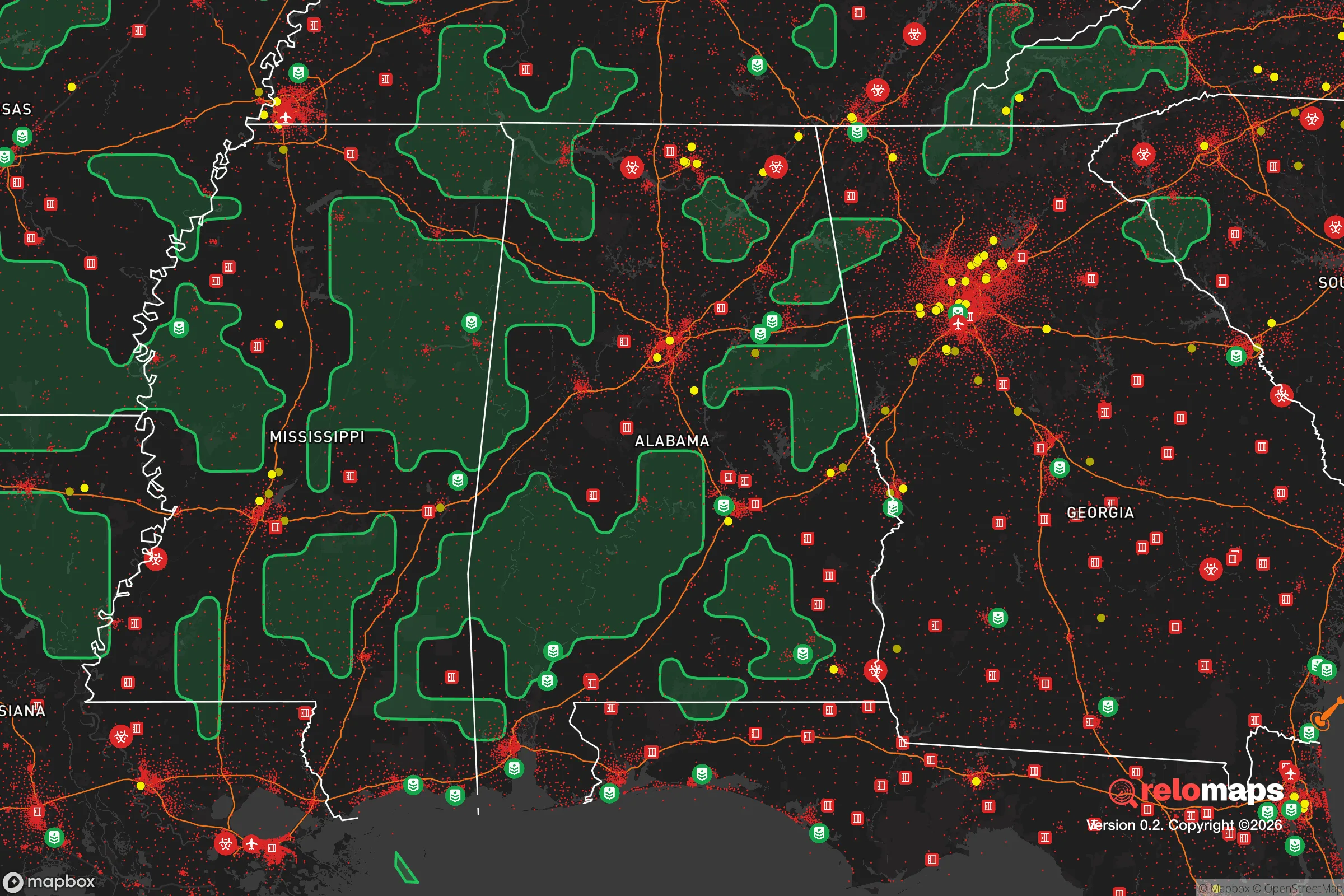


Important Note: For informational purposes only. This does not mean nothing bad ever happens in the green zones. Please use common sense. This is based on public data and modeled with AI. We tried to take a conservative approach but mistakes happen. We update this regularly as new information becomes available.
Solar Generator Recommendations
Backup power matters more here than in safer locations. We've picked three solar generators across budgets and capacity tiers — start with the budget unit if you only need a few essentials, or step up if you want to run a fridge and HVAC for days at a time.

Jackery Portable Power Station Explorer 300
Budget OptionPower on the Go: Weighing only 11 lbs, it's convenient to set up and store with book-sized foldable solar panels

BLUETTI Portable Power Station AC180
Designed for both indoor and outdoor scenarios, AC180 is highly capable as it has a robost capacity and continuous output power.

EF ECOFLOW DELTA Pro Ultra Power Station
Upgraded PickEcoFlow DELTA Pro Ultra is a whole-home energy system designed to grow with your family. Integrated with the Smart Home Panel 2, it scales to meet your evolving energy needs — keeping your home powered, intelligent, and secure through every stage of life.
We earn a commission, at no additional cost to you.
Strategic Assessment Analysis
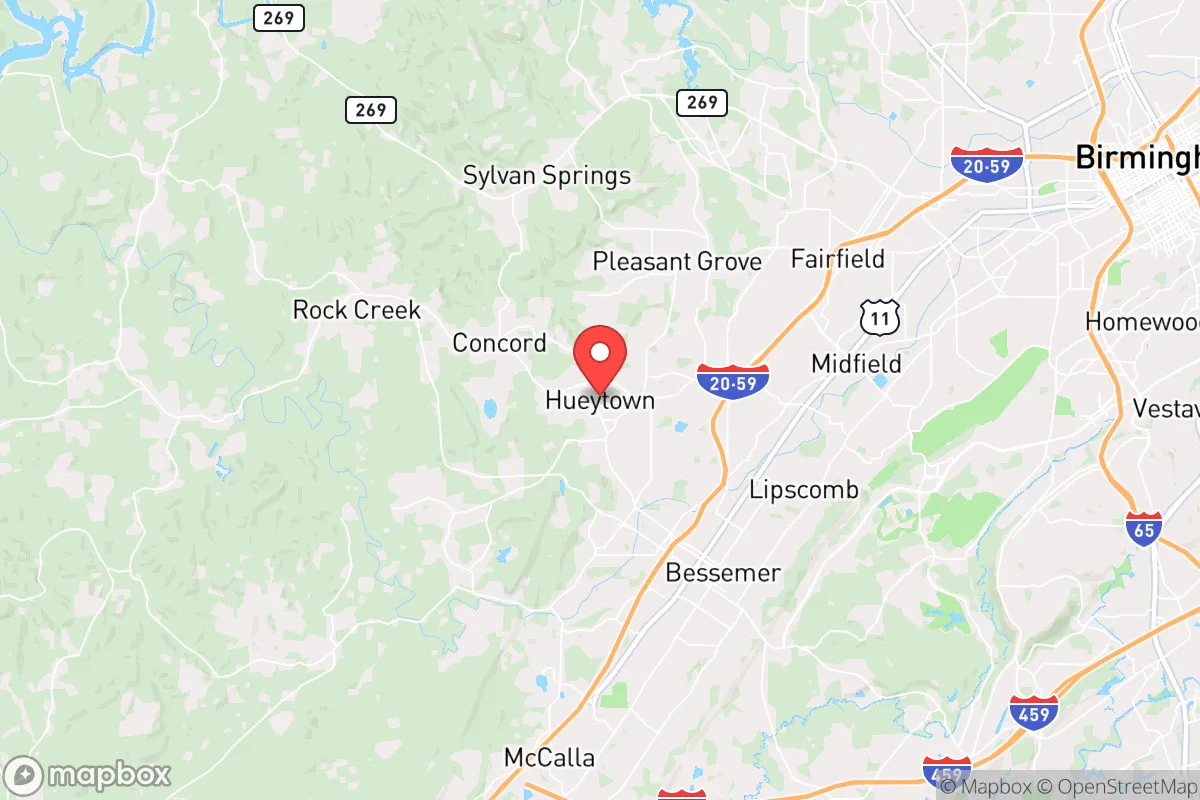
Hueytown, Alabama, sits in a strategic pocket of Jefferson County that offers a meaningful balance between accessibility and buffer—close enough to Birmingham’s infrastructure but far enough to avoid the worst of urban collapse scenarios. For a relocator thinking in terms of resilience, this town’s position along the I-20/59 corridor gives you a solid evacuation route west toward Mississippi or south toward the Gulf, while the surrounding hills and forested patches provide natural cover and defensible terrain. The area has weathered economic shifts and population changes without losing its small-town bones, which matters when you’re assessing long-term stability rather than short-term convenience.
Geographic position and natural advantages for long-term security
Hueytown sits roughly 12 miles southwest of downtown Birmingham, tucked into the rolling foothills of the Appalachian range. That elevation—averaging around 500 to 600 feet above sea level—means you’re above the flood plains that plague parts of central Alabama, and the local geology is mostly sandstone and shale, which drains well and supports groundwater recharge. The Black Warrior River runs about 10 miles to the west, offering a secondary water source if municipal systems go down, and the Bankhead National Forest is roughly 45 miles northwest, providing a potential retreat zone if things get really bad. The area’s natural chokepoints—narrow two-lane roads through the hills—make it harder for large groups to move through undetected, which is a tactical advantage if you’re thinking about perimeter defense. Timber and game are abundant in the surrounding woodlands, with white-tailed deer, turkey, and small game available for hunting, though you’ll want to secure private land access since public hunting areas can get crowded during a crisis.
Risks, exposures, and proximity to fallout-relevant landmarks
The biggest liability here is proximity to Birmingham’s urban core and its associated vulnerabilities. Birmingham is a major transportation hub with rail lines, interstate junctions, and a population of roughly 200,000 that could surge during an evacuation. If civil unrest or a mass casualty event hits the city, Hueytown sits directly in the path of anyone fleeing west on I-20/59. The city also has a chemical plant and several industrial facilities along the corridor—nothing on the scale of a nuclear reactor, but enough hazardous material storage to create a secondary risk if an earthquake or sabotage event occurs. The nearest nuclear plant is the Browns Ferry facility in Limestone County, about 90 miles north, which is outside the typical 50-mile evacuation zone but still within fallout range depending on wind patterns. Tornadoes are the most frequent natural threat—Jefferson County averages 12 to 15 tornado warnings per year, and Hueytown was hit by an EF-3 in 2011 that caused significant damage. Flooding is minimal in the town itself, but low-lying areas near Valley Creek can become impassable after heavy rain. On the plus side, the area has no major military bases or government installations that would make it a primary target, and the nearest interstate bridge chokepoint is the I-20/59 bridge over the Black Warrior River, which could be monitored or defended if needed.
Practical resilience for a relocator: food, water, energy, and defensibility
For a prepper-minded relocator, Hueytown offers a mix of suburban convenience and rural practicality. The town has its own water treatment plant drawing from groundwater wells, which is more resilient than surface-water-dependent systems—if the grid goes down, wells with hand pumps or generator backup can keep you operational. The local power grid is served by Alabama Power, which has a decent track record for restoration after storms, but you should plan for at least 7 to 10 days of off-grid capability during a major event. Natural gas lines run through parts of the town, so a dual-fuel generator setup is viable. Food storage is straightforward: there are several grocery stores within a 10-minute drive, but for long-term stockpiling, you’ll want to look at the bulk suppliers in Bessemer (about 5 miles east) or consider a garden plot—the growing season runs from March to October, and the soil is decent for vegetables if you amend it with compost. Defensibility is moderate: the town’s layout is a mix of older neighborhoods with tree cover and newer subdivisions with open sightlines. A property on the western edge, near the wooded hills, gives you better concealment and escape routes into the national forest. The local police department is small—around 25 officers—so during a prolonged crisis, you’re largely on your own. The sheriff’s office covers unincorporated areas, but response times can stretch to 20 minutes or more in rural pockets. Community-wise, Hueytown has a strong church presence and a history of mutual aid among long-term residents, which is a social resilience factor you can’t buy. If you’re willing to invest in a well, solar panels, and a secure perimeter, this area can support a self-sufficient household for weeks or months without outside help.
The overall strategic picture for Hueytown is one of cautious viability. It’s not a remote bunker location—you’re still within striking distance of Birmingham’s problems—but it offers a realistic middle ground for someone who wants to stay connected to regional resources while maintaining a defensible position. The terrain, water access, and community fabric give it an edge over purely suburban sprawl, and the evacuation routes west and south provide options if the situation deteriorates. For a single individual or family with a conservative mindset, the trade-off is clear: you trade absolute isolation for better supply chains and a stronger social network, which in a long-term collapse scenario might be the smarter bet. Just make sure you’ve got a plan for the first 72 hours, because that’s when the urban spillover will hit hardest.

* Values derived from national, state, county, city and local statistics and may differ in a specific area. Last updated: 2026-04-19T18:55:11.000Z
Narrative content on this page is AI-generated and may contain mistakes. Verify any details that matter before acting on them.
ReloMaps may earn a commission from affiliate links at no extra cost to you.

