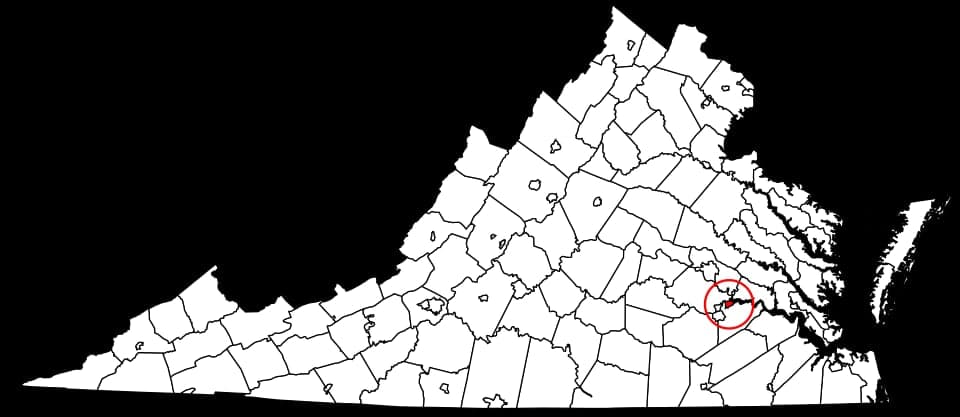
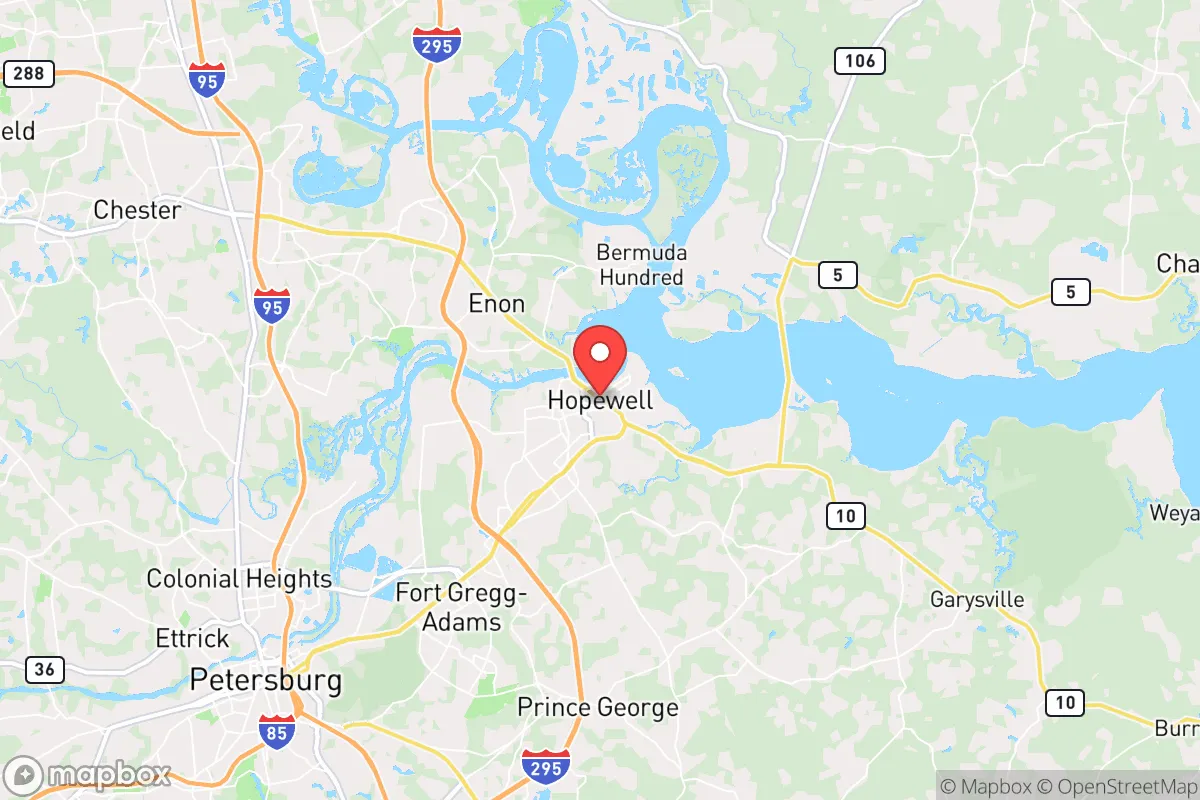
Photo: Wikipedia
Demographics of Hopewell, VA
Affluence Level in Hopewell, VA
A low-income area with significant economic hardship. Household wealth and educational attainment are well below national averages.
People of Hopewell, VA
The people of Hopewell, Virginia, today number 22,944, forming a city that is nearly evenly split between Black (41.2%) and White (41.6%) residents, with a growing Hispanic population (8.6%) and a very small East/Southeast Asian community (1.1%). The city is notably less diverse by origin than the national average, with only 1.6% of residents foreign-born, and it carries a distinctive blue-collar, industrial identity shaped by a century of chemical and paper manufacturing. With just 12.5% of adults holding a bachelor’s degree, Hopewell’s population is less educated than the surrounding region, reflecting its historical role as a working-class mill town rather than a professional or academic hub.
How the city was settled and grew
Hopewell’s population history is almost entirely a 20th-century story, not a colonial one. The area was originally part of Prince George County, and the first permanent European settlement was a small farming community called City Point, which served as a key Union supply base during the Civil War. However, the modern city was born in 1914 when the DuPont Company built a massive dynamite plant on the site to supply World War I. This single event transformed a rural crossroads into an instant industrial city. The original workforce was drawn from rural Virginia and North Carolina — mostly white farmers and laborers — who built the first neighborhoods like City Point (the historic riverfront district) and West Hopewell (the area west of the railroad tracks). During World War II, the Allied Chemical plant expanded dramatically, and a second wave of white Appalachian migrants arrived, settling in North Hopewell near the plant gates. By 1950, Hopewell’s population peaked at over 20,000, and it was overwhelmingly white and native-born.
Modern era (post-1965)
The post-1965 era brought the city’s most significant demographic shift: the Great Migration of Black Americans from the rural South into industrial towns. Between 1960 and 1980, Hopewell’s Black population surged from roughly 15% to over 40%, as African American families moved from nearby counties like Sussex and Southampton to work in the chemical plants and paper mills. These families concentrated in South Hopewell (the area south of the Appomattox River) and the Bellemeade neighborhood, which became predominantly Black by the 1990s. Meanwhile, the white population began a slow decline as younger generations left for college or jobs in Richmond (25 miles north), and the city’s manufacturing base contracted. The Hispanic population, now 8.6%, began arriving in the 1990s and 2000s, largely from Mexico and Central America, drawn to low-skill jobs in warehousing and food processing. They have settled primarily in West Hopewell and the Oaklawn area, where rental housing is more affordable. The East/Southeast Asian community (1.1%) is small and consists mostly of Vietnamese and Filipino families who came as secondary migrants from larger cities like Richmond or Norfolk, with no single neighborhood concentration. The Indian-subcontinent population is effectively zero (0.0%), meaning no visible enclave exists.
The future
Hopewell’s population is aging and slowly shrinking — it has lost about 2,000 residents since its 1970 peak of 25,000. The city is not homogenizing; rather, it is tribalizing into distinct racial enclaves. White residents are increasingly concentrated in the historic City Point district and newer subdivisions on the western edge, while Black residents remain dominant in South Hopewell and Bellemeade. The Hispanic population is the fastest-growing segment, projected to reach 12-15% by 2035, but it remains largely confined to the West Hopewell rental corridor. The foreign-born share (1.6%) is unlikely to rise dramatically because the city lacks the service-sector jobs or university presence that attract immigrants to larger metro areas. The next 10-20 years will likely see continued white flight to surrounding counties (Chesterfield, Prince George), a plateauing Black population, and steady Hispanic growth that may eventually make Hopewell a tri-ethnic city (White, Black, Hispanic) rather than a bi-racial one. The college-educated share (12.5%) may rise slightly if the city succeeds in attracting remote workers to its riverfront redevelopment, but the industrial base will remain the primary economic anchor.
For someone moving in now, Hopewell is becoming a more diverse but still deeply segregated small city, where neighborhood choice largely determines social experience. The industrial character remains dominant, and the population is stable but not growing. New residents should expect a working-class environment with limited ethnic diversity beyond the Black-white-Hispanic triad, and a community where most people were born within 50 miles of the city limits.

* Values derived from national, state, county, city and local statistics and may differ in a specific area. Last updated: 2026-04-19T20:40:14.000Z
Narrative content on this page is AI-generated and may contain mistakes. Verify any details that matter before acting on them.
ReloMaps may earn a commission from affiliate links at no extra cost to you.

