Photo: Wikipedia
Demographics of Homewood, AL
Affluence Level in Homewood, AL
An upper-middle-class area. Household wealth, education levels, and homeownership run ahead of national benchmarks.
People of Homewood, AL
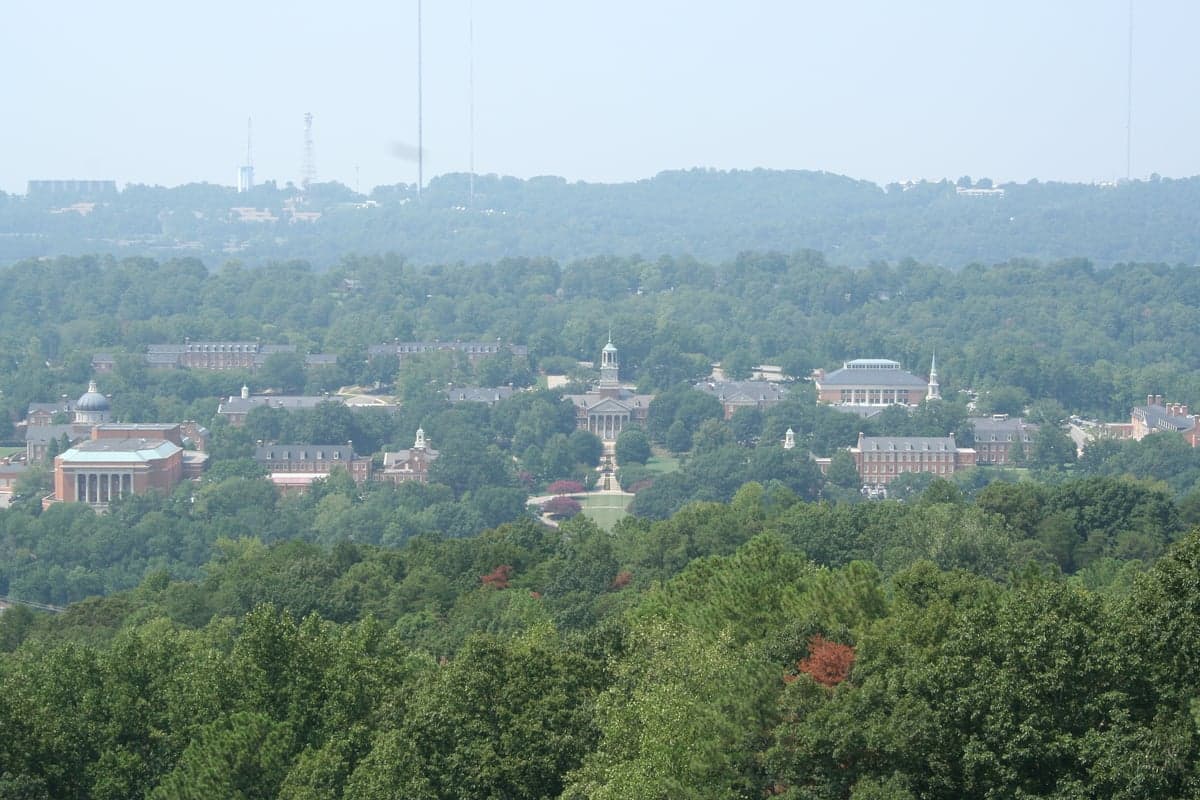
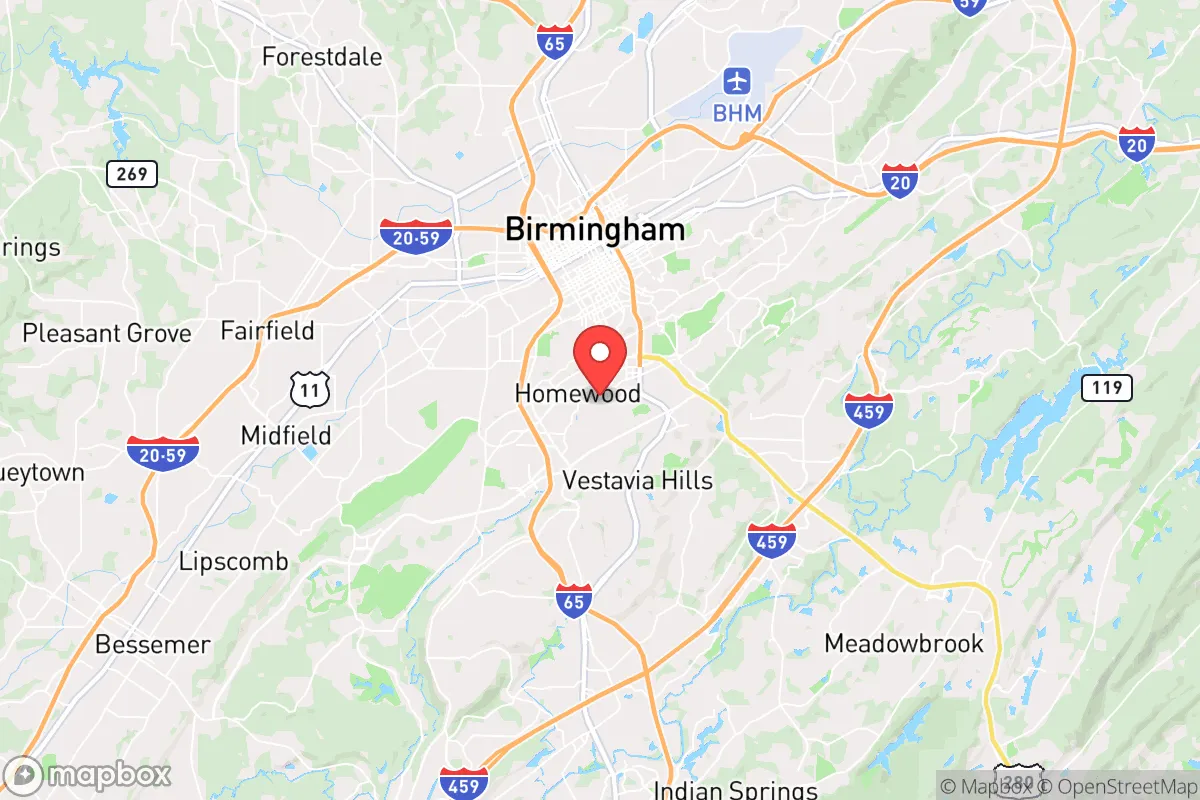
The people of Homewood, Alabama, today number 27,697, forming a densely settled, highly educated inner-ring suburb of Birmingham. The city is predominantly White (72.3%) with a significant Black minority (13.1%) and growing Hispanic (7.6%) and Indian-subcontinent (2.0%) communities. With 69.9% of adults holding a college degree, Homewood’s population is notably more educated than the state average, and its identity is shaped by a mix of historic streetcar suburbs, post-war subdivisions, and recent infill development.
How the city was settled and grew
Homewood’s human history begins not with colonial settlement but with post-Civil War industrial growth. The area was originally farmland and timberland, but the arrival of the Birmingham mineral railroad in the 1880s triggered its first wave of residents: working-class families, many of them White migrants from rural Alabama and Tennessee, who built homes near the tracks in what is now Rosedale. This neighborhood, with its modest cottages and grid streets, became the city’s original population center. A second wave came in the 1910s and 1920s as Birmingham’s steel mills boomed. The Edgewood neighborhood was platted in 1916 as a streetcar suburb for middle-class White professionals who commuted downtown. Its tree-lined boulevards and Craftsman bungalows attracted doctors, lawyers, and merchants. By the time Homewood incorporated in 1926, its population was almost entirely White, with a small number of Black domestic workers living in scattered pockets near the railroad corridor. The Great Depression slowed growth, but the post-World War II era brought a third wave: returning veterans and their families, drawn by VA loans and new construction. The West Homewood neighborhood, developed in the 1950s and 1960s, filled with ranch-style homes and attracted a mix of White professionals and skilled tradespeople. This wave cemented Homewood’s character as a stable, family-oriented suburb.
Modern era (post-1965)
The 1965 Hart-Cellar Act had a modest but measurable effect on Homewood. The city’s foreign-born population today is just 4.4%, but that share has grown from near zero in 1970. The most visible post-1965 change was domestic: White flight from Birmingham proper accelerated in the 1970s and 1980s, bringing a wave of middle-class White families to established neighborhoods like Rosedale and Edgewood, as well as to newer subdivisions in Shades Mountain. This inflow reinforced Homewood’s White majority. Meanwhile, Black homebuyers began moving into the city in small numbers during the 1980s, primarily into the West Homewood and Rosedale areas, drawn by good schools and proximity to Birmingham jobs. The Black population peaked at roughly 18% in the 2000 census before settling to its current 13.1%. The Hispanic population, now 7.6%, began growing in the 1990s, driven by construction and service-sector jobs. Hispanic families concentrated in Rosedale and parts of West Homewood, where older, more affordable housing stock offered entry points. The Indian-subcontinent community (2.0%) arrived primarily after 2000, attracted by medical and tech jobs at UAB and nearby corporations; they settled in Edgewood and Shades Mountain, drawn by top-rated schools. East/Southeast Asian residents (1.3%) followed a similar pattern, with a smaller footprint in Edgewood.
The future
Homewood’s population is trending toward greater diversity, but the pace is slow and uneven. The White share has declined from 80% in 2000 to 72.3% today, while the Hispanic and Indian-subcontinent shares have grown steadily. The Black population has plateaued, and East/Southeast Asian numbers remain small. The city is not tribalizing into distinct ethnic enclaves; rather, Rosedale and West Homewood are becoming the most diverse neighborhoods, while Edgewood and Shades Mountain remain overwhelmingly White and affluent. The foreign-born population is likely to continue growing, driven by Indian and Hispanic families seeking good schools and safe streets, but Homewood’s high housing costs (median home value above $400,000) will limit in-migration to upper-middle-income households. The next 10-20 years will likely see a gradual increase in the Hispanic share to 10-12% and the Indian share to 3-4%, with the White share settling around 65-68%. The city will remain a majority-White, highly educated suburb, but with a noticeably more multicultural character than its peer suburbs in Jefferson County.
For someone moving in now, Homewood is becoming a place where traditional Southern suburban stability meets slow, steady diversification. The schools are the primary draw, and the population trends reflect that: families willing to pay a premium for the Homewood school system are the dominant demographic. The city is not experiencing rapid ethnic turnover or generational replacement; rather, it is absorbing new groups incrementally, neighborhood by neighborhood, without losing its core identity as a White, professional-class enclave with a growing multicultural fringe.

* Values derived from national, state, county, city and local statistics and may differ in a specific area. Last updated: 2026-04-19T18:53:28.000Z
Narrative content on this page is AI-generated and may contain mistakes. Verify any details that matter before acting on them.
ReloMaps may earn a commission from affiliate links at no extra cost to you.

