Photo: Wikipedia
Demographics of Hickory, NC
Affluence Level in Hickory, NC
A middle-class area roughly in line with national averages across income, home values, education, and employment.
People of Hickory, NC
The people of Hickory, North Carolina, today number roughly 43,747, forming a community that is predominantly White (64.3%) with significant Hispanic (13.9%) and Black (13.3%) populations, and a smaller but growing East/Southeast Asian presence (4.0%). The city’s character is rooted in its furniture and textile manufacturing heritage, which created a stable, working-to-middle-class identity that persists in neighborhoods like Viewmont and Highland. A notable 35.9% of adults hold a college degree, reflecting a shift toward a more educated workforce, while the foreign-born share sits at 5.8%—lower than the national average but concentrated in specific enclaves.
How the city was settled and grew
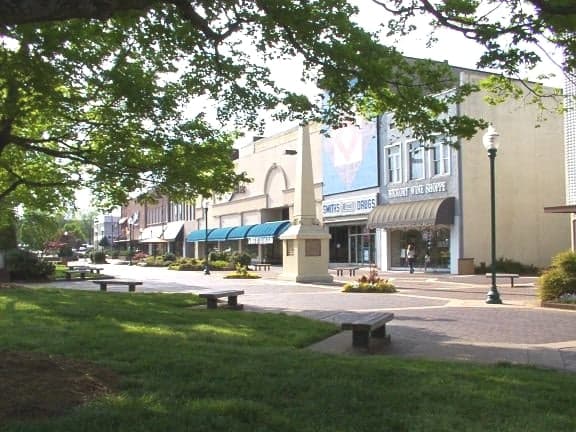
Hickory’s population story begins not with colonial settlement but with the arrival of the railroad in the 1850s, which transformed a small crossroads into a manufacturing hub. The city was officially incorporated in 1870, and its early growth was driven by German and Scotch-Irish migrants from the surrounding Catawba Valley, who built the first furniture factories and cotton mills. These families settled in what is now the Downtown Historic District, where brick commercial blocks and millworker cottages still stand. By the early 1900s, the furniture boom drew Appalachian migrants from nearby counties, who filled neighborhoods like Oakwood and Claremont with modest frame houses. The Black population grew during this era as well, largely employed in domestic service and mill labor, and concentrated in the Ridgeview neighborhood, which became the historic heart of Hickory’s African American community. The city’s population hit 13,000 by 1930, then swelled to 20,000 by 1960 as textile mills expanded.
Modern era (post-1965)
The 1965 Immigration and Nationality Act opened doors for new arrivals, but Hickory’s foreign-born population remained small until the 1990s. The most significant post-1965 shift was domestic: White families suburbanized into areas like Lake Hickory and St. Stephens, while Black residents began moving into previously White neighborhoods like Viewmont as segregation-era housing restrictions faded. The Hispanic population grew rapidly after 2000, driven by Mexican and Central American immigrants recruited for furniture and poultry processing jobs. Today, Hispanic residents are concentrated in the Southwest Hickory area near the old mill districts, where bilingual storefronts and Catholic churches anchor the community. East/Southeast Asian residents—primarily Vietnamese and Filipino—arrived in smaller waves, often as professionals in healthcare and manufacturing, and are dispersed across the city rather than forming a single ethnic enclave. The Indian subcontinent population remains negligible at 0.2%, with no distinct neighborhood concentration.
The future
Hickory’s population is slowly diversifying, but the trend is toward assimilation rather than tribalization into separate enclaves. The Hispanic share (13.9%) is projected to grow modestly as second-generation families move into mixed-income areas like Highland and Oakwood, while the Black population (13.3%) has stabilized after decades of out-migration to larger Southern cities. The East/Southeast Asian community (4.0%) is likely to expand as Catawba Valley Medical Center and local tech firms recruit skilled workers, but the Indian subcontinent population is expected to remain tiny. The White share (64.3%) is declining gradually, consistent with national trends, but Hickory is not experiencing rapid ethnic turnover—the city remains majority-White and culturally rooted in its Southern Appalachian heritage. The college-educated share (35.9%) is rising, which may accelerate in-migration of professionals from Charlotte (60 miles south) seeking lower housing costs.
For someone moving to Hickory now, the city offers a stable, family-oriented environment where historic neighborhoods like Ridgeview and Viewmont retain distinct identities but are not sharply divided by race or class. The population is becoming slightly more diverse and educated, but the pace is gradual, and the dominant culture remains that of a traditional Southern manufacturing town adapting to a post-industrial economy. New residents will find a community where neighborly familiarity still matters, and where the biggest demographic story is not conflict but a slow, organic evolution.

* Values derived from national, state, county, city and local statistics and may differ in a specific area. Last updated: 2026-04-21T17:14:29.000Z
Narrative content on this page is AI-generated and may contain mistakes. Verify any details that matter before acting on them.
ReloMaps may earn a commission from affiliate links at no extra cost to you.

