Photo: Wikipedia
Demographics of Herndon, VA
Affluence Level in Herndon, VA
An upper-middle-class area. Household wealth, education levels, and homeownership run ahead of national benchmarks.
People of Herndon, VA
Herndon, Virginia, is a dense, majority-minority suburb of 24,529 residents where no single ethnic group holds a majority. The city is characterized by a large Hispanic plurality (38.9%), a significant White minority (32.9%), and substantial Indian (9.1%) and Black (8.0%) communities, alongside a notable East/Southeast Asian population (5.9%). With over half of adults holding a college degree and a foreign-born rate of 24.9%, Herndon is a classic gateway suburb — a place where successive waves of immigrants and domestic migrants have layered their histories atop one another, creating a distinctly diverse, middle-class community.
How the city was settled and grew
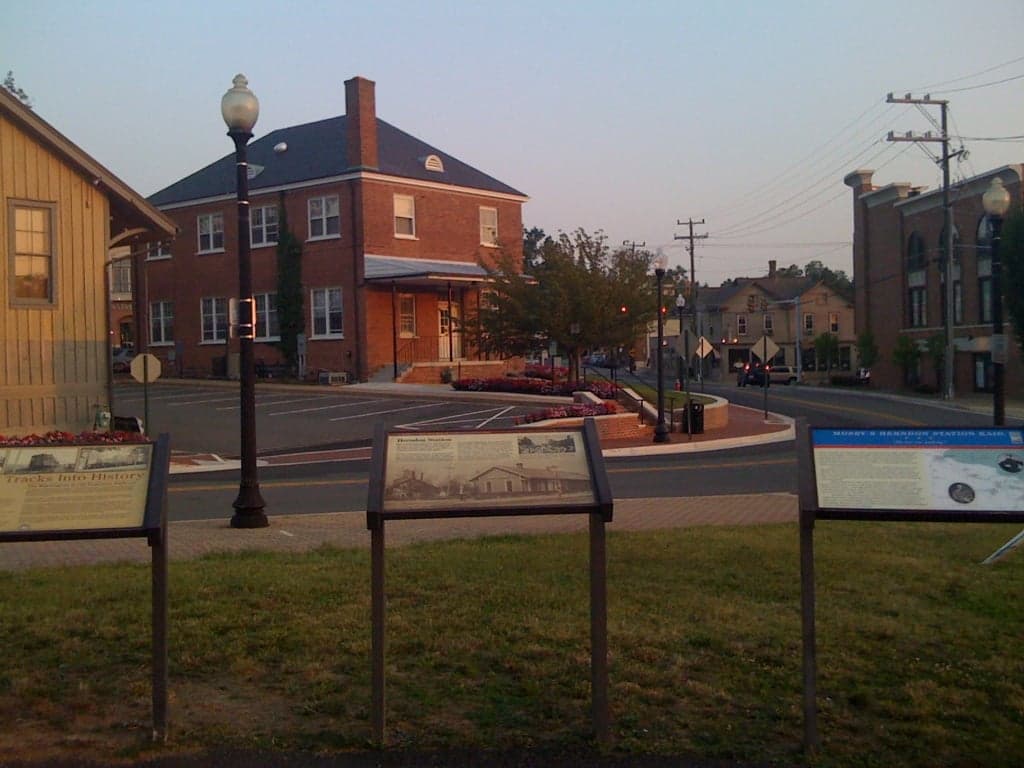
Herndon was founded in 1858 as a railroad stop on the Alexandria, Loudoun & Hampshire line, drawing its earliest residents from English, German, and Scots-Irish farming families who worked the surrounding dairy and grain fields. The original settlement clustered around what is now Downtown Herndon (along Elden and Center Streets), where merchants and tradesmen built the town's first commercial blocks. Through the early 20th century, the population remained small and overwhelmingly White, with a modest Black community centered in the Dranesville District area, where freedmen and their descendants had established farms and churches after the Civil War. The town's growth was slow until the post-World War II era, when the expansion of federal government employment in nearby Washington, D.C., began drawing White-collar workers to the area. By 1960, Herndon's population had reached roughly 1,800, still predominantly White and native-born.
Modern era (post-1965)
The 1965 Hart-Cellar Immigration Act, combined with the 1970s construction of the Dulles Toll Road and the rise of tech employers like AOL and Orbital Sciences, transformed Herndon. The first major non-White wave was Hispanic — primarily Salvadoran and Guatemalan immigrants — who arrived in the 1980s and 1990s to work in construction, landscaping, and service industries. They settled heavily in the Ridge Heights and Monroe Street neighborhoods, where affordable garden apartments and older single-family homes provided entry points. By 2000, Herndon's Hispanic share had climbed past 25%, and the city became a regional hub for Central American culture, with panaderías and bodegas lining Elden Street. Simultaneously, the 1990s tech boom drew Indian professionals — engineers and IT specialists — who clustered in newer subdivisions like Franklin Farm and McNair Farms, drawn by good schools and proximity to Dulles tech corridors. East/Southeast Asian families (Vietnamese, Korean, Chinese) arrived in smaller numbers during the same period, settling in Fox Mill and Floris areas. Black in-migration, both from other parts of the U.S. and from African countries, grew steadily after 2000, with families choosing Herndon Heights and the area around Stuart Road. The White population, once nearly universal, declined from roughly 70% in 1990 to 32.9% today, as older families aged out and were replaced by younger, more diverse arrivals.
The future
Herndon's population is not homogenizing; rather, it is tribalizing into distinct, stable enclaves. The Hispanic community shows signs of plateauing — the foreign-born share has held steady near 25% for a decade — while the Indian and East/Southeast Asian populations continue to grow, driven by ongoing tech-sector hiring. The White share is likely to stabilize near 30%, as the city's historic single-family neighborhoods retain older homeowners and attract some new domestic migrants. The key trend is generational assimilation: second-generation Hispanic and Indian residents are increasingly college-educated and English-dominant, blurring ethnic boundaries in public spaces while maintaining cultural institutions. Over the next 10–20 years, Herndon will likely become more professional-class overall, with the college-educated share rising above 55%, but the city's identity as a multiethnic, middle-class suburb — not a wealthy enclave or a poor one — will persist. New development along the Silver Line metro extension (opening 2025–2026) will bring higher-density housing near the Herndon-Monroe station area, potentially accelerating turnover in older neighborhoods.
For someone moving in now, Herndon offers a dense, walkable downtown, strong public schools, and a population that is genuinely diverse — not just in census categories but in daily life. The city is becoming more professional and more educated, but it retains a working-class Hispanic core that gives it a distinct character. It is not a place of ethnic conflict, but neither is it a melting pot; it is a place where groups live alongside one another, each maintaining its own institutions and neighborhoods. For a conservative-leaning family or individual, Herndon provides a stable, family-oriented environment with a clear sense of place — a rarity in the transient D.C. suburbs.

* Values derived from national, state, county, city and local statistics and may differ in a specific area. Last updated: 2026-05-01T16:07:47.000Z
Narrative content on this page is AI-generated and may contain mistakes. Verify any details that matter before acting on them.
ReloMaps may earn a commission from affiliate links at no extra cost to you.

