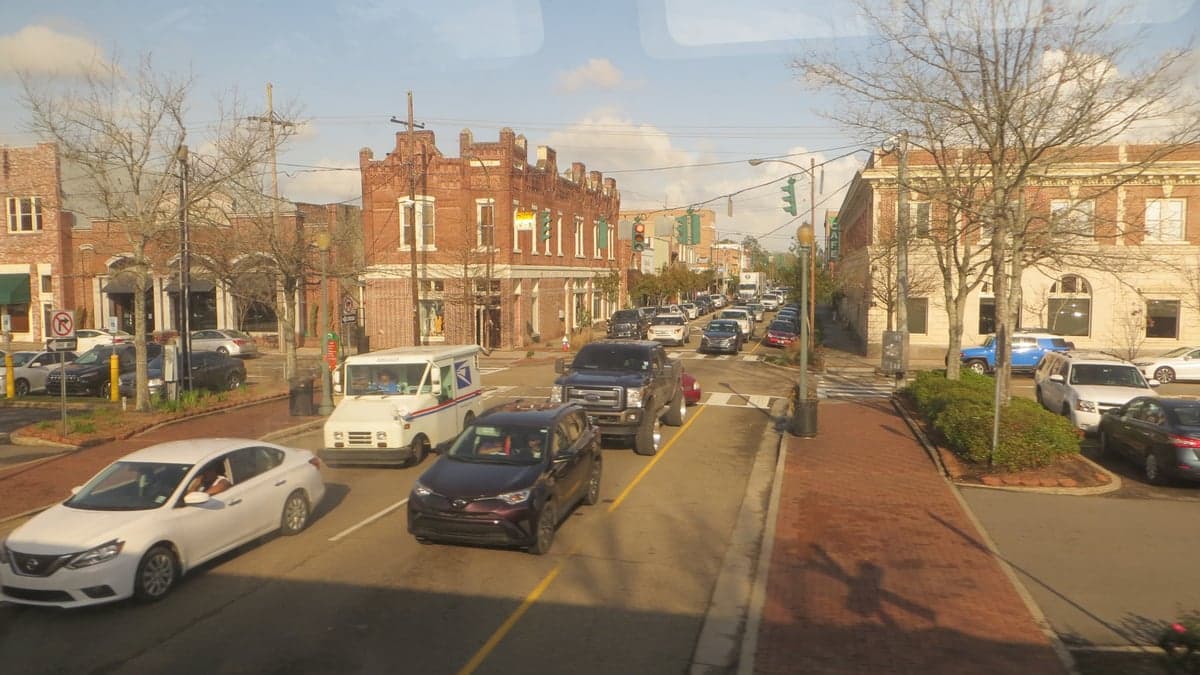
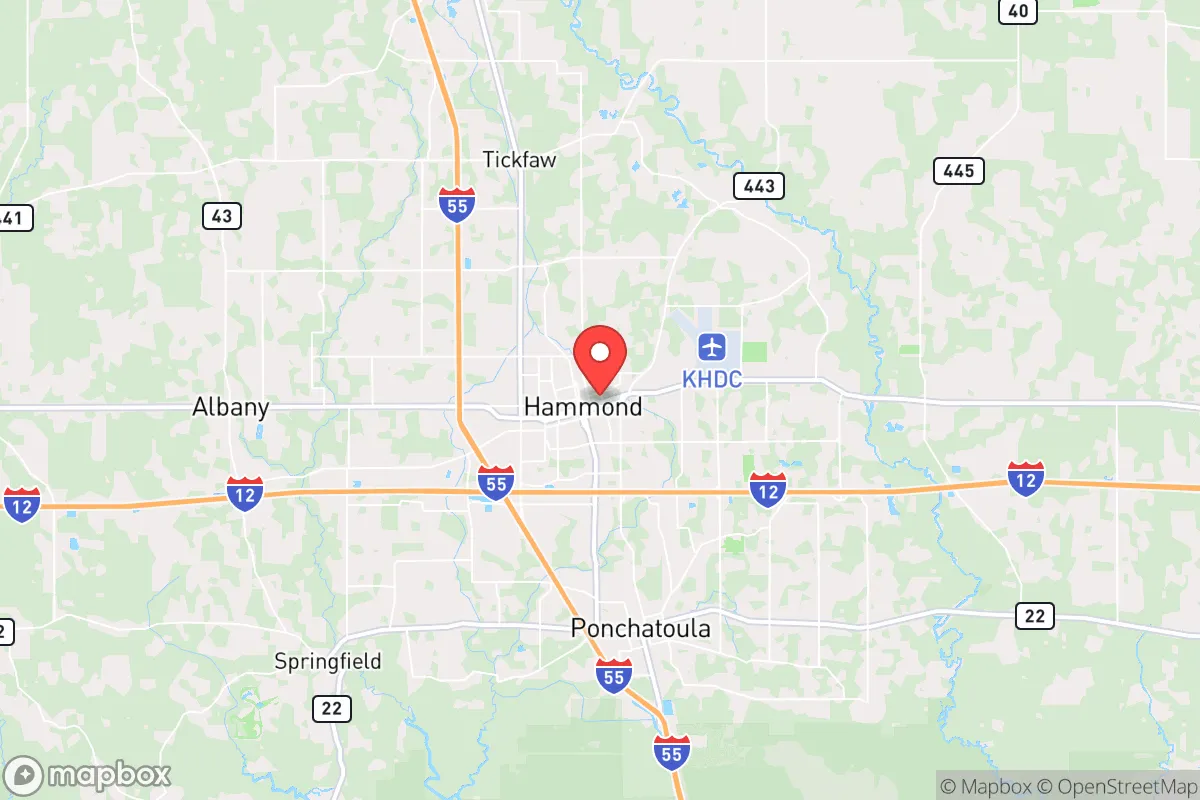
Photo: Wikipedia
Demographics of Hammond, LA
Affluence Level in Hammond, LA
A low-income area with significant economic hardship. Household wealth and educational attainment are well below national averages.
People of Hammond, LA
The people of Hammond, Louisiana, today form a nearly evenly split Black and White community of roughly 20,790 residents, creating a demographic character distinct from many other mid-sized Louisiana cities. With a foreign-born population of just 0.8% and a modest 3.3% Hispanic share, Hammond remains overwhelmingly native-born and biracial, shaped by its history as a railroad town and educational hub. The city’s identity is anchored by Southeastern Louisiana University, which brings a transient student population, while the permanent residents are concentrated in historic neighborhoods that still reflect the settlement patterns of the 19th and early 20th centuries.
How the city was settled and grew
Hammond was founded in the 1850s as a railroad stop on the New Orleans, Jackson, and Great Northern line, named after Peter Hammond, a Swedish immigrant who owned the land. The original population was drawn by the timber industry and the railroad, with early settlers being primarily Anglo-American Protestants from the surrounding Florida Parishes, along with a smaller number of German and Irish laborers who built the rail lines. By the late 19th century, the strawberry industry became a major economic driver, attracting Italian immigrants who settled in what is now known as the Italian District around Southwest Railroad Avenue and North Cherry Street. African Americans, who had been in the area since slavery, formed their own community in the North Hammond neighborhood, centered around Martin Luther King Jr. Drive and North Oak Street, where they built churches, schools, and businesses under Jim Crow segregation. The city’s growth remained modest through the early 1900s, with the population reaching about 6,000 by 1940, still divided along racial lines into distinct neighborhoods that persist today.
Modern era (post-1965)
The post-1965 period brought significant demographic change, driven by the expansion of Southeastern Louisiana University and the construction of Interstate 12. The university, which grew from a teachers’ college to a regional university, attracted a more diverse faculty and student body, though the city’s permanent population remained largely biracial. White flight to suburban areas like Pumpkin Center and Natalbany in the 1970s and 1980s reduced the White share of Hammond’s population, while Black residents increasingly moved into previously all-White neighborhoods near the university, such as West Hammond around West Church Street. The Hispanic population grew slowly, from negligible levels to 3.3% by 2020, concentrated in the South Hammond area near the railroad tracks, where a small number of Mexican and Central American immigrants work in construction and service industries. The Asian population, at 0.9%, consists primarily of Vietnamese and Filipino families who arrived after the Vietnam War, settling near the university and along Thomas Street. The Indian subcontinent population remains at 0.0%, reflecting the city’s lack of tech or medical sectors that typically attract that group. By 2020, the city had reached 20,790 residents, with a racial composition that had stabilized into a near 50-50 split between White and Black residents, with minimal foreign-born influence.
The future
Hammond’s population is likely to remain stable in size and composition over the next 10-20 years, with no major drivers of rapid growth or diversification. The city’s low foreign-born rate (0.8%) and modest Hispanic share suggest that immigration will not significantly alter the demographic balance, unlike in larger Louisiana cities such as New Orleans or Baton Rouge. The Black and White populations are increasingly mixing in neighborhoods like Downtown Hammond, where redevelopment of historic buildings into apartments has attracted both groups, but the city remains largely tribalized into the historic North Hammond (predominantly Black) and South Hammond (predominantly White) areas. The university will continue to bring a transient population of students, many of whom leave after graduation, limiting long-term demographic change. The aging of the White population, combined with a slightly younger Black population, could shift the balance toward a Black majority within 20 years, but the change will be gradual. The city is not homogenizing into a single identity but rather maintaining distinct enclaves, with the Italian District and North Hammond retaining their cultural character.
For someone moving in now, Hammond offers a stable, biracial community with a small-town feel and a strong university presence, but little ethnic diversity beyond the Black-White divide. The city is becoming more integrated in its downtown core while preserving historic neighborhood boundaries, making it a place where newcomers can find a clear sense of place but should expect a population that is overwhelmingly native-born and rooted in the region’s history.

* Values derived from national, state, county, city and local statistics and may differ in a specific area. Last updated: 2026-05-01T05:32:49.000Z
Narrative content on this page is AI-generated and may contain mistakes. Verify any details that matter before acting on them.
ReloMaps may earn a commission from affiliate links at no extra cost to you.

