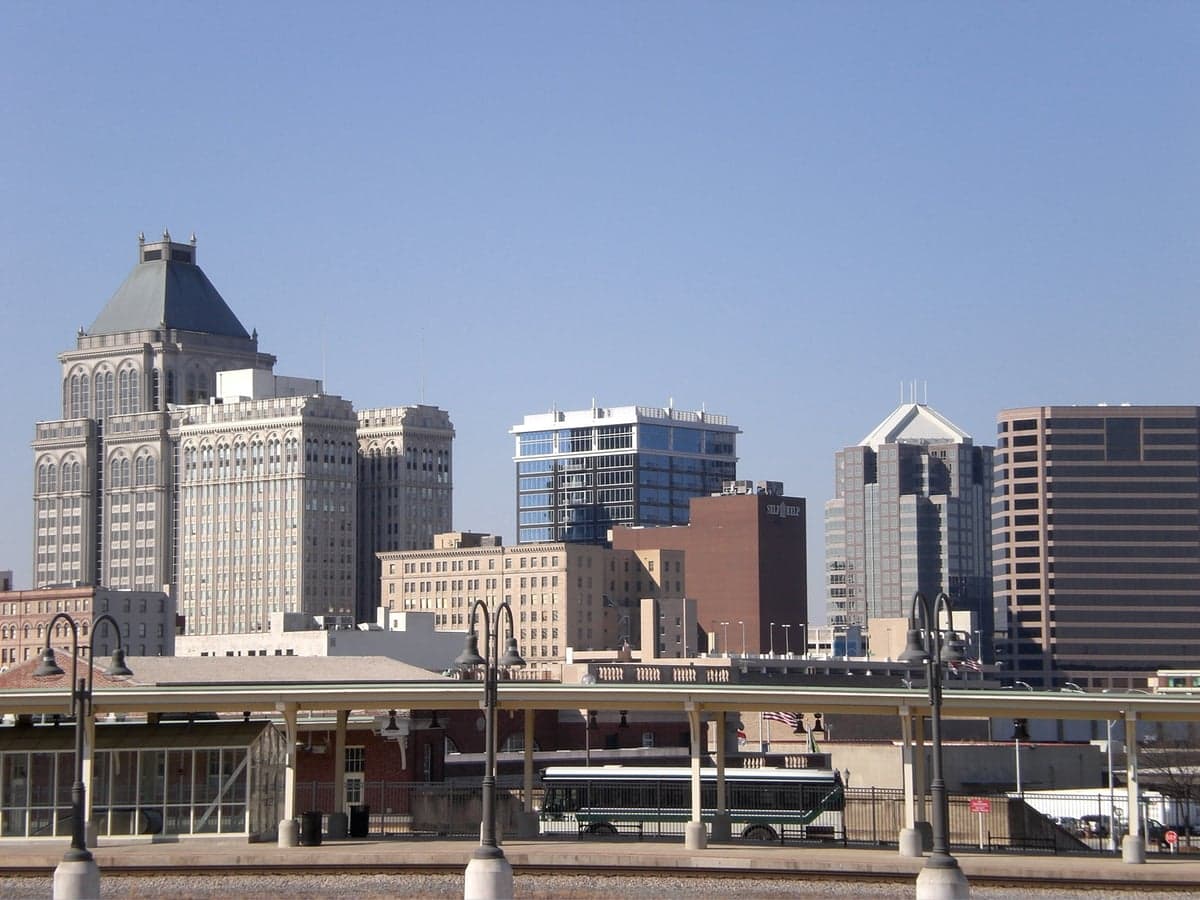
Photo: Wikipedia
Demographics of Greensboro, NC
Affluence Level in Greensboro, NC
A middle-class area roughly in line with national averages across income, home values, education, and employment.
People of Greensboro, NC
Greensboro, North Carolina, is a city of 298,564 residents defined by its deep African American majority (41.6%) and a substantial white population (37.9%), creating a biracial core that is now being reshaped by a growing Hispanic community (10.5%) and smaller but notable East/Southeast Asian (3.3%) and Indian (1.7%) populations. With a foreign-born share of just 6.8% and a college-educated rate of 39.9%, Greensboro is less diverse than many Southern peers but retains a distinct, historically grounded character rooted in textiles, civil rights, and steady migration from the surrounding rural Piedmont. The city feels more settled and family-oriented than fast-growing Charlotte or Raleigh, with a population that is slowly diversifying rather than exploding in size.
How the city was settled and grew
Greensboro was founded in 1808 as the county seat of Guilford County, chosen for its central location rather than any natural advantage. The original white settlers were primarily English, Scots-Irish, and German farmers moving west from the Virginia and North Carolina coastal plains, drawn by cheap land grants and the region's fertile, rolling hills. The city's first major growth spurt came after the Civil War with the arrival of the railroad and the rise of the textile industry. By the 1890s, cotton mills and tobacco factories drew thousands of rural white families from the Appalachian foothills into mill villages like Fisher Park and Lindley Park, where company-owned housing and churches anchored tight-knit, working-class communities. African Americans, who had been a small enslaved population before the war, migrated in large numbers during the Great Migration (1910–1970), settling in historically Black neighborhoods such as Southside and East Greensboro, where they built their own schools, businesses, and civic institutions around Bennett College and North Carolina A&T State University. By 1950, Greensboro was a majority-white city of roughly 74,000, with a Black population of about 25% concentrated in the eastern and southern wards.
Modern era (post-1965)
The 1965 Immigration and Nationality Act had a modest effect on Greensboro compared to coastal cities. The city's foreign-born share remains low at 6.8%, but the composition has shifted notably since the 1990s. The most significant change has been the arrival of Hispanic immigrants, primarily from Mexico and Central America, who began settling in the Glenwood and West Market Street corridors in the 1990s, drawn by construction, poultry processing, and landscaping jobs. Today, the Hispanic population stands at 10.5%, making it the fastest-growing demographic segment. East/Southeast Asian communities (3.3%) — largely Vietnamese, Korean, and Chinese — arrived in two waves: refugees after the Vietnam War in the 1970s and 1980s, and later professional migrants tied to the city's universities and health systems. They tend to cluster in the New Irving Park and Lake Jeanette areas, drawn by good schools and newer housing. The Indian subcontinent population (1.7%) is smaller but highly educated, concentrated in the medical and tech sectors around Cone Health and the Greensboro Coliseum area. Meanwhile, domestic migration patterns have shifted: since 2000, the white population has declined slightly as families move to exurban counties like Rockingham and Randolph, while the Black population has stabilized after decades of out-migration to Atlanta and the Northeast. The city's overall growth has been slow — roughly 8% since 2010 — reflecting a mature, built-out urban core with limited annexation.
The future
Greensboro's demographic trajectory points toward gradual diversification rather than rapid transformation. The Hispanic share is projected to reach 14–16% by 2040, driven by both immigration and higher birth rates, with continued concentration in the Glenwood and West Market Street corridors. The East/Southeast Asian and Indian populations are likely to grow modestly as the city's universities and health sector expand, but they will remain small enclaves rather than reshaping the city's character. The Black and white populations are both aging and slowly declining in share, though the Black community remains the largest single group and the anchor of the city's political and cultural identity. A key trend is the increasing economic and geographic sorting: affluent professionals — both white and Black — are consolidating in the northwest quadrant around Irving Park and Lake Brandt, while lower-income residents are pushed east of U.S. 29 and south of I-85. This is creating a more fragmented city, with distinct enclaves based on income and race rather than the historic biracial divide. The foreign-born population is unlikely to reach double digits anytime soon, meaning Greensboro will remain a predominantly native-born, Southern city with a growing Hispanic minority.
For a conservative-leaning mover, Greensboro offers a stable, family-oriented environment with a strong sense of place and a population that is changing slowly enough to feel familiar. The city is not homogenizing into a generic Sun Belt suburb; it is tribalizing into distinct, self-reinforcing neighborhoods defined by income, race, and lifestyle. New arrivals should expect a city where community identity is rooted in specific blocks and subdivisions rather than a unified civic culture — a place where the past still shapes the present, and where the future will be negotiated block by block.

* Values derived from national, state, county, city and local statistics and may differ in a specific area. Last updated: 2026-05-03T04:45:57.000Z
Narrative content on this page is AI-generated and may contain mistakes. Verify any details that matter before acting on them.
ReloMaps may earn a commission from affiliate links at no extra cost to you.

