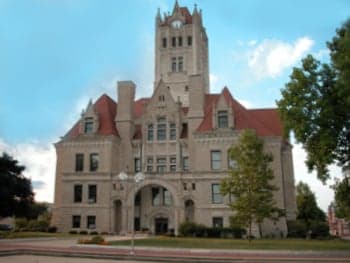
Photo: Wikipedia
Demographics of Greenfield, IN
Affluence Level in Greenfield, IN
A middle-class area roughly in line with national averages across income, home values, education, and employment.
People of Greenfield, IN
The people of Greenfield, Indiana, today form a predominantly white, family-oriented community of 24,308 residents, with a notably low foreign-born share of 0.8% and a college attainment rate of 25.2%. The city’s character is shaped by its Hancock County seat status, a strong sense of local tradition, and a population density that feels suburban yet rooted in agricultural history. Distinctive markers include a heavy concentration of multigenerational families in established neighborhoods and a growing number of younger families drawn by relatively affordable housing and proximity to Indianapolis.
How the city was settled and grew
Greenfield was founded in 1828 as the Hancock County seat, carved from forested land that had been ceded by the Miami and Delaware tribes through the 1818 Treaty of St. Mary’s. The original settlers were primarily of English, Scotch-Irish, and German stock, arriving from Kentucky, Ohio, and Pennsylvania via the National Road (U.S. 40). The town’s early economy revolved around agriculture—corn, wheat, and livestock—with a gristmill and sawmill anchoring the first commercial district. The arrival of the Indianapolis & Cincinnati Railroad in 1853 spurred a second wave of settlement, drawing German and Irish laborers who built homes in what is now the Old Town District, centered around the courthouse square. By 1900, the population had reached roughly 3,500, with a small but established African American community concentrated near South Street and Apple Street, working as domestic servants, railroad hands, and farm laborers. The early 20th century saw modest growth from the opening of the Greenfield Mills and a canning factory, attracting additional German and Polish families to the North Side neighborhoods along North State Street.
Modern era (post-1965)
The post-1965 period brought suburbanization rather than immigration-driven change. The 1965 Hart-Cellar Act had minimal effect on Greenfield: the foreign-born share remained below 1% through 2020. Instead, the city grew through domestic in-migration from Indianapolis and other parts of central Indiana, as families sought larger lots and lower taxes. The Spring Lake Estates subdivision, developed in the 1970s, attracted white-collar commuters working in Indianapolis’s insurance and manufacturing sectors. The Brandywine neighborhood, built in the 1980s and 1990s, absorbed younger families from the city’s east side. The Hispanic population, now 2.3%, began to appear in the 1990s, primarily in rental housing near U.S. 40 and State Road 9, working in construction, landscaping, and the nearby Honda plant in Greensburg. The Black population, at 1.5%, remains small and is scattered rather than concentrated, with no distinct ethnic enclave. East/Southeast Asian residents (0.7%) and Indian-subcontinent residents (0.7%) are largely professionals employed at Hancock Regional Hospital or commuting to Indianapolis tech firms, living in newer subdivisions like Eagle Creek and Havenwood. The city’s white share, 91.6%, reflects both limited in-migration from diverse areas and the out-migration of younger, more diverse residents to Indianapolis or larger suburbs.
The future
The population trajectory suggests slow, steady growth—likely reaching 26,000–27,000 by 2035—driven by continued suburban spillover from Indianapolis along the I-70 corridor. The city is not homogenizing into a single bloc but rather tribalizing into distinct lifestyle enclaves: established families in Old Town and North Side, newer commuters in Spring Lake Estates and Brandywine, and a small but stable Hispanic community near the highway. The immigrant population is plateauing rather than growing, as the low foreign-born share (0.8%) shows little sign of increasing without a major employer or refugee resettlement program. The East/Southeast Asian and Indian communities are likely to remain small and assimilated, with second-generation residents moving to larger cities for education and careers. The next decade will see the city become slightly more diverse at the margins—Hispanic share may reach 3–4%—but the core demographic identity will remain white, native-born, and family-oriented, with a growing divide between long-time residents and newcomers from Indianapolis.
For someone moving in now, Greenfield offers a stable, low-diversity environment where community ties are strong and change is gradual. The city is becoming a bedroom suburb for Indianapolis professionals, but retains a distinct small-town identity centered on the courthouse square and annual events like the Riley Festival. New residents should expect a place where neighborly familiarity is the norm, where the population is aging slightly but still family-focused, and where demographic shifts are measured in decades rather than years.

* Values derived from national, state, county, city and local statistics and may differ in a specific area. Last updated: 2026-04-22T10:28:11.000Z
Narrative content on this page is AI-generated and may contain mistakes. Verify any details that matter before acting on them.
ReloMaps may earn a commission from affiliate links at no extra cost to you.

