Photo: Wikipedia
Demographics of Gonzales, LA
Affluence Level in Gonzales, LA
A below-average socioeconomic profile. Incomes, home values, and educational attainment trail the U.S., with higher poverty and unemployment.
People of Gonzales, LA
The people of Gonzales, Louisiana, today form a nearly evenly split Black and White community of 12,748 residents, with a growing Hispanic minority of 11.5% and a very small foreign-born population of just 3.6%. Known as the "Jambalaya Capital of the World," the city carries a distinct working-class, family-oriented character shaped by its industrial and agricultural roots. With 26.5% of adults holding a college degree, Gonzales is less educated than the national average, reflecting a blue-collar economy centered on petrochemical plants, manufacturing, and regional healthcare. The population is dense for a small city, with a strong sense of local identity and a relatively low rate of in-migration from outside the region.
How the city was settled and grew
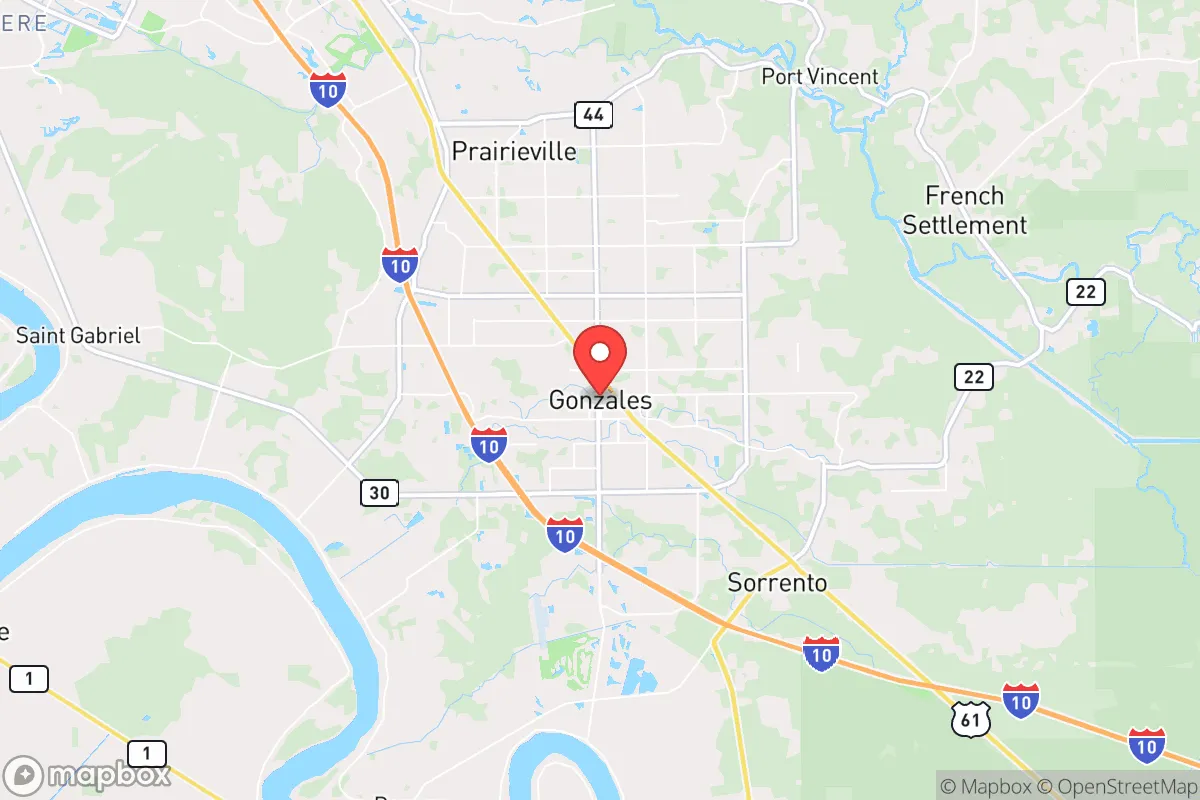
Gonzales was founded in the 1850s as a railroad stop on the New Orleans, Opelousas and Great Western Railroad, drawing its earliest residents from French-speaking Acadian families who had been displaced from Nova Scotia generations earlier. These Cajun settlers established small farms along Bayou Manchac and the Amite River, and the town was officially incorporated in 1887. The original core of the community developed around what is now Old Gonzales, the historic district along Burnside Avenue and South Irma Boulevard, where the first general stores, churches, and a school were built. By the early 1900s, the railroad and the arrival of the sugar and lumber industries brought a wave of Black laborers from rural Ascension Parish and neighboring St. James Parish, who settled in the Darrow and Geismar areas just outside the city limits, as well as in the South Irma neighborhood within Gonzales itself. These families worked the sugar cane fields and later the emerging oil refineries, forming the foundation of the city's Black community. The white population remained overwhelmingly Cajun and Catholic, with French still spoken in homes well into the 1950s.
Modern era (post-1965)
The post-1965 era transformed Gonzales from a quiet railroad town into a suburban bedroom community for Baton Rouge, located just 20 miles north. The 1970s and 1980s saw a surge of white families moving from Baton Rouge and New Orleans into new subdivisions like Pelican Point and Oak Grove, drawn by cheaper land, newer schools, and the expansion of the ExxonMobil and Shell chemical plants along the Mississippi River. This wave was overwhelmingly domestic, not foreign, and the city's Black population remained concentrated in the older South Irma and Burnside Avenue corridors, while newer Black families moved into subdivisions like Summerlin and Brittany Estates in the 1990s and 2000s. The Hispanic population, now 11.5%, began arriving in the 2000s, primarily from Mexico and Central America, to work in construction, landscaping, and the petrochemical plants. They settled mostly in the Geismar area and along the Airline Highway corridor, though no single Hispanic-majority neighborhood has emerged. The Asian and Indian populations remain effectively zero, a notable contrast to larger Louisiana cities like Baton Rouge and New Orleans. The city's racial balance has shifted from roughly 60% white in 1990 to 42.3% white today, with the Black share rising from about 35% to 44.3% over the same period, driven by natural increase and continued domestic migration from rural parishes.
The future
The population of Gonzales is likely to continue its slow homogenization into a Black-majority city, mirroring trends seen in other small Louisiana industrial towns. The white population is aging and declining slightly, while the Black population is younger and growing through natural increase. The Hispanic share is expected to rise gradually, possibly reaching 15-18% by 2040, but will likely remain concentrated in the Geismar and Airline Highway corridor rather than forming a distinct ethnic enclave. The foreign-born population will remain low, as Gonzales lacks the job diversity and urban amenities that attract immigrants to larger cities. New subdivisions like Brittany Estates and Summerlin are attracting younger Black families, while white families with school-age children are increasingly choosing newer exurban developments in Prairieville and Dutchtown to the north. The city is not tribalizing into hostile enclaves, but it is becoming more economically stratified, with older neighborhoods like Old Gonzales and South Irma seeing lower property values and higher rental rates, while newer subdivisions remain predominantly owner-occupied.
For someone moving in now, Gonzales is a stable, affordable, and family-oriented community with a strong sense of local tradition, but it is also a city in demographic transition. The schools are racially integrated but face challenges common to small Louisiana districts, and the economy remains tied to the volatile petrochemical industry. New residents should expect a place where community ties run deep, but where the population is slowly shifting toward a Black majority with a growing Hispanic minority, and where the white population is increasingly choosing to live in the surrounding unincorporated areas rather than inside the city limits.

* Values derived from national, state, county, city and local statistics and may differ in a specific area. Last updated: 2026-04-19T23:16:06.000Z
Narrative content on this page is AI-generated and may contain mistakes. Verify any details that matter before acting on them.
ReloMaps may earn a commission from affiliate links at no extra cost to you.

