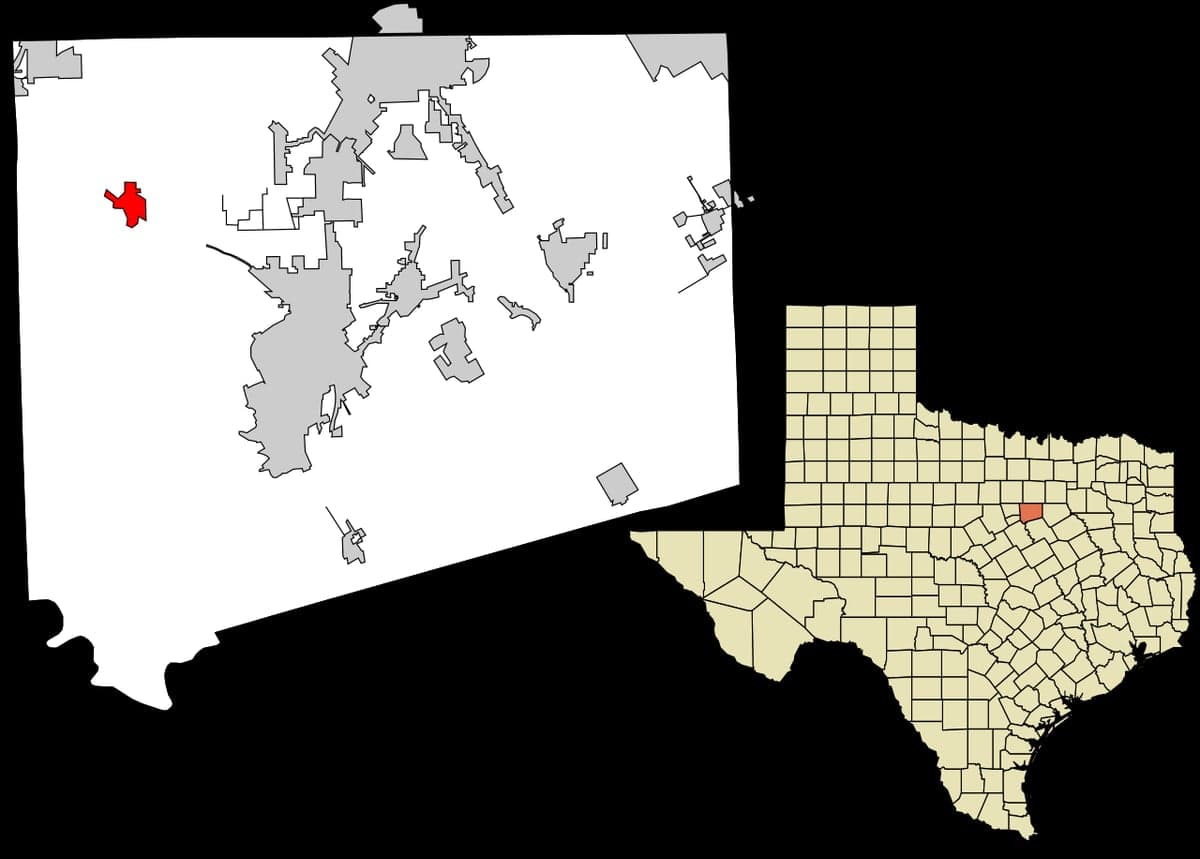
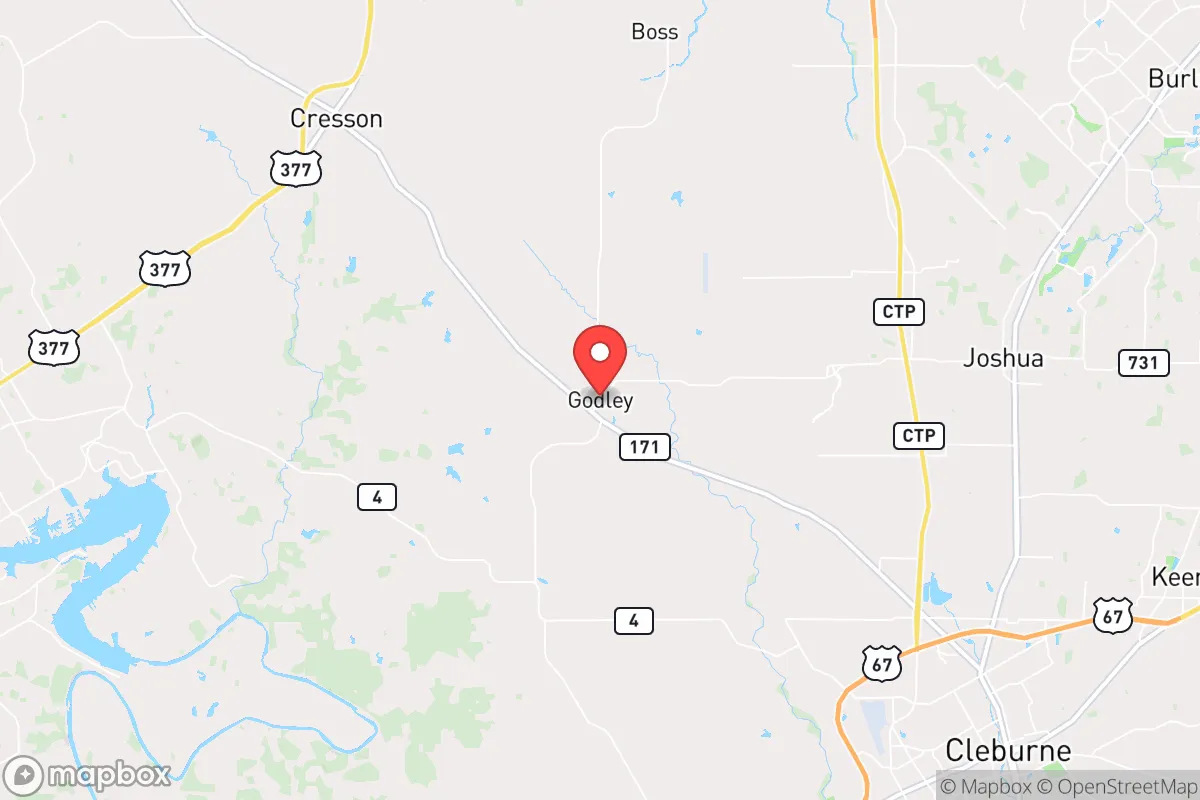
Photo: Wikipedia
Demographics of Godley, TX
Affluence Level in Godley, TX
A middle-class area roughly in line with national averages across income, home values, education, and employment.
People of Godley, TX
Godley, Texas, is a small, tightly-knit community of 2,223 residents where a strong sense of local identity is rooted in its rural heritage and family-centric values. The population is predominantly White (71.8%) with a significant and growing Hispanic minority (23.3%), reflecting a demographic profile common to many North Texas exurbs. With a low foreign-born rate of just 1.3% and a college-educated share of 25.2%, Godley remains a place where long-time residents and new families seeking space and safety are shaping a community that is quietly diversifying while holding onto its small-town character.
How the city was settled and grew
Godley’s human history begins in the late 19th century, when the area was first settled by Anglo-American farmers and ranchers drawn by the promise of fertile blackland prairie and the expansion of the railroad. The town was officially platted in 1886 along the Gulf, Colorado and Santa Fe Railway, which made it a shipping point for cotton, cattle, and grain. The original settlers were predominantly of Northern European descent—English, Scots-Irish, and German—who established homesteads and small farms. The historic Downtown Godley district, centered around Main Street and the railroad depot, became the commercial and social hub for these early families. To the north, the Godley Cemetery area marks the resting place of many founding families, while the Old Godley School neighborhood, near the original schoolhouse, housed the children of these early agricultural settlers. The town remained a small, homogeneous farming community through the first half of the 20th century, with little in-migration beyond the occasional merchant or railroad worker.
Modern era (post-1965)
The post-1965 era brought gradual change, driven primarily by domestic in-migration from the Dallas-Fort Worth metroplex rather than international immigration. As suburban sprawl pushed south and west from Fort Worth, Godley began attracting families seeking larger lots, lower taxes, and a slower pace of life. The Godley Estates subdivision, developed in the 1970s and 1980s, became a landing point for these new residents—mostly White middle-class families moving from Tarrant County. The 1990s and 2000s saw the construction of Prairie View and Heritage Ranch, neighborhoods that absorbed a second wave of domestic migrants, including some Hispanic families who had previously lived in nearby Cleburne or Fort Worth. The Hispanic share of the population rose from a negligible figure in 1990 to 23.3% today, driven largely by natural increase and secondary migration from established Texas communities rather than new foreign-born arrivals. The Black population remains very small at 0.8%, and there are no recorded East/Southeast Asian or Indian subcontinent residents, reflecting Godley’s limited draw for international immigrants. The Godley High School area has become a unifying district where children from all neighborhoods mix, though social life still tends to cluster around church affiliations and school sports.
The future
Godley’s population is likely to continue growing slowly but steadily, driven by exurban expansion from Fort Worth and the completion of new housing developments like Silver Creek Ranch, which is currently under construction. The Hispanic share is expected to rise further, potentially reaching 30-35% by 2040, as younger Hispanic families age into homeownership and new domestic arrivals seek affordable land. However, the foreign-born rate will likely remain low (below 3%), meaning this growth will come from U.S.-born Hispanic families rather than new immigrants. The White population will remain the majority but will see its share decline gradually. The community is not tribalizing into distinct ethnic enclaves; instead, neighborhoods like Prairie View and Heritage Ranch are becoming more integrated, with Hispanic and White families living side by side. The biggest demographic shift may be generational: as older Anglo residents pass away or move to retirement communities, younger families—both White and Hispanic—are buying their properties, gradually reshaping the town’s cultural tone toward a more blended, family-oriented exurban identity.
For someone moving in now, Godley is becoming a place where traditional small-town values—church, school, and family—remain central, but the faces in the pews and at the PTA meetings are slowly diversifying. It is not a melting pot in the urban sense, but a community where a growing Hispanic presence is being absorbed into the existing social fabric without significant friction. The low crime rate, good schools, and affordable land will continue to attract conservative-leaning families, while the lack of rental housing and high homeownership rate (over 80%) will keep the population stable and invested. Godley is not becoming a diverse, cosmopolitan suburb; it is becoming a slightly more diverse version of its historic self—a place where the next generation will likely look and sound a bit different from the founders, but will share the same core priorities of faith, family, and freedom.

* Values derived from national, state, county, city and local statistics and may differ in a specific area. Last updated: 2026-04-18T19:35:35.000Z
Narrative content on this page is AI-generated and may contain mistakes. Verify any details that matter before acting on them.
ReloMaps may earn a commission from affiliate links at no extra cost to you.

