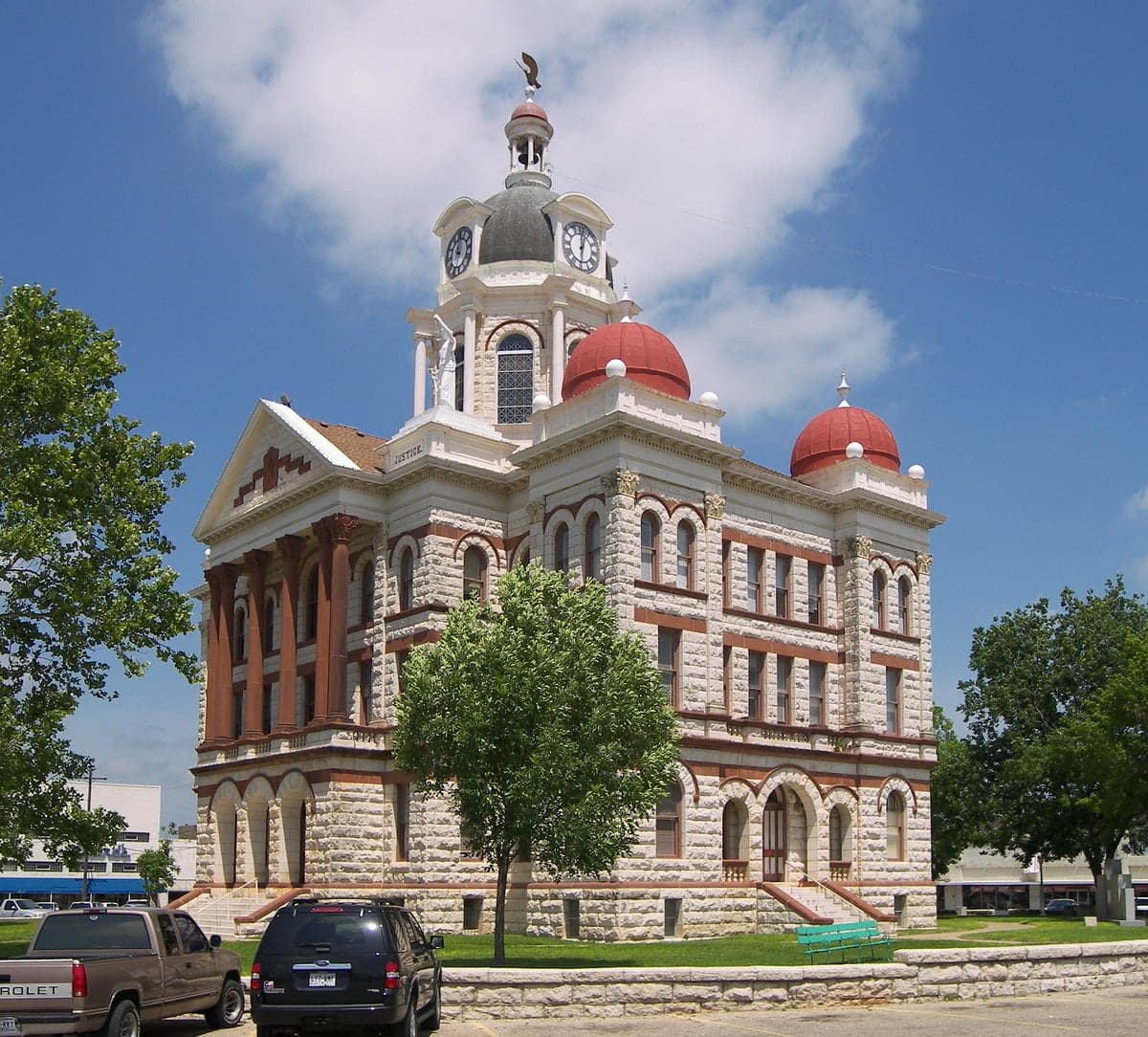
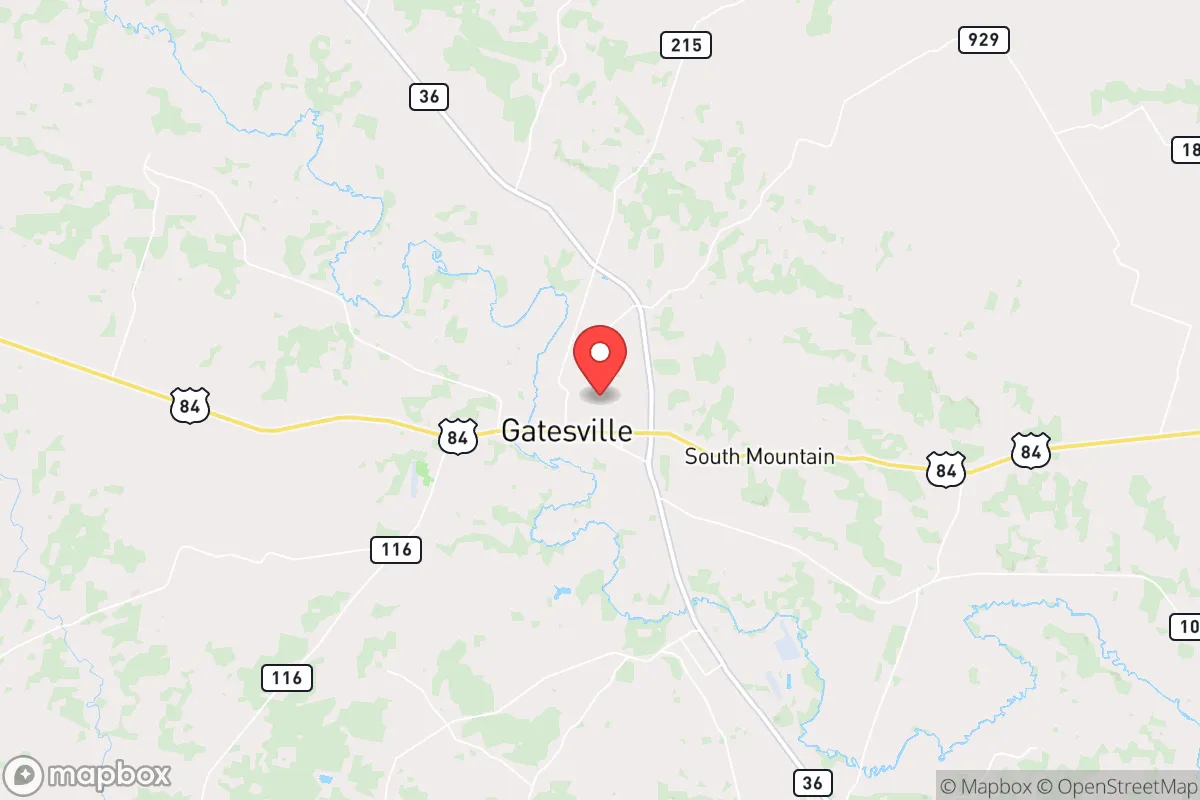

Photo: Wikipedia
Demographics of Gatesville, TX
Affluence Level in Gatesville, TX
A middle-class area roughly in line with national averages across income, home values, education, and employment.
People of Gatesville, TX
The people of Gatesville, Texas, today number 16,058, forming a community that is notably more diverse than its rural Central Texas surroundings. The city’s population is split nearly evenly between non-Hispanic white residents (50.1%) and a coalition of Hispanic (25.9%), Black (14.9%), and smaller Asian and Indian communities, creating a demographic profile distinct from the overwhelmingly white counties that border it. With only 8.9% of adults holding a bachelor’s degree, Gatesville is a working-class town where correctional employment, manufacturing, and agriculture anchor daily life, and where the presence of four state prison units shapes both the economy and the social fabric.
How the city was settled and grew
Gatesville’s original population arrived in the 1850s as Anglo-American settlers from the Deep South, drawn by land grants in the fertile Leon River valley. The town was formally established in 1854 as the seat of Coryell County, and its early economy revolved around cotton farming and cattle ranching. The first wave of Black residents came during Reconstruction, many as freedmen who settled in the South Side neighborhood along the river bottom, where they worked as sharecroppers and later as laborers on local farms. A small but persistent Mexican-American community formed in the early 1900s, concentrated in the Barrio district near the railroad tracks, arriving as migrant farmworkers and later settling permanently to work in the cotton gins and the county’s growing service sector. By 1950, the population was roughly 70% white, 25% Black, and 5% Hispanic, with virtually no Asian or Indian presence.
Modern era (post-1965)
The post-1965 period brought two transformative changes: the expansion of the Texas Department of Criminal Justice (TDCJ) and the broader suburbanization of Central Texas. The opening of the Gatesville Unit (now the Christina Crain Unit) in 1971, followed by the Hilltop, Mountain View, and Alfred D. Hughes units, drew a wave of correctional officers and administrative staff from across the state. Many of these new arrivals—disproportionately white and Black—settled in the Northside neighborhood, where newer subdivisions were built to house TDCJ employees. The Hispanic population grew steadily through the 1980s and 1990s, driven by families from the Rio Grande Valley and northern Mexico who came for construction, prison support jobs, and agricultural work; they expanded the Barrio eastward into the Eastside district. The Black population, which had been largely static since the 1950s, saw modest growth as correctional jobs attracted African American families from East Texas, many settling in the South Side and newer tracts near the prison complex. The Asian and Indian populations remain tiny—0.8% and 0.3% respectively—and are almost entirely composed of professionals (doctors, engineers) working at the local hospital or the prison system’s administrative offices, with no distinct ethnic enclave.
The future
Gatesville’s demographic trajectory points toward continued diversification, but at a slower pace than the booming I-35 corridor 40 miles east. The Hispanic share is projected to rise gradually, likely reaching 30–32% by 2035, driven by natural increase and continued in-migration from South Texas. The Black population is expected to hold steady or decline slightly, as younger Black residents leave for larger cities with more economic opportunity. The white share will continue to shrink, but the city is not experiencing the rapid white flight seen in some Texas towns; instead, white residents are aging in place in the Westside and Downtown historic districts. The Asian and Indian communities are likely to remain small, as Gatesville lacks the professional job base and ethnic infrastructure (temples, grocery stores, cultural organizations) that attract larger populations. The city is not tribalizing into distinct enclaves—neighborhoods remain relatively mixed by class and race—but the Barrio and South Side retain strong ethnic identities. The biggest wildcard is prison policy: any state decision to close or consolidate units could trigger an exodus of correctional families, disproportionately affecting the Northside and Eastside.
For someone moving in now, Gatesville offers a stable, working-class community where racial and ethnic groups coexist without the sharp polarization seen in larger Texas cities. The low college attainment rate and heavy reliance on correctional employment mean that economic mobility is limited, but housing remains affordable and the pace of life is quiet. The city is becoming slightly more Hispanic and slightly less white, but the change is gradual—this is not a place undergoing rapid demographic transformation. It is a town that has absorbed waves of newcomers without losing its essential character as a rural county seat anchored by the prison system.

* Values derived from national, state, county, city and local statistics and may differ in a specific area. Last updated: 2026-05-18T01:52:25.000Z
Narrative content on this page is AI-generated and may contain mistakes. Verify any details that matter before acting on them.
ReloMaps may earn a commission from affiliate links at no extra cost to you.

