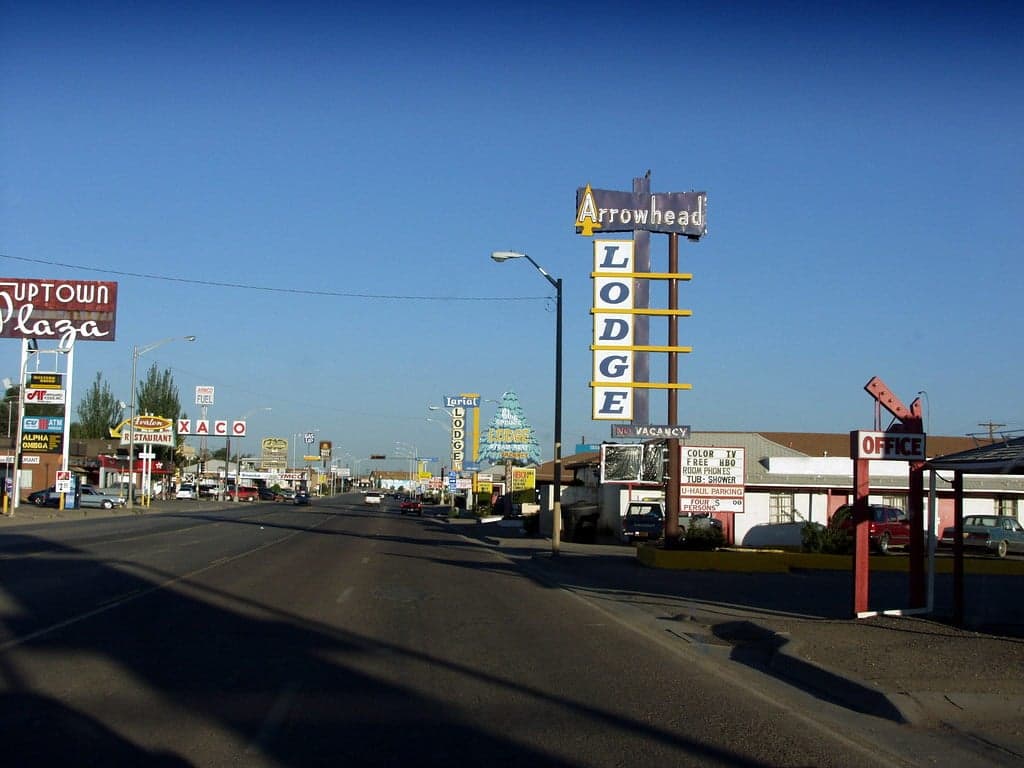
Photo: Wikipedia
Strategic Assessment of Gallup, NM
Workable tactical position. Some exposure to population density or targets, but generally defensible in a crisis.
What does the Strategic Assessment tell us?
Our Strategic Assessment grades tactical survivability of an area. Major population centers, military targets, fallout zones, natural disasters, and border exposure all drive risk — lower exposure means a more defensible position in a crisis.
This is heavily inspired by Joel Skousen's Strategic Relocation book. Highly recommended you checkout the book ($)What does this tell us?
Our Strategic Assessment grades tactical survivability of an area. Major population centers, military targets, fallout zones, natural disasters, and border exposure all drive risk — lower exposure means a more defensible position in a crisis.
This is heavily inspired by Joel Skousen's Strategic Relocation book. Highly recommended you checkout the book ($)Strategic Pillars

Key Distances
Regional Safe Places
Below is our recommended "safe zones" in New Mexico and the surrounding area based on our strategic heuristics. For most people, it's unrealistic to live in a “safe zone” full-time due to work, family or other personal reasons. They tend to be more rural. However, many of these areas are perfect for second homes and retreat properties that double as a vacation home or even a short-term rental.

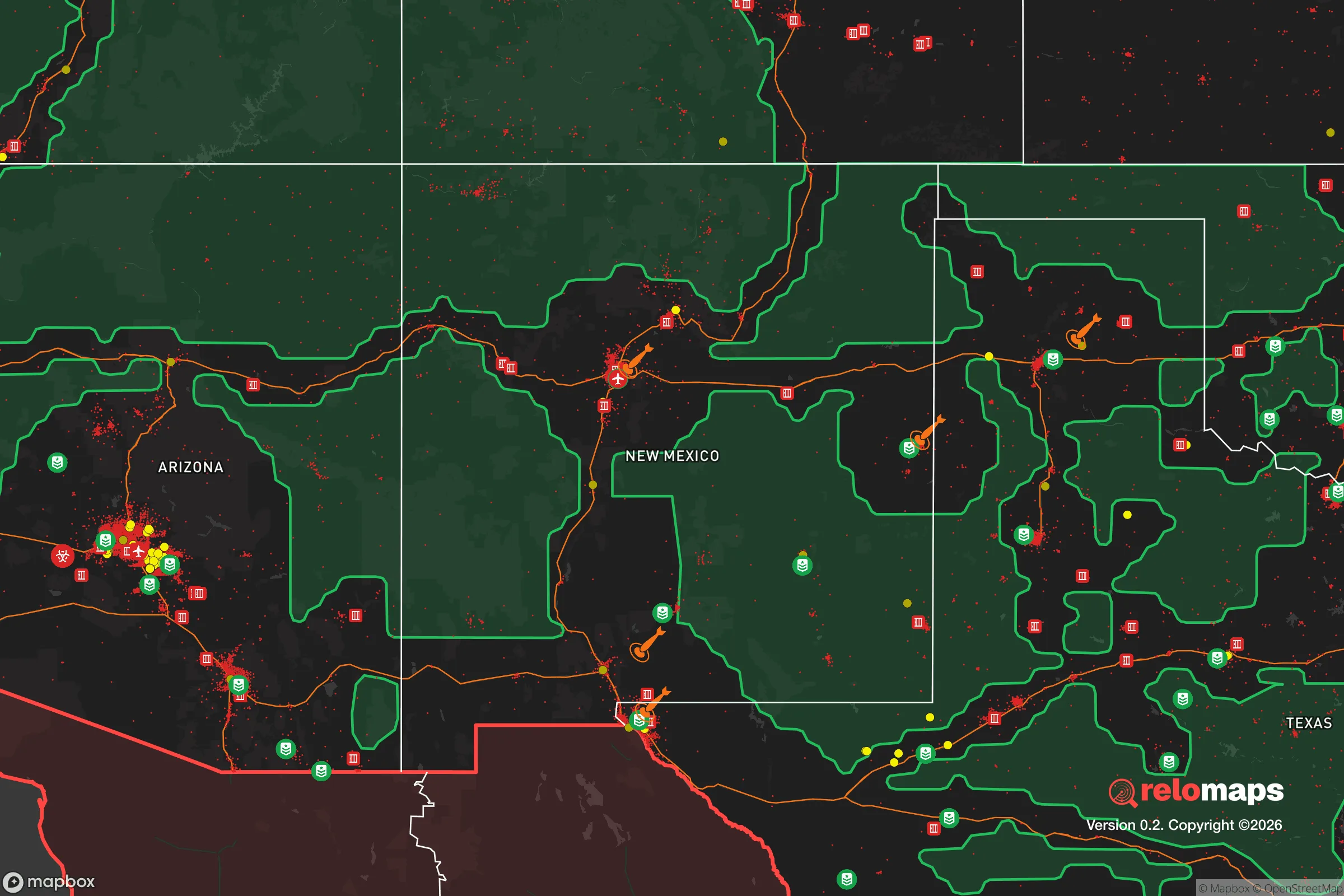


Important Note: For informational purposes only. This does not mean nothing bad ever happens in the green zones. Please use common sense. This is based on public data and modeled with AI. We tried to take a conservative approach but mistakes happen. We update this regularly as new information becomes available.
Solar Generator Recommendations
Backup power matters more here than in safer locations. We've picked three solar generators across budgets and capacity tiers — start with the budget unit if you only need a few essentials, or step up if you want to run a fridge and HVAC for days at a time.

Jackery Portable Power Station Explorer 300
Budget OptionPower on the Go: Weighing only 11 lbs, it's convenient to set up and store with book-sized foldable solar panels

BLUETTI Portable Power Station AC180
Designed for both indoor and outdoor scenarios, AC180 is highly capable as it has a robost capacity and continuous output power.

EF ECOFLOW DELTA Pro Ultra Power Station
Upgraded PickEcoFlow DELTA Pro Ultra is a whole-home energy system designed to grow with your family. Integrated with the Smart Home Panel 2, it scales to meet your evolving energy needs — keeping your home powered, intelligent, and secure through every stage of life.
We earn a commission, at no additional cost to you.
Strategic Assessment Analysis
Gallup, New Mexico, sits as a hardscrabble outpost on the edge of the Navajo Nation, and for the strategic relocator, its value lies in a specific kind of resilience: it’s far enough from the major fault lines of American collapse to offer breathing room, but close enough to critical infrastructure to matter. This is not a place of soft comforts; it’s a place where the high desert demands self-reliance, and where the region’s history of boom-and-bust extraction has forged a population that doesn’t flinch at hardship. For someone thinking in terms of decades, not election cycles, Gallup presents a serious, if austere, option.
Geographic position and natural advantages for long-term security
Gallup’s primary strategic asset is its location at the intersection of Interstate 40 and the BNSF Railway’s transcontinental mainline, a dual corridor that links the Southwest to the rest of the country. In a crisis, this means access to movement and supply lines that smaller towns lack. The surrounding McKinley County sits at an elevation of roughly 6,500 feet, which provides a cooler, drier climate than the low desert—a meaningful buffer against the worst of heat-related grid collapse. The area is also hundreds of miles from any major population center (Albuquerque is 140 miles east, Flagstaff 180 miles west), placing it well outside the likely blast radius or refugee surge from a major city. The Colorado River Basin’s headwaters are a few hours north, and the region’s groundwater, while not abundant, is less contested than in Phoenix or Las Vegas. For the prepper, the high desert offers natural defensibility: wide vistas, limited approach routes, and a population density of roughly 6 people per square mile in the county outside the city limits.
Risks, exposures, and proximity to fallout-relevant landmarks
No strategic assessment is honest without naming the liabilities. Gallup sits roughly 100 miles southeast of the Four Corners area, which includes the San Juan Generating Station (a coal plant now largely decommissioned) and the legacy of uranium mining that litters the Navajo Nation. While not a direct fallout zone, the region’s soil and water have known contamination issues from abandoned mines—a long-term health risk that demands private well testing and filtration. More immediately, Interstate 40 is a double-edged sword: in a mass evacuation scenario, it becomes a choke point and a target. The city itself is a rail hub, meaning any disruption to national logistics—whether from cyberattack, fuel shortages, or civil unrest—will hit Gallup hard. There is also the proximity to the Waste Isolation Pilot Plant (WIPP) near Carlsbad, about 300 miles southeast, a nuclear waste repository that, while not an immediate threat, is a reminder that the region is part of the nation’s energy infrastructure. For the conservative relocator, the biggest exposure is the city’s reliance on a single employer—the Indian Health Service and the local hospital system—and the broader economic fragility of a town that has seen coal jobs vanish and opioid addiction spike. This is not a place to arrive without a plan.
Practical resilience for a relocator: food, water, energy, and defensibility
For the individual or family looking to build a self-sufficient homestead, Gallup’s practical realities are mixed. Water is the hard limit. The area averages 10-12 inches of precipitation annually, and the Navajo Nation’s water rights are a legal and political tangle. A relocator must secure a property with a well permit or a reliable rainwater catchment system—this is not negotiable. The growing season is short (roughly 120 days) and the soil is alkaline, but cold-hardy crops like potatoes, squash, and certain grains can work with serious soil amendment. Energy is a bright spot: the region averages over 280 sunny days per year, making solar a viable primary source, and the wind resource is substantial. Wood for heating is available from the surrounding national forests (Cibola and Santa Fe), but permits and sustainable harvest are required. Defensibility is good for a rural property: the terrain is broken by mesas and arroyos, offering natural cover and limited sightlines for intruders. The local culture is one of “mind your own business,” but the community is tight-knit and suspicious of outsiders—a double-edged sword that means building trust takes years. For the prepper, the biggest practical advantage is the absence of HOA-style restrictions and the low cost of land (raw parcels can be found for under $1,000 an acre), allowing for the kind of infrastructure—berms, cisterns, off-grid power—that would be impossible in suburban or coastal areas.
The overall strategic picture for Gallup is that of a hard, honest, and isolated option for the relocator who values distance over convenience. It is not a retreat for those seeking a soft landing; it is a place for those who understand that resilience is built, not bought. The risks are real—water scarcity, economic fragility, and the legacy of industrial contamination—but they are calculable and manageable with preparation. For the conservative individual or family looking to step off the grid of American fragility, Gallup offers a location that is far enough from the chaos to breathe, but close enough to the nation’s spine to matter. The question is not whether you can survive here, but whether you can thrive in the austerity it demands. If the answer is yes, this high desert outpost may be one of the last affordable, defensible, and strategically sound places left in the Southwest.

* Values derived from national, state, county, city and local statistics and may differ in a specific area. Last updated: 2026-05-04T02:06:52.000Z
Narrative content on this page is AI-generated and may contain mistakes. Verify any details that matter before acting on them.
ReloMaps may earn a commission from affiliate links at no extra cost to you.

