Photo: Wikipedia
Demographics of Gahanna, OH
Affluence Level in Gahanna, OH
An upper-middle-class area. Household wealth, education levels, and homeownership run ahead of national benchmarks.
People of Gahanna, OH
Gahanna, Ohio, today is a predominantly white, college-educated suburb of 35,438 residents, where 53% of adults hold a bachelor’s degree or higher. The city is notably less diverse than the Columbus metro area as a whole, with a Black population of 15.1% and small but distinct East/Southeast Asian (3.0%) and Hispanic (2.8%) communities. Its foreign-born share stands at just 2.7%, well below the national average, giving Gahanna a character of stable, long-settled families rather than a gateway for new arrivals. The city’s identity is shaped by its role as a solidly middle-to-upper-middle-class suburb with strong schools and a historic village core that still anchors civic life.
How the city was settled and grew
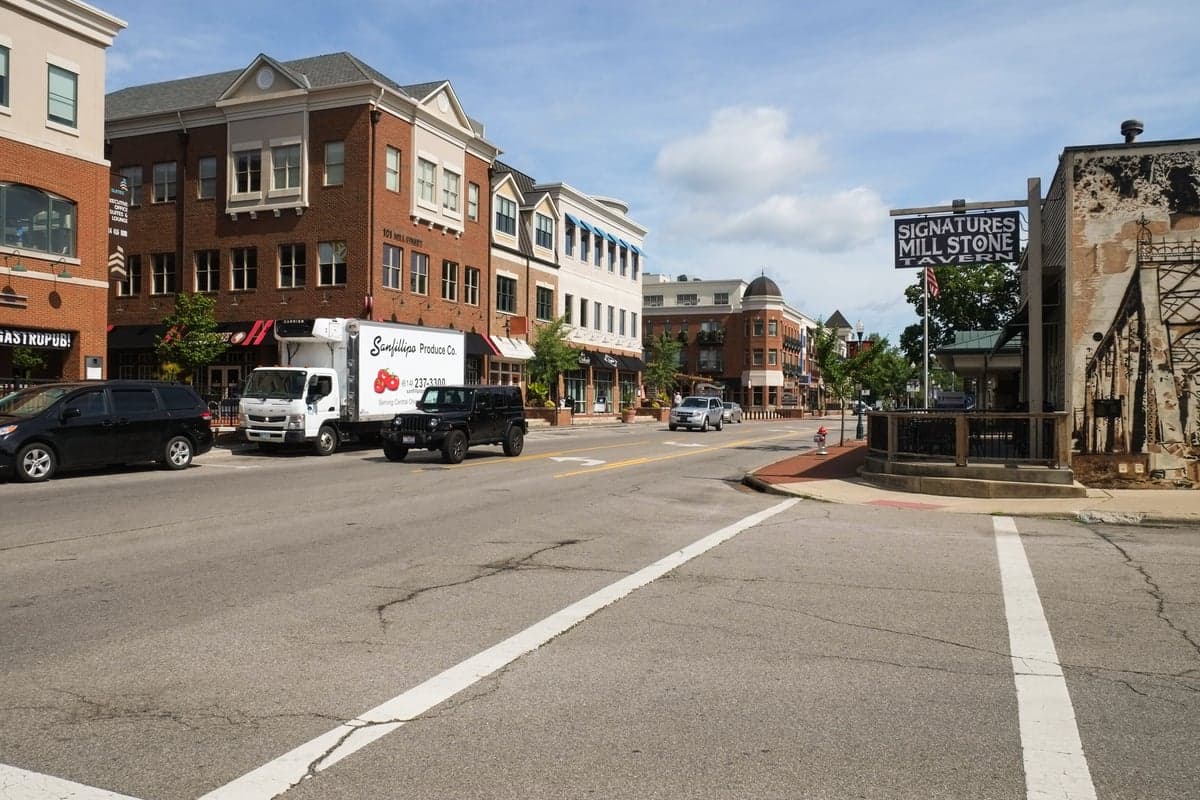
Gahanna’s population history begins in the 1840s, when the National Road and the arrival of the railroad drew German and Irish farmers to the fertile bottomlands along Big Walnut Creek. The original village plat was laid out in 1849, and the first wave of settlers built small frame houses along what is now Olde Gahanna, the historic district centered on Mill Street and Granville Street. These early residents were overwhelmingly Protestant German farmers and merchants, with a smaller contingent of Irish laborers who worked on the railroad and the nearby Columbus feeder lines. By 1900, Gahanna remained a tiny hamlet of fewer than 500 people, its economy tied to grain milling and the local brickworks. The next significant wave came during the post-World War II suburban boom, when returning GIs and their families sought affordable land east of Columbus. Developers platted Havenswood and Woodside Green in the 1950s and 1960s, attracting white middle-class families from Columbus and Appalachia. These neighborhoods filled with ranch-style homes and young children, cementing Gahanna’s reputation as a family-oriented bedroom community. The city’s population jumped from 1,500 in 1950 to over 12,000 by 1970, almost entirely white and native-born.
Modern era (post-1965)
After the 1965 Hart-Cellar Act, Gahanna saw only modest diversification compared to nearby Columbus neighborhoods. The city’s Black population grew from less than 1% in 1970 to 15.1% today, driven largely by middle-class Black families moving from Columbus’s east side into subdivisions like Beacon Hill and Chapel Hill during the 1990s and 2000s. These neighborhoods offered newer housing stock and access to Gahanna’s highly rated Lincoln High School. The East/Southeast Asian community, now 3.0% of the population, began arriving in the 1980s and 1990s, primarily professionals employed at nearby hospitals and Ohio State University. They concentrated in the Jefferson Township area and the newer developments around Waggoner Road, where larger homes and good school ratings were priorities. The Indian-subcontinent population remains tiny at 0.5%, mostly families working in tech and healthcare who settled in the same school-accessible corridors. The Hispanic share, 2.8%, is a mix of Mexican-American families who moved from Columbus and a smaller number of Puerto Rican transplants, scattered across the city without a single ethnic enclave. Gahanna’s foreign-born share has remained flat at roughly 2-3% since 2000, indicating that the city does not function as a primary landing point for immigrants.
The future
Gahanna’s population is likely to continue its slow, incremental diversification rather than experience rapid demographic change. The city’s housing stock—dominated by single-family homes with median values above $300,000—limits affordability for lower-income immigrant families, while the strong school system continues to attract college-educated white and Black families from across central Ohio. The East/Southeast Asian and Indian populations are expected to grow modestly as tech and healthcare employment in the Columbus region expands, but these groups will likely remain small and assimilated rather than forming distinct ethnic neighborhoods. The Black population has plateaued near 15% over the past decade, suggesting that Gahanna has reached a stable equilibrium as a majority-white suburb with a significant Black minority. No single group is tribalizing into an enclave; instead, the city is homogenizing around a shared middle-class, family-oriented identity. The next 10-20 years will likely see Gahanna remain a predominantly white, native-born suburb with a slowly growing but still small immigrant presence.
For someone moving in now, Gahanna offers a stable, low-diversity environment with excellent schools and a strong sense of local history. The city is not a melting pot or a rapidly changing frontier—it is a settled, comfortable suburb where the population is gradually becoming more varied but remains anchored by its white, college-educated majority. New residents will find a place where community identity is rooted in the village’s 19th-century origins and the post-war suburban expansion, not in recent immigration or ethnic turnover.

* Values derived from national, state, county, city and local statistics and may differ in a specific area. Last updated: 2026-04-21T18:01:29.000Z
Narrative content on this page is AI-generated and may contain mistakes. Verify any details that matter before acting on them.
ReloMaps may earn a commission from affiliate links at no extra cost to you.

