 Popular
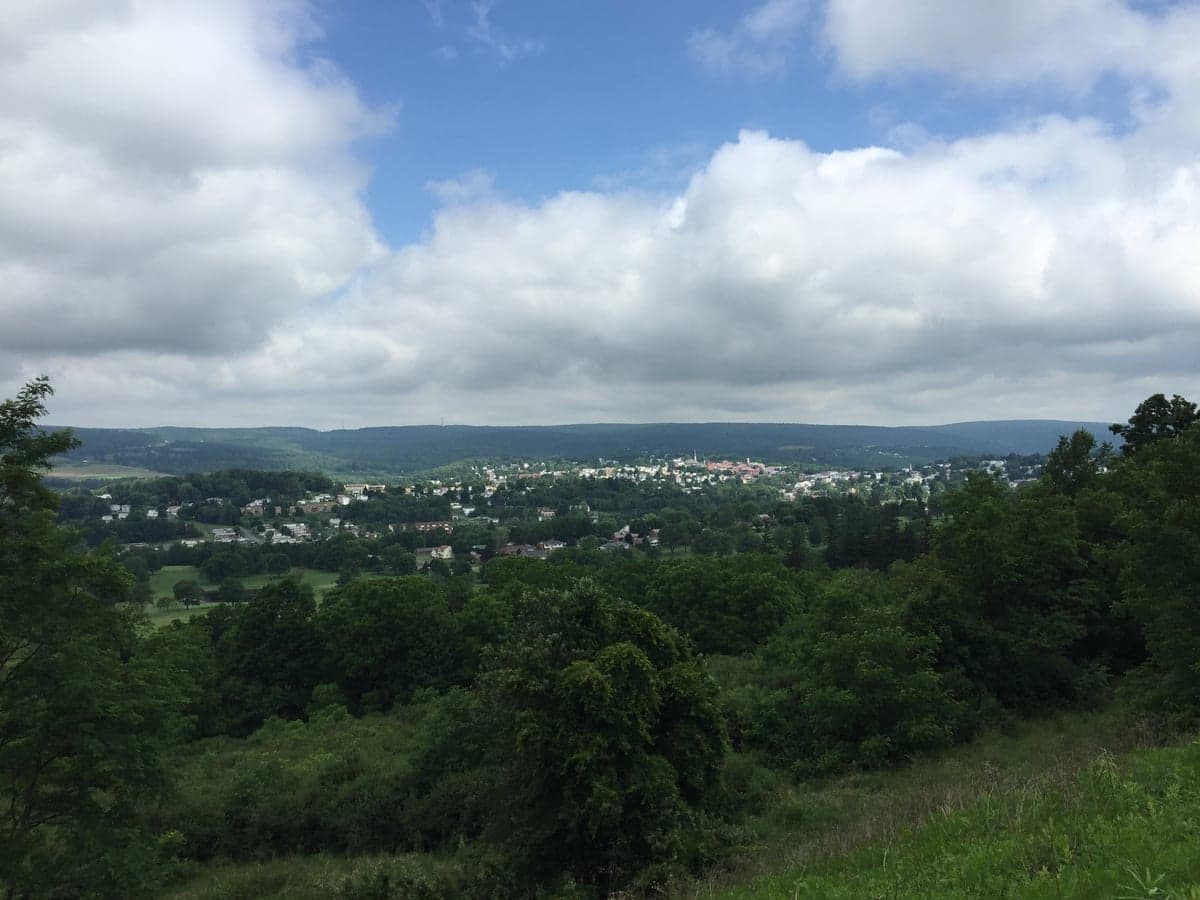
Photo: Wikipedia
Demographics of Frostburg, MD
Affluence Level in Frostburg, MD
A below-average socioeconomic profile. Incomes, home values, and educational attainment trail the U.S., with higher poverty and unemployment.
People of Frostburg, MD
Frostburg, Maryland, is a small city of 7,025 residents with a distinctly stable, family-oriented character shaped by its Appalachian heritage and university presence. The population is predominantly white (81.8%) with a notable Black community (11.6%), while foreign-born residents make up just 1.7% of the city. With 41.3% of adults holding a college degree—driven largely by Frostburg State University—the city blends blue-collar roots with an educated, professional core. Residents describe Frostburg as a tight-knit place where generational families live alongside university faculty and staff, creating a community that values tradition, local institutions, and outdoor recreation.
How the city was settled and grew
Frostburg's human history begins with the National Road, which reached the area in the early 1800s and transformed a remote mountain pass into a stagecoach stop and coal-shipping hub. The original settlers were predominantly German and Scotch-Irish farmers and miners who arrived from Pennsylvania and western Maryland, drawn by the region's rich bituminous coal seams. By the 1850s, the Cumberland and Pennsylvania Railroad had made Frostburg a coal-railroad boomtown, and the population swelled with Welsh, English, and Irish immigrants who worked the mines and built the city's early infrastructure. These groups settled in distinct neighborhoods: Irish immigrants concentrated in the "Brickyard" area along lower Water Street, while Welsh miners established homes around the "Welsh Hill" district near the present-day university campus. The city incorporated in 1870 with a population of roughly 2,000, and by 1900 it had grown to over 5,000 as Italian and Eastern European immigrants arrived to work the deeper coal seams. These later arrivals formed enclaves in the "East End" neighborhood along Main Street and in the "South Side" near the railroad yards, where many descendants still live today. The coal economy dominated until the 1950s, when mechanization and mine closures began a long population decline.
Modern era (post-1965)
The post-1965 period brought two major demographic shifts to Frostburg: the expansion of Frostburg State University and the decline of the coal industry. The university, which became a state college in 1963 and a university in 1987, attracted faculty and students from across Maryland and the Mid-Atlantic, diversifying the city's professional class. This influx settled primarily in the "College Heights" area around the campus and in newer subdivisions like "Woodland Hills" on the city's western edge. Meanwhile, the Black population—historically small but present since the coal era—grew modestly from about 5% in 1970 to 11.6% today, with families concentrated in the "Bowery Street" corridor and parts of the East End. Hispanic and Asian populations remain very small (2.3% and 2.3% respectively), reflecting Frostburg's limited immigration draw compared to larger Maryland cities. The foreign-born share of 1.7% is among the lowest in the state, and most immigrants are university-affiliated professionals rather than labor migrants. The city's population peaked at around 8,500 in 1960 and has since declined to 7,025, as younger residents often leave for job markets in Baltimore, Washington, or Pittsburgh.
The future
Frostburg's population is aging and slowly shrinking, with a median age of 36.7 years and a natural decrease (more deaths than births) in recent years. The city is not homogenizing into a single identity but rather tribalizing into two distinct groups: long-term, multi-generational families who remain in historic neighborhoods like the Brickyard and East End, and a transient university population concentrated in College Heights and Woodland Hills. The Black community is stable but not growing rapidly, while Hispanic and Asian populations are plateauing at low single-digit shares. The Indian subcontinent population is negligible at 0.1%, and no significant immigrant enclave is emerging. Over the next 10-20 years, Frostburg will likely continue its slow decline unless the university expands enrollment or new industries (such as remote work or tourism) attract younger families. The city's character will remain predominantly white and working-to-middle class, with a strong institutional anchor in the university.
For someone moving to Frostburg today, the city offers a stable, safe, and affordable environment where community ties run deep and change comes slowly. The trade-off is limited economic opportunity and a population that skews older and more homogenous than the national average. New residents will find a place where knowing your neighbors still matters, and where the university provides a steady cultural and educational counterweight to the surrounding Appalachian landscape.

* Values derived from national, state, county, city and local statistics and may differ in a specific area. Last updated: 2026-04-22T02:14:30.000Z
Narrative content on this page is AI-generated and may contain mistakes. Verify any details that matter before acting on them.
ReloMaps may earn a commission from affiliate links at no extra cost to you.

