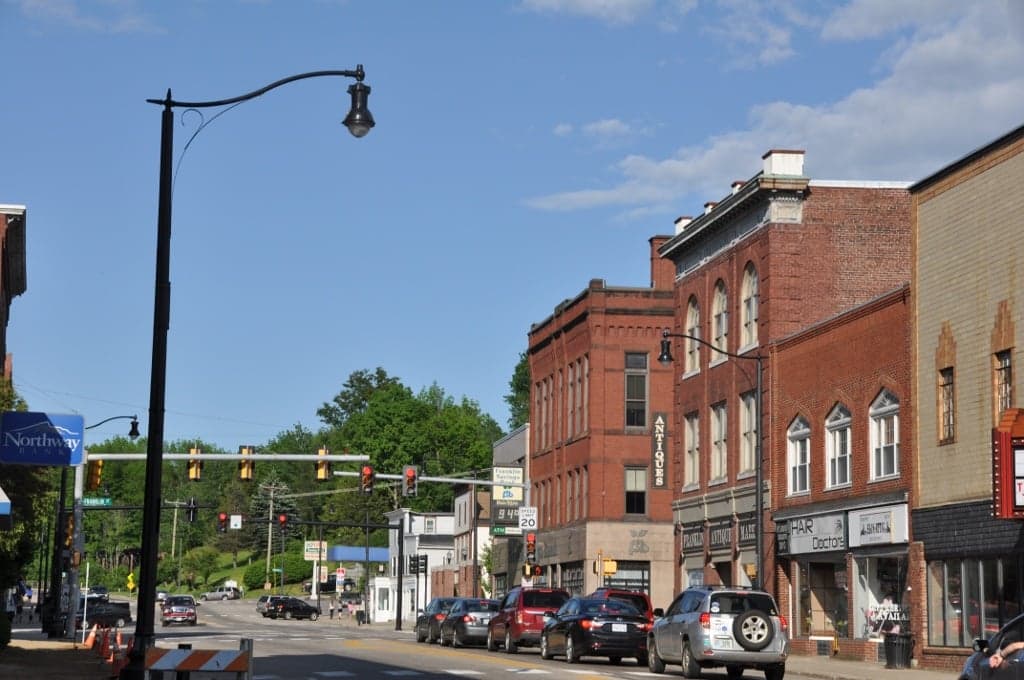
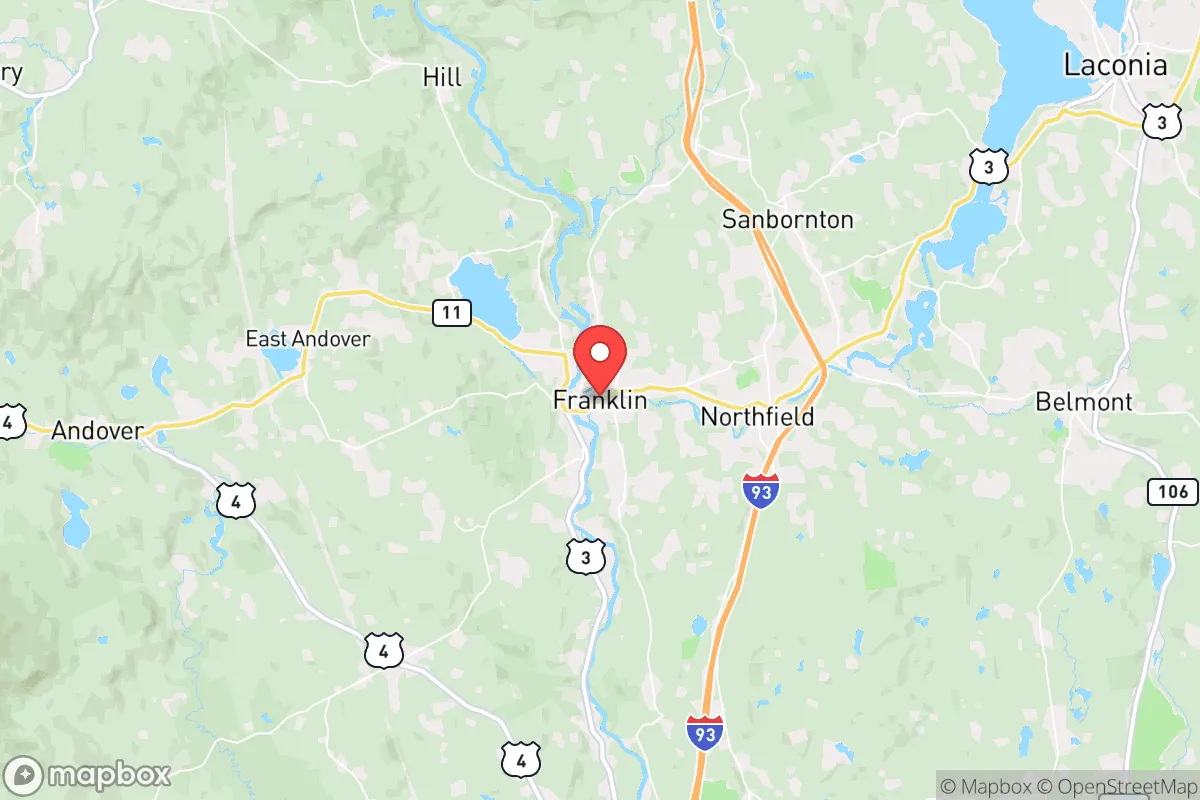
Photo: Wikipedia
Demographics of Franklin, NH
Affluence Level in Franklin, NH
A middle-class area roughly in line with national averages across income, home values, education, and employment.
People of Franklin, NH
The people of Franklin, New Hampshire, today number 8,757, forming a densely settled, predominantly white community with a distinctly working-class character. The city’s identity is rooted in its industrial past and a strong sense of local independence, reflected in a low foreign-born population of 2.0% and a population that is 94.2% white. With only 19.2% holding a college degree, Franklin is a place where practical skills and trades have long been the backbone of the community, and its residents are known for a no-nonsense, self-reliant ethos that values tradition and stability over rapid change.
How the city was settled and grew
Franklin’s population history begins with the Merrimack River and the power it provided. Originally part of the Masonian land grants, the area was settled in the mid-1700s by English colonists drawn to the fertile river valleys and dense forests. The real population boom came in the 19th century with the rise of water-powered mills. The Franklin Falls area became the industrial heart, drawing waves of French-Canadian laborers from Quebec starting in the 1850s. These families built the tight-knit “French Hill” neighborhood, where French was spoken on the streets for generations. Simultaneously, the “West Franklin” district grew around the railroad and paper mills, housing a mix of English, Irish, and Scottish mill workers. By the early 1900s, the city’s population had swelled to over 6,000, with these ethnic enclaves forming the city’s social and political fabric. The mills—especially the large paper and pulp operations—were the primary draw, creating a community where nearly every family had a member working in the factories.
Modern era (post-1965)
After the 1965 Hart-Cellar Act, Franklin saw virtually no new immigration from outside North America. The city’s foreign-born population today sits at just 2.0%, and the non-white population remains minimal: 0.3% Black, 0.2% East/Southeast Asian, and 0.0% Hispanic and Indian-subcontinent. The major demographic shift since the 1970s has been domestic out-migration. As the paper mills automated and then closed, many younger residents left for larger cities, leaving an aging population. The neighborhoods that once defined the city’s ethnic character—French Hill and West Franklin—have largely assimilated into a homogenous white working-class identity. A small influx of retirees and second-home buyers has occurred in the “Webster Lake” area, drawn by the lake’s recreational appeal, but this has not altered the city’s core demographic. The “Downtown” district, once a bustling commercial hub, has seen population thinning as retail shifted to strip malls and online shopping, leaving a more residential character in the surrounding streets.
The future
Franklin’s population is projected to remain stable or decline slightly over the next decade. The city is not homogenizing further—it is already one of the most demographically uniform communities in New Hampshire. The key trend is aging: the median age is rising as younger adults leave for job markets in Manchester, Concord, or out of state. The immigrant communities are not growing, plateauing, or assimilating because they are effectively absent. The only potential for demographic change lies in domestic in-migration from southern New England or other states, driven by Franklin’s relatively low housing costs compared to the Seacoast or Boston suburbs. However, this inflow is likely to be small and will not shift the city’s racial or ethnic composition. The “Sulphite Hill” neighborhood, once a company housing area for mill workers, now contains a mix of older lifelong residents and a few younger families seeking affordable starter homes.
Franklin is becoming a quieter, older, and more economically stable version of its industrial self. For someone moving in now, the city offers a predictable, low-diversity environment where community ties are strong but opportunities for newcomers are limited. The population is not tribalizing into new enclaves; it is consolidating into a single, aging, white working-class identity. The bottom line: Franklin is a place for those who value stability, low cost of living, and a traditional New England small-city atmosphere, but not for those seeking rapid growth, diversity, or a dynamic job market.

* Values derived from national, state, county, city and local statistics and may differ in a specific area. Last updated: 2026-04-19T09:38:14.000Z
Narrative content on this page is AI-generated and may contain mistakes. Verify any details that matter before acting on them.
ReloMaps may earn a commission from affiliate links at no extra cost to you.

