
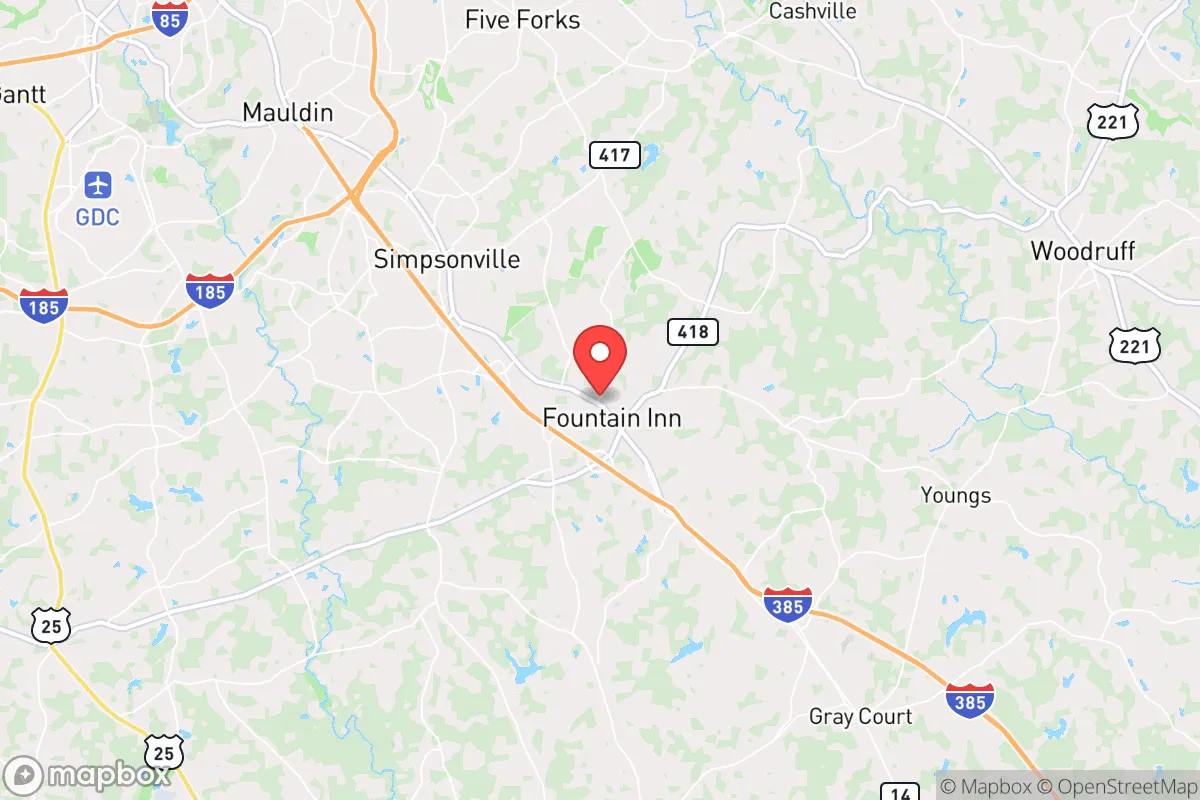
Photo: Wikipedia
Personal Sovereignty in Fountain Inn, SC
Viable for self-reliance. Generally workable, though some barriers may limit total independence.
What does Personal Sovereignty tell us?
Personal Sovereignty measures your capacity for self-reliance and independence with minimal government friction. Higher scores mean fewer barriers between you and the way you want to live... but it assumes you have the space you need and good neighbors.
What does this tell us?
Personal Sovereignty measures your capacity for self-reliance and independence with minimal government friction. Higher scores mean fewer barriers between you and the way you want to live... but it assumes you have the space you need and good neighbors.
State Policy
Energy independence: Importer (25% of energy produced in-state)
Personal Liberty
Homesteading

Personal Liberty Analysis
Fountain Inn, South Carolina, offers a notably high degree of personal sovereignty compared to much of the United States, largely due to the state’s consistent legal framework that prioritizes individual liberty over government control. For a conservative-leaning individual or family concerned with preserving autonomy in an era of expanding federal and state mandates, this Greenville County suburb presents a strategic environment where the default posture is one of non-interference. The combination of a low tax burden, strong self-defense laws, and a regulatory climate that still permits significant self-reliance makes it a viable option for those who wish to live with minimal government intrusion into their daily lives, finances, and personal choices.
Tax burden and regulatory posture: How South Carolina protects your income and property
South Carolina’s tax structure is a major pillar of its sovereignty-friendly environment, and Fountain Inn residents benefit directly from it. The state imposes a flat income tax rate of 6.2% on all taxable income above a modest threshold, a system that is simpler and less punitive than the progressive brackets found in many northern states. There is no state-level tax on Social Security benefits, and retirees receive a significant deduction on other retirement income, which is a direct preservation of personal earnings. Property taxes in Greenville County are among the lowest in the Southeast, with an effective rate typically hovering around 0.5% to 0.7% of assessed value, thanks to Act 388 of 2006, which exempts owner-occupied primary residences from school operating millage. This means your home is not a perpetual revenue stream for the local government. On the regulatory front, South Carolina operates under a "right-to-work" legal framework, meaning you cannot be forced to join a union as a condition of employment. The state also maintains a relatively light touch on business licensing and zoning at the county level, though Fountain Inn itself has a municipal planning department. For a prepper or survivalist, this translates to fewer bureaucratic hurdles when establishing a home-based business, storing supplies, or modifying your property for self-sufficiency. The key takeaway: the state government is structurally designed to take less of your money and impose fewer rules than in high-tax, high-regulation states like New York, California, or Illinois.
Self-defense and gun law specifics: Stand your ground and constitutional carry in practice
For those who view the right to self-defense as non-negotiable, South Carolina is one of the strongest jurisdictions in the country, and Fountain Inn sits squarely within that legal reality. The state has a constitutional carry law (permitless carry) for any law-abiding adult 18 or older, meaning you can carry a concealed firearm without a government-issued permit. This is a direct assertion of the Second Amendment as an individual right, not a privilege granted by the state. Additionally, South Carolina’s Stand Your Ground statute (Section 16-11-440) removes any duty to retreat before using deadly force if you are lawfully present and reasonably believe it is necessary to prevent death or great bodily harm. This applies in your home, your vehicle, and any public place where you have a legal right to be. The castle doctrine is also codified, creating a legal presumption that someone who unlawfully enters your home intends to cause harm. For a survivalist mindset, this legal framework is critical: it means the law is on your side if you must defend your family or property, and there is no requirement to first attempt escape or negotiation. Local law enforcement in Greenville County and the City of Fountain Inn generally respect these rights, and there are no local ordinances that override state preemption on firearm regulations. This is a stark contrast to states like New Jersey or California, where even owning standard-capacity magazines can be a crime.
Self-reliance and homesteading viability: Lot sizes, zoning, and off-grid feasibility in Fountain Inn
The practical ability to live a self-reliant lifestyle in Fountain Inn depends heavily on which part of the city you choose, but the surrounding area offers genuine opportunities. Within the city limits, standard residential lots are typically 0.25 to 0.5 acres, which is enough for a substantial vegetable garden, a small chicken coop, and rainwater collection, but not for livestock or large-scale agriculture. City zoning codes do regulate outbuildings, fences, and the keeping of farm animals, so a full homestead within city limits requires careful review of the municipal code. However, the real opportunity lies just outside the city limits in unincorporated Greenville County or neighboring Laurens County. There, you can find 1 to 5 acre parcels at prices significantly lower than the national average, often under $20,000 per acre. County zoning is far more permissive, allowing for larger gardens, livestock (horses, goats, cattle), and accessory structures like workshops or storage sheds without extensive permitting. Off-grid feasibility is moderate: South Carolina has no state law prohibiting rainwater collection, and solar panel installation is straightforward, though you will still need to connect to the electrical grid unless you invest in a substantial battery system. Well water is common on rural parcels, and septic systems are standard. The state does not have a building code that mandates grid connection, so a properly designed off-grid home is legally possible. For a prepper, the strategic move is to buy land just outside the city limits, where you can build a self-sufficient compound while still being a 10-minute drive from the grocery store and medical facilities in Fountain Inn.
Personal liberties: Parental rights, medical autonomy, speech, and property protections
South Carolina has taken a strong legislative stance on several fronts that directly affect personal sovereignty, and these laws apply uniformly in Fountain Inn. Parental rights are explicitly protected under state law, with the "Parental Rights and Responsibilities Act" affirming that parents have the fundamental right to direct the upbringing, education, and healthcare of their children. This means no government mandate for critical race theory in schools, no forced medical procedures without parental consent, and a legal presumption that parents—not the state—know what is best for their kids. On medical autonomy, South Carolina has resisted federal overreach on vaccine mandates, and while the state does have standard vaccination requirements for school attendance, religious and medical exemptions are available and generally respected. The state also passed a law prohibiting discrimination against unvaccinated individuals in public accommodations. Free speech is robustly protected, with no state-level hate speech laws that criminalize political or religious expression. Property rights are strengthened by South Carolina’s status as a "right-to-farm" state, which protects agricultural operations from nuisance lawsuits—a useful provision if you plan to keep animals or run a small farm. Eminent domain is restricted to public use projects, and the state has a strong homestead exemption that protects up to $58,925 of equity in your primary residence from creditors. For a conservative individual, these protections create a legal buffer against the kind of government overreach seen in states that have used emergency powers to shut down businesses, mandate vaccines, or override parental decisions.
In the broader context of the United States, Fountain Inn and the surrounding Upstate region represent a pocket of high personal sovereignty that is increasingly rare. Compared to the Pacific Northwest, the Northeast Corridor, or the West Coast, South Carolina offers a legal environment where your right to keep and bear arms, control your property, raise your children according to your values, and keep more of your earnings is treated as the default, not a privilege to be negotiated. For a survivalist or prepper, this is not a perfect libertarian utopia—there are still property taxes, building permits, and state income tax—but it is a place where the government’s footprint is light enough that a determined individual can live largely on their own terms. The strategic value of Fountain Inn lies in its balance: proximity to a growing job market and healthcare infrastructure, combined with a legal and regulatory climate that still respects the individual as the primary unit of society.

* Values derived from national, state, county, city and local statistics and may differ in a specific area. Last updated: 2026-04-30T00:28:31.000Z
Narrative content on this page is AI-generated and may contain mistakes. Verify any details that matter before acting on them.
ReloMaps may earn a commission from affiliate links at no extra cost to you.

